Here's the frustrating part: quoting delays usually aren't caused by the manufacturer's lead time. They happen because the initial spec submission is incomplete, triggering a back-and-forth that adds days or weeks before a purchase order is ever issued.
This guide walks through exactly what information to gather before you make contact, what drives pricing on configured-to-order regulators, and how to move through the quoting process at OLC as efficiently as possible. By the end, you'll have a clear action plan — not just a list of things to think about.
Key Takeaways
- Define your target outlet pressure range first — it determines which regulator type applies and rules out most standard options right away
- Plastic tubing extrusion can require pressures as low as 0.05" of water — a range beyond most industrial regulators
- A complete first submission cuts quote turnaround time — missing details force a restart
- Buying direct from OLC means no distributor markup, with every unit built to order in-house in Shrewsbury, MA
- A 3-year warranty and 10–25 year product lifespan are standard on all MicroAir units
What Is a Custom Extrusion Pressure Regulator?
Beyond the Off-the-Shelf Option
In the context of plastic tubing extrusion, "custom" doesn't mean a one-off engineered prototype. It means a regulator specified to match your application's pressure range, flow requirements, port connections, and tubing material — not whatever happens to be in stock at an industrial distributor.
Plastic tubing extrusion has one pressure requirement that eliminates most standard industrial regulators outright: ultra-low pressure, often well below 1 PSI and sometimes measured in fractions of an inch of water column.
According to OLC's MicroAir product documentation, available pressure ranges start as low as 0–2" of water and extend up to 0–5 PSI. A unit tested in-house held 0.05" of water without instability. Standard industrial regulators are not built for this operating regime — at those pressures, they chatter, droop, or simply can't maintain the setpoint.
MPO Magazine reports that even the slightest pressure change can create significant diameter variation in thin-walled tubing. For medical applications where ID tolerances can be as tight as ±0.001", that's not a performance nuance — it's a quality failure.
Configured-to-Order vs. Fully Custom-Engineered
There's an important practical distinction between these two paths:
- Configured-to-order: Select a standard MicroAir model (I, II, or IV) with the options your line needs — pressure range, channel count, display type, output signal. Quicker to quote, quicker to ship, and lower cost.
- Fully custom-engineered: Designed from scratch for applications that fall outside existing model parameters. Expect a longer lead time, higher cost, and an engineering review process reserved for unusual requirements.
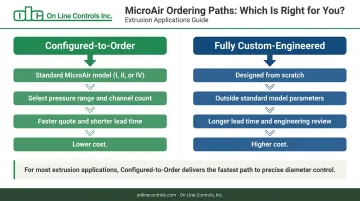
For the vast majority of plastic tubing extrusion applications, a configured-to-order MicroAir unit covers the requirement. Knowing which path applies before you reach out is one of the fastest ways to move a quote forward.
What Information Do You Need Before Requesting a Quote?
Gathering Your Application-Specific Parameters
The single biggest cause of quoting delays is an incomplete spec submission. Before contacting any supplier, gather the following:
Pressure and flow parameters:
- Inlet pressure (MicroAir units connect to factory air regulated down to approximately 50–55 PSI)
- Required outlet pressure range — and critically, where your target setpoint falls within that range (OLC recommends targeting the middle of the meter scale for optimal precision)
- Flow rate requirements, including whether the application involves variable flow scenarios like bump or taper tubing
Connection and configuration specs:
- Port size and thread standard (MicroAir units use ¼" NPT male fittings as standard)
- Number of lumens — multi-lumen tubing requires independently regulated channels, available in dual, 3-channel, or 4-channel configurations
- Control type: manual adjustment (MicroAir I), contact closure input (MicroAir II), or 0–10V analog input for PLC integration (MicroAir IV)
Environmental requirements:
- Cleanroom compatibility — OLC offers an external oil-less air pump option for clean room environments
- Any documentation requirements, including CE compliance for international installations (OLC's products are CE compliant as standard)
Providing End-Use and Tubing Details
Tubing material and target dimensions directly inform pressure range selection. Common benchmarks:
- Medical micro-tubes commonly require ranges of 0–3" or 0–5" of water
- Standard medical tubing typically runs 0–15" or 0–30" of water
- Automotive tubing usually falls in the 0–3 PSI or 0–5 PSI range
OEM extruder builders should also include:
- Extruder model and line speed
- Control system integration requirements (PLC communication, motorized potentiometer interface)
- Any custom configurations affecting component selection
Key Factors That Affect Custom Pressure Regulator Pricing
Pricing for configured-to-order MicroAir units is available on request — OLC does not publish price lists. Knowing what drives cost helps you frame your budget before the quote conversation.
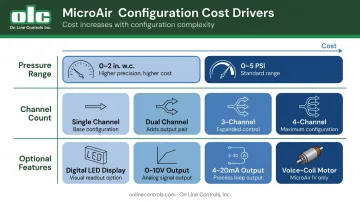
Pressure Range and Configuration
Ultra-low pressure regulation demands tighter manufacturing tolerances and specialized diaphragm materials. A 0–2" of water unit is a different manufacturing challenge than a 0–5 PSI unit, and that difference shows up in price.
Configuration adds further cost depending on what you need:
- Single-channel units cost less than 3- or 4-channel configurations
- Optional features (digital LED display, 0–10V or 4–20mA output, remote control unit) add to the base price
- The MicroAir IV's voice-coil linear motor — which enables sub-100ms response — is more mechanically complex than the MicroAir I's manual design
Order Quantity and Direct Pricing
A single replacement unit carries a higher per-unit cost than a production run order. Volume matters for any built-to-order product.
OLC sells direct worldwide, with no distributor markup. You're quoting directly with someone who knows the application — which tends to shorten the back-and-forth on spec questions.
What You Don't Need to Budget For Separately
Two items that often add hidden cost elsewhere are already covered with OLC:
- CE compliance is standard on all products — international buyers don't need to budget separately for compliance documentation
- Motorized potentiometers can be quoted alongside any MicroAir unit, since OLC manufactures both lines — no need to manage separate vendor quotes
Step-by-Step: How to Get a Fast Quote from OLC
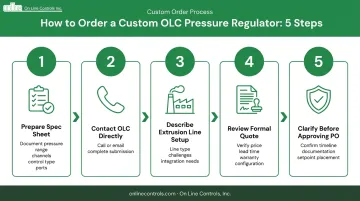
Step 1 — Prepare Your Spec Sheet
Before making first contact, document:
- Target operating pressure range and setpoint
- Inlet pressure available at your line
- Number of channels required
- Control type (manual, contact closure, or 0–10V analog)
- Port requirements and mounting constraints
- Tubing material and target dimensions
- Application type (medical, automotive, multi-lumen, etc.)
- Any CE documentation requirements for international installation
A complete first submission is the single most effective way to shorten quote turnaround.
Step 2 — Contact OLC Directly
Reach out by phone at 978-562-5353 or email at olc@onlinecontrols.com.
OLC operates with direct sales — the person on the other end has deep product knowledge and can ask the right clarifying questions immediately. You reach someone who knows the product, not a general intake queue.
Step 3 — Describe Your Extrusion Line Setup
Be ready to discuss:
- Whether the line runs continuous or intermittent
- Current pressure control challenges (chatter, drift, instability at low setpoints)
- Whether you're replacing an existing unit or specifying for a new line
- Integration requirements with gauges, PLCs, or other control systems
This context allows OLC to recommend the right MicroAir model and configuration rather than sending a one-size-fits-all quote.
Step 4 — Review the Formal Quote
Once OLC has your setup details, the quote will reflect your specific configuration. Verify it covers:
- Unit price and lead time
- Warranty coverage (3-year parts and labor with unlimited phone support is standard)
- Full configuration: channel count, pressure range, and any add-on options
Cross-check these against your spec sheet before moving forward.
Step 5 — Clarify Before Approving
Before submitting a PO, confirm:
- Delivery timeline and whether it fits your project schedule
- Whether installation documentation is included (a user manual ships with each unit)
- That the configured range puts your target setpoint in the middle of the meter scale
- For international orders: shipping carrier (UPS, DHL, or FedEx) and any customs documentation needed
Resolving these points before PO submission prevents surprises after the order is placed.
What to Expect After Submitting Your Quote Request
After you submit a quote request, a reputable manufacturer will follow up to confirm specs and flag any compatibility concerns before issuing a formal written quote. If a supplier sends a quote with no clarifying questions at all, that's worth noting — it may indicate the application details weren't fully reviewed.
All MicroAir units are built to order and assembled in-house in Shrewsbury, MA. Because OLC's product line is configured-to-order rather than fully custom-engineered, the path from approved quote to shipped unit is faster than it would be for a ground-up engineering engagement.
International buyers should raise shipping destination and documentation requirements during the quote conversation. OLC ships to 18 countries and all products are CE compliant as standard. Carriers include:
- UPS, DHL, or FedEx (destination-dependent)
- Export documentation available on request
- Logistics lead time should be factored into your project schedule from the start
OLC treats quote requests with the same urgency as repairs — an extrusion line down is costly, and most repair turnarounds are handled in one day. That same fast-response approach applies when a quote submission arrives complete.
Why Engineers Choose OLC for Custom Extrusion Pressure Regulators
OLC has been focused specifically on ultra-low air pressure regulation for plastic tubing extrusion for over 44 years. Tubing extrusion isn't a side application. It's what the company was built around from day one.
Major OEM extruder builders including Davis-Standard, Conair, RDN, and Graham/AK Brand specify MicroAir units for their lines. Larry Alpert, formerly President of Biomerics Advanced Extrusion and now at Graham American Kuhne, put it directly: "Air control is so often overlooked, almost like an afterthought... I've seen instances where someone will spend over half a million dollars on an extrusion line, but balk at a $5K/10K/$20K investment for the air controls."
What engineers and procurement teams consistently cite:
- Manufactured in the USA
- 3-year warranty on parts and labor, including unlimited phone support
- Product lifespan of 10–25 years (many units run 15–20 years under continuous use)
- No recalibration required — units are factory set before shipping and maintain precision throughout their operational life
- Hysteresis-free, instant-response performance (MicroAir IV responds to a 50% full-scale step in under 0.1 second, typically 20ms)
- CE compliant for international customers
- Direct sales with no distributor markup
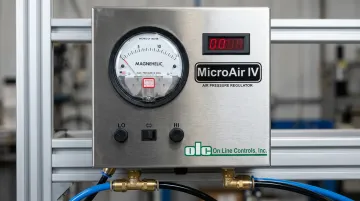
Reaching out early in the spec process (not just at PO time) is how engineers get the most accurate quotes and avoid configuration mismatches. OLC's team can confirm range selection before an order is placed — a step that directly affects output quality when you're operating at 0.05" of water.
Frequently Asked Questions
How much does a pressure regulator cost?
OLC does not publish list prices ; MicroAir pricing is available on request based on configuration. Cost is driven by pressure range, number of channels, control type, and optional features like digital displays or analog outputs. Contact OLC at 978-562-5353 or olc@onlinecontrols.com for a quote based on your specific specs.
How do you size a pressure regulator?
Sizing means matching the regulator's pressure range and flow capacity to your inlet pressure, required outlet pressure, and flow rate — not the physical port size. For tubing extrusion, OLC recommends placing your target setpoint in the middle of the selected range for optimal precision.
What information do I need to get a quote for a custom pressure regulator?
The essentials: target outlet pressure range, available inlet pressure, required flow rate, number of channels, control type (manual, contact closure, or 0–10V), port requirements, tubing material, and application type. For OEM builders, add extruder model and any control system integration requirements.
How long does it take to get a custom pressure regulator quote?
Turnaround is faster when specifications are complete on first contact. Partial submissions requiring follow-up exchanges add time. Call OLC at 978-562-5353 for current lead times; all units are built to order in-house.
How much does custom aluminum extrusion cost?
Custom aluminum extrusion — shaping aluminum alloy through a die to create structural profiles — is a different manufacturing process entirely. If you're looking for pressure regulators that control internal air pressure during plastic tubing extrusion, that's OLC's specialty.
Can I use a standard pressure regulator for plastic tubing extrusion?
Standard industrial regulators typically cannot achieve the pressures plastic tubing extrusion requires , often sub-1 PSI and sometimes as low as 0.05" of water. At those levels, standard regulators experience pressure droop and instability that create dimensional variation. For medical, automotive, and precision tubing applications where tolerances are measured in thousandths of an inch, purpose-built solutions are the practical requirement, not an upgrade.