Introduction
On paper, an extrusion pressure regulator looks like a straightforward component purchase. In practice, the wrong supplier choice can cascade into production downtime, scrap spikes, and compliance failures that far exceed any initial cost savings.
The stakes are real. A 2025 FDA Class I recall for Smiths Medical endotracheal tubes — triggered by smaller-than-expected tube diameters affecting sizes 2.0 through 3.5 mm — illustrates what dimensional control failures look like at the end of the supply chain. Pressure instability during extrusion is one of the upstream causes.
Pressure regulators for plastic tubing extrusion must maintain stability at ultra-low ranges (often sub-1 inch of water) where standard industrial regulators simply cannot perform. Not all suppliers are built for this. Many general pneumatics distributors list regulators as a standard catalog item with no real expertise in precision tubing applications.
This guide gives procurement teams a structured framework: technical benchmarks, evaluation criteria, and supplier red flags to identify who's actually equipped for precision tubing work.
Key Takeaways
- Extrusion pressure regulators control inner diameter and wall thickness during free extrusion — pressure instability directly causes dimensional scrap
- Evaluate suppliers across six dimensions: technical precision, total cost of ownership, certifications, OEM adoption, warranty/support, and supply chain stability — this guide covers each one
- Quality units carry 10–25 year service lives with no calibration requirement; purchase price alone is a poor proxy for value
- OEM adoption by major extruder manufacturers (Davis-Standard, Conair, RDN, Gimac) provides stronger reliability validation than marketing claims
- Red flags matter as much as positive criteria: vague stability specs, short warranties, and no direct engineering support are all disqualifying signs
What Is an Extrusion Pressure Regulator?
An extrusion pressure regulator is a precision control device that maintains constant, ultra-low air pressure inside extruded plastic tubing during the free extrusion process. That internal air pressure prevents tubing collapse and controls dimensional output — outer diameter, inner diameter, and wall thickness — while the tubing cools.
Operating pressures range from below 1 inch of water up to approximately 5 psi, with the most common extrusion range sitting at 0–30 inches of water column. Micro-tubing and ultra-thin catheter applications may operate at 0–3 or 0–5 inches of water. Larger medical or industrial profiles may require 0–50 inches of water or higher.
Standard industrial pressure regulators are not engineered for sub-1 inch water column precision. At these ranges, even minor drift generates measurable dimensional variation. This is why specialized suppliers — not general pneumatics distributors — are the correct sourcing category.
The Three Technology Types
Procurement teams will encounter three distinct product types:
| Type | Control Method | Best For |
|---|---|---|
| Manual spring-based (e.g., MicroAir I) | 30-turn knob, no electronic input | Stable single-lumen lines, no automation |
| Electronic contact closure (e.g., MicroAir II) | Up/Down inputs from OD gauge | Closed-loop OD feedback systems |
| Voice coil analog (e.g., MicroAir IV) | 0–10 VDC input, PLC-compatible | Bump/taper tubing, high-speed transitions |
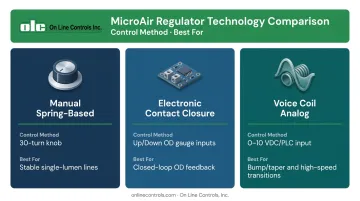
The voice coil type responds to a 50% full-scale pressure step in under 0.1 seconds (typically 20 milliseconds). Manual and contact-closure units cannot match that response speed. The right technology type depends on application complexity, not budget alone.
Each type also carries distinct integration requirements — PLC compatibility, input signal format, and feedback loop design all vary. Procurement evaluation criteria should reflect those differences before shortlisting suppliers.
Key Supplier Evaluation Criteria for Procurement Teams
Because extrusion pressure regulators directly influence dimensional consistency, scrap rates, and regulatory compliance, supplier selection must connect technical specifications to measurable business outcomes. The following six criteria give procurement teams a defensible evaluation framework.
Weight these criteria based on your application complexity. Medical tubing with tight tolerances demands stricter scoring on technical precision and certifications than industrial tubing applications.
Technical Precision and Product Performance
This is the foundation. A supplier's product must demonstrate verifiable pressure stability — ±0.2% of full scale or better for medical and precision applications — and hysteresis-free operation. Pressure variation during cutting events, spooling, and line speed changes is a primary driver of dimensional scrap. Ask suppliers for published stability specifications in application-relevant units (inches of water or percentage of full scale), not just marketing language.
Key questions to ask:
- What is the rated stability at the operating range you require?
- Does the product maintain pressure during high-flow events like cuts?
- What is the display or output signal resolution, and is it sufficient for your tolerance band?
On the resolution question: a digital display providing ±0.1% of full scale (0.01 inches of water resolution) supports sub-1 inch water column precision in catheter applications. A magnehelic gauge at ±2% of full scale may not.
Also verify that your target operating pressure falls in the middle 50% of the regulator's rated range. All precision regulators lose some accuracy below 10% of full scale — a 0–30 inch water unit running at 2 inches is operating in a degraded precision zone.
Product Lifespan, Reliability, and Total Cost of Ownership
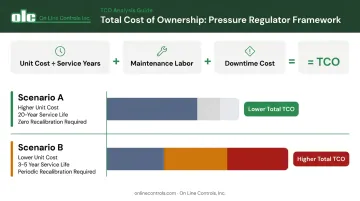
Purchase price is a poor proxy for value in this product category. A useful TCO framework:
TCO = (Unit cost ÷ Expected service years) + Maintenance labor + Downtime cost from failures
Quality pressure regulators carry 10–25 year service lives in field use. Many units from On Line Controls remain in continuous operation for 15–20 years — a documented outcome, not a theoretical projection. A unit priced higher upfront but lasting 20 years with zero calibration requirements will almost always outperform a cheaper unit requiring frequent servicing or replacement every 3–5 years.
Calibration requirements are a key TCO differentiator. Units requiring periodic recalibration add:
- Recurring labor and downtime for each calibration event
- Potential process interruption in validated manufacturing environments
- Risk of post-calibration drift before the next scheduled check
MicroAir regulators from On Line Controls carry an explicit no-recalibration-required specification — factory-set before shipping, with no need to return the unit during its operational life. Ask every supplier directly: Does this product require recalibration in service, and if so, at what intervals?
Certifications, Compliance, and Manufacturing Origin
For operations supplying medical device OEMs, food-grade markets, or export customers, the pressure regulator supplier must provide documentation that supports your quality system. Specifically request:
- CE compliance declaration for European shipment
- Material certificates for wetted components (critical for ISO 13485 process validation documentation)
- Traceability documentation aligned with your QMS requirements
21 CFR Part 820 requires medical device manufacturers to maintain a quality management system incorporating ISO 13485. Suppliers whose documentation supports that framework reduce your compliance burden; those who cannot provide traceability create gaps.
Manufacturing origin is a separate but related risk factor. USA-manufactured products reduce lead time exposure, avoid import tariff risk, and simplify compliance documentation for customers with domestic sourcing requirements. Ask explicitly: Where is this product manufactured and assembled?
OEM Adoption and Customer Reference Validation
OEM adoption by major extruder manufacturers is a procurement-specific signal worth weighting heavily. When Davis-Standard, Conair, RDN, or Gimac specify a pressure regulator for factory installation on new extrusion lines, that product has been validated by engineering teams with deep process expertise. Independent engineering validation carries more weight than any marketing specification sheet.
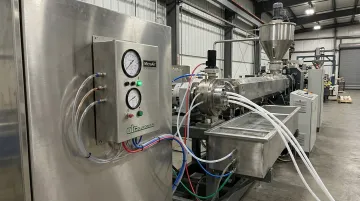
MicroAir regulators from On Line Controls are factory-specified by Graham/AK Brand, Davis-Standard, Conair, RDN, and Gimac — available for purchase with a new extrusion line or as a retrofit on existing equipment.
Beyond OEM validation, request customer references from operations running similar applications to yours. Ask specifically:
- How does performance compare across multiple units purchased over time?
- Have you seen consistency between serial number batches?
- How has the supplier responded to technical issues in the field?
Single-unit sample performance is not a reliable predictor. Consistency across a production fleet is.
Warranty Terms, Support Responsiveness, and Post-Sale Service
Fleet consistency tells you what the product does under normal conditions. Warranty and support terms tell you what happens when something doesn't go as planned — and in extrusion, a regulator failure mid-production can generate significant scrap before it's even detected.
Strong warranty terms in this category include:
- Three-year minimum on parts and labor (benchmark for quality suppliers)
- Unlimited technical support by phone and email throughout the warranty period
- Range change capability — free within 30 days of purchase, available at cost thereafter
- Direct access to application engineers, not routing through third-party distributors
OLC's MicroAir line carries a three-year warranty covering parts and labor, plus unlimited phone support. For units under 10 years old, repairs are typically completed in one day , which matters when production downtime is your costliest outcome.
Red flag: warranty terms shorter than two years, support restricted to business hours only, or all technical inquiries routed through distributors. For a component this central to production quality, you need direct engineering access when something goes wrong.
Delivery Capability and Supply Chain Stability
Pressure regulators for tubing extrusion are not interchangeable between suppliers without process revalidation. A supplier that exits the market, discontinues a model, or significantly extends lead times can trigger costly requalification, particularly in validated manufacturing environments where process changes may require revalidation under GHTF guidance.
Assess supplier longevity and supply continuity directly:
- How long has the company been manufacturing this specific product?
- Is production domestic or offshore, and what does that mean for lead times?
- Does the supplier sell direct internationally, or through distributors that could create pricing and documentation inconsistencies?
On Line Controls has manufactured MicroAir regulators since 1980 , over 44 years of continuous product development within the same application focus. The company sells directly to customers in 18 countries, with regional representatives in Mexico and parts of Asia. That direct model provides more consistent pricing, documentation, and support than multi-tier distribution.
Red Flags to Watch for When Vetting Pressure Regulator Suppliers
These warning signs carry as much weight as the positive criteria above. Spotting them early can prevent a costly supplier mistake.
Calibration and stability ambiguity. Suppliers who cannot provide published stability specifications in application-relevant units (inches of water or percentage of full scale), or who describe calibration as "periodic" without defining intervals, warrant closer scrutiny — or disqualification.
NIST does not recommend a universal recalibration interval. Suppliers claiming standard intervals without process-specific justification are likely defaulting to marketing language rather than documented product performance.
Warranty and support evasiveness. Watch for:
- Warranty terms shorter than two years
- Technical support restricted to business hours only
- All support routed through third-party distributors rather than the manufacturer's own engineers
- Heavily caveated warranty terms that create ambiguity about what's actually covered
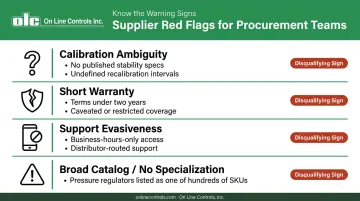
Lack of application-specific experience. General industrial component distributors selling pressure regulators as one of hundreds of SKUs cannot help procurement and engineering teams specify correctly. Look for suppliers whose entire product focus is extrusion pressure control. A broad catalog is a red flag here, not a reassurance.
Why OLC Is the Trusted Choice for Extrusion Pressure Regulation
On Line Controls has manufactured MicroAir ultra-low pressure regulators specifically for plastic tubing extrusion since 1980. That 44-year focused product history means the MicroAir line was engineered from the ground up for extrusion stability and lifespan requirements — not adapted from a general-purpose pneumatic design.
Here's how those credentials hold up against the criteria procurement teams prioritize:
- Stability of ±0.2% of full scale at 30 inches of water and below, with hysteresis-free operation via viscostatic damping and digital display resolution to 0.01 inches of water
- Field-documented service life of 10–25 years; no recalibration required; three-year warranty on parts and labor with unlimited phone support
- CE compliant for international shipment; manufactured in the USA at Shrewsbury, MA
- Factory-specified by Graham/AK Brand, Davis-Standard, Conair, RDN, and Gimac — available on new lines and as retrofits
- 44+ years of continuous operation with direct sales to 18 countries; build-to-order manufacturing with same-day service turnaround on units under 10 years old
To discuss your application directly, reach OLC's team at olc@onlinecontrols.com or 978-562-5353.
Conclusion
The goal is not to source the lowest-cost pressure regulator. It is to identify the supplier whose product, support structure, and supply chain stability best protect production uptime, dimensional quality, and compliance posture over the full service life of the equipment.
Build supplier re-evaluation into your quality management cycle rather than waiting for a failure to trigger the review. As production requirements evolve, the supplier relationship and product specification should be revisited proactively. Key triggers include:
- Tighter dimensional tolerances on new product lines
- New tubing geometries requiring different pressure ranges
- Expanded OEM certification demands (FDA, ISO, automotive)
A pressure regulator with a 15–20 year service life will outlast several procurement cycles. The evaluation you do today sets the quality and compliance baseline for the decade ahead — treat it accordingly.
Frequently Asked Questions
How do you choose the right pressure regulator for tubing extrusion?
Match the pressure range to your application — micro-tubing, standard medical tubing, and larger profiles each have distinct requirements. Target the middle 50% of your rated range for best accuracy. Beyond specs, evaluate total cost of ownership: lifespan, maintenance burden, and calibration requirements matter as much as unit price.
What are the signs of a failing pressure regulator in an extrusion line?
Watch for unexplained dimensional drift, rising scrap rates, pressure hunting, or the need for increasingly frequent manual setpoint correction. These symptoms develop gradually — treat early dimensional variation as a diagnostic signal, not a routine process adjustment.
What certifications should an extrusion pressure regulator supplier have?
Requirements vary by market. CE compliance is mandatory for European shipment. For medical applications, request ISO 13485 process validation documentation, material certificates, and traceability records for wetted components. Ask for declarations of conformity that align with your quality system.
How long should an extrusion pressure regulator last before replacement?
Quality regulators built for tubing extrusion typically achieve 10–25 years of service life. Early pressure drift, frequent recalibration needs, or limited parts availability indicate lower build quality. Ask suppliers whether their service life figures come from field data or theoretical projection.
What is the difference between a manual and electronic pressure regulator for extrusion?
Manual spring-based units work well for stable, single-lumen applications. Electronic controllers with OD gauge integration respond across full scale in roughly two minutes. Voice coil actuators handle a 50% full-scale step in under 0.1 seconds — the right choice for bump/taper tubing where speed is critical.
What questions should procurement teams ask a pressure regulator supplier before buying?
The most important qualifying questions:
- What are the published stability specifications in inches of water or percentage of full scale?
- Does the product require calibration in service, and if so, at what intervals?
- What is the standard warranty period and what does it cover?
- Which OEM extruder manufacturers specify your product?
- Do you offer direct technical support from application engineers, and what is the typical response time?