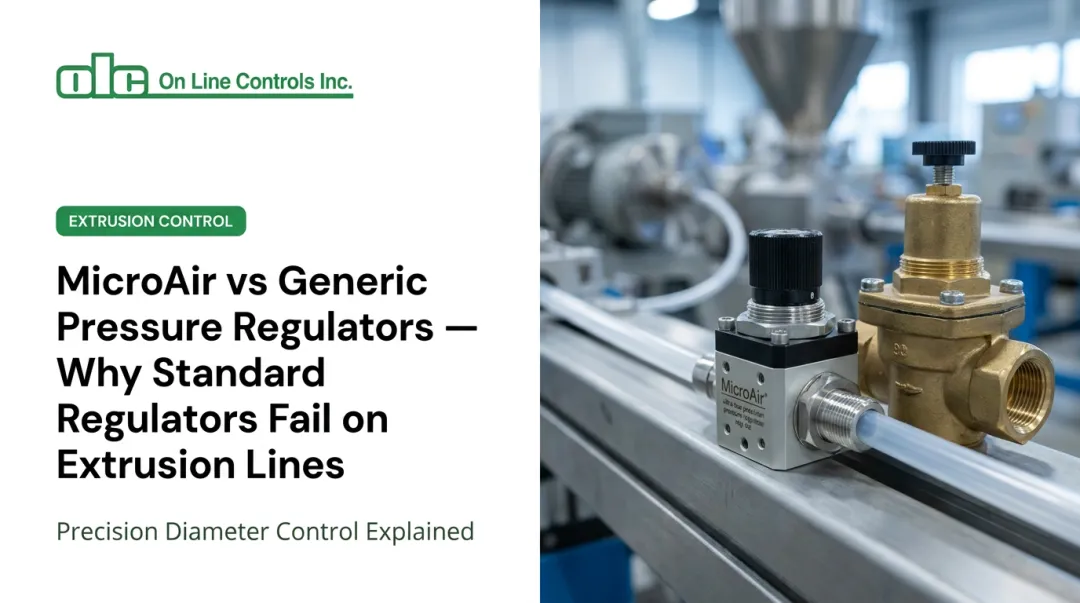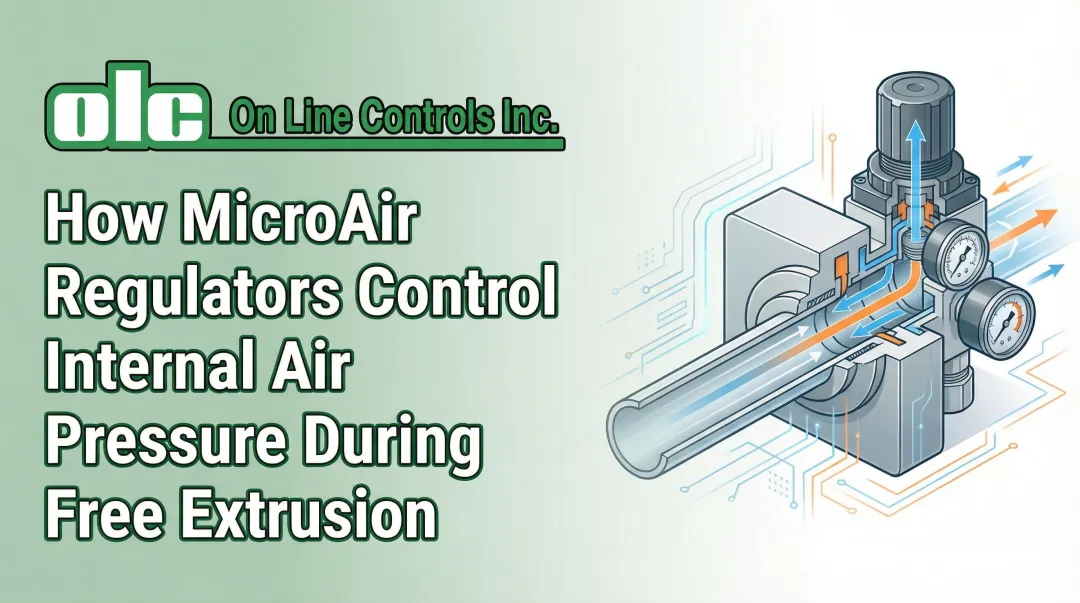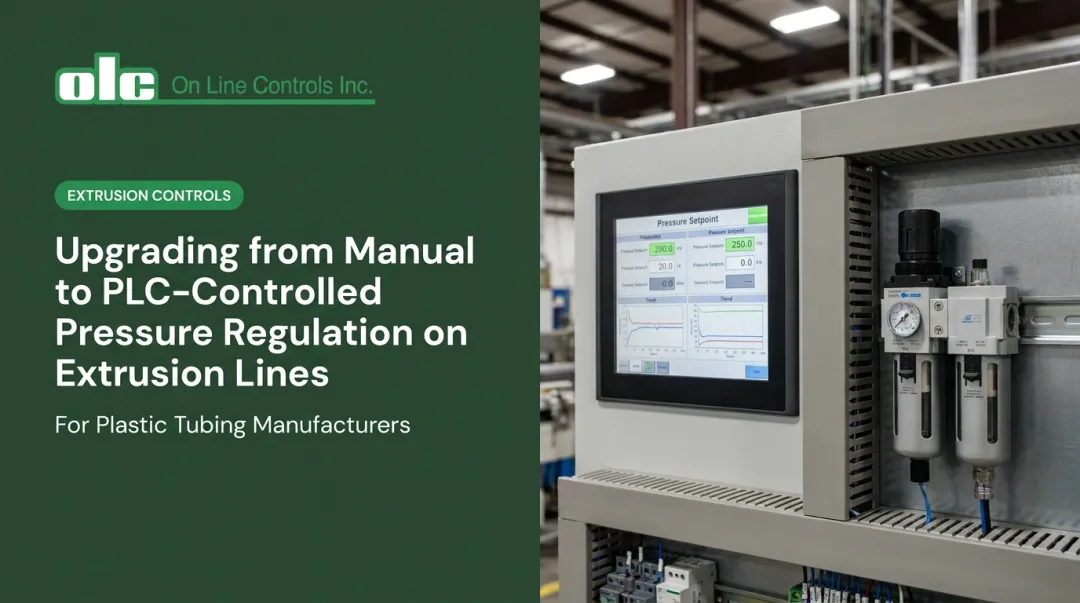
What many manufacturers don't immediately connect to these challenges is the air pressure regulator sitting on the line. It's a small component relative to the extruder, the die, or the downstream measurement system. But during free extrusion, the internal air support pressure that regulator controls is what holds the lumen open and keeps OD, ID, and wall thickness in spec as the tube forms.
Many catheter lines are still running with general-purpose or industrial regulators that were never designed for the sub-1-inch-of-water pressures medical tubing requires. This article covers the specific, operational reasons why catheter manufacturers switch to MicroAir from On Line Controls — and what changes when they do.
Key Takeaways
- MicroAir regulates internal air pressure below 1 inch of water (0.036 psi), a range standard industrial regulators cannot accurately resolve
- Its hysteresis-free design eliminates the dimensional drift that causes "was in spec at the start, drifted by the end" failures
- A 10–20 year service life with no required calibration eliminates calibration-related maintenance risk on catheter extrusion lines
- Leading extruder OEMs (Davis-Standard, Graham/AK Brand, and Conair) integrate MicroAir directly into new equipment
- OLC sells directly to catheter manufacturers in 18 countries, with a 3-year parts and labor warranty and unlimited phone support
What MicroAir Is and Why It Matters in Catheter Extrusion
MicroAir is an ultra-low air pressure regulator manufactured by On Line Controls (OLC), based in Shrewsbury, MA. During the free extrusion of plastic tubing, the catheter lumen doesn't form against a mandrel — it forms around a column of pressurized air. MicroAir controls that air column with enough precision to hold lumen dimensions stable as the tube travels from die to cooling.
Why Catheter Extrusion Is Different
Catheters are FDA-regulated medical devices. ISO 10555-1:2023, recognized by the FDA in 2024, governs intravascular catheter requirements. Published manufacturing data puts the tolerance demands in concrete terms: PTFE catheter liner wall tolerances run as tight as ±0.0002 to ±0.00025 inches, with tri-layer medical tubing holding OD tolerances of ±0.015 mm.
Freudenberg Medical documents micro-extrusion wall thicknesses down to 0.0508 mm (0.002 inches). At tolerances this narrow, internal air pressure isn't a background variable — it's the variable.
Peer-reviewed research confirms that changes in internal air pressure during catheter thin-wall tube extrusion directly affect both inner diameter and outer diameter. Small deviations don't produce marginal product — they produce out-of-spec product.
MicroAir's value shows up in dimensional yield: tighter Cpk, fewer line stops, less scrap, and output that holds spec across the full production run.
Three Advantages That Drive the Switch to MicroAir
The advantages below are grounded in what catheter extrusion engineers actually measure: dimensional yield, defect rates, downtime, and total cost per foot of good tubing.
Ultra-Low Pressure Control Matched to Medical Tubing Requirements
Catheter lumen formation happens at pressures most industrial regulators can't accurately read, let alone hold. OLC's internal documentation specifies that MicroAir can regulate and hold pressures below 1 inch of water (0.036 psi) using its 0–2 inch or 0–3 inch water column ranges. The MicroAir I has been tested holding 0.05 inches of water without issue using a 0–0.25 inch range.
Standard industrial precision regulators operate at far higher minimum ranges. When a regulator can't resolve at sub-1-inch-of-water pressures, it doesn't hold a steady mid-range output — it oscillates between over-pressurizing and under-pressurizing the lumen. The result is measurable dimensional variation on every run.
How this plays out in production:
- Catheter OD and wall tolerances specified in hundredths of a millimeter mean even minor pressure excursions produce non-conforming product
- MD+DI reports that OD tolerances for catheter-delivery tubing run ±2% for rigid tubes and ±3% for flexible tubing, with a Cpk of 1.33 representing a controlled process at 99.994% conformance
- Uncontrolled medical tubing extrusion processes can push scrap rates to 10–20%
KPIs directly affected: OD/ID/wall dimensional Cpk, first-pass yield rate, scrap rate per run, NCR frequency
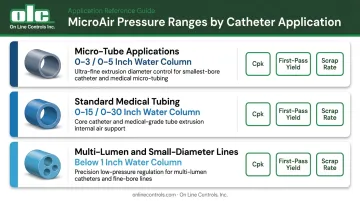
When this matters most: Multi-lumen catheter production, small-diameter catheter lines, and any application where the lumen formation pressure runs below 5 inches of water. OLC's most common ranges for medical tubing are 0–15 inches and 0–30 inches of water, with micro-tube applications using 0–3 or 0–5 inch ranges.
Hysteresis-Free Operation for Run-to-Run Consistency
Hysteresis in a pressure regulator is the lag between a set pressure and actual output as operating conditions change. A regulator with measurable hysteresis outputs different pressures depending on whether conditions are increasing or decreasing — a mechanical artifact of friction and spring resistance in conventional diaphragm and piston designs.
MicroAir eliminates this through a specific force balance architecture: the relief valve stem is suspended vertically on a balance spring, literally floating on a cushion of air. With friction effectively removed from the equation, output pressure is the same whether the line is accelerating, decelerating, or holding steady.
A fluid-filled damping chamber below the relief valve prevents oscillation without ever contacting the process air.
The MicroAir IV model — designed for bump and taper catheter profiles — uses a precision voice-coil linear motor with viscostatic (fluid-resistance) damping in place of a spring, achieving response times under 0.1 second (typically ~20 milliseconds) for 50% full-scale changes.
Why hysteresis causes the "drifted by end of spool" failure pattern:
- Line speed changes, spool transitions, and cutter operations all alter airflow demand momentarily
- A hysteresis-prone regulator responds to these events with a pressure lag — the tubing that forms during those transitions comes out at different dimensions than the tubing on either side
- These events happen dozens of times per spool, which is why dimensional variation accumulates rather than appearing randomly
KPIs directly affected: Dimensional Cpk stability across run duration, inline gauge alarm rate, operator intervention frequency, customer return/rejection rate
This advantage is most critical on long unattended production runs, automated lines, and bump or taper catheter profiles where pressure setpoint changes are frequent and geometry errors from a lagging regulator are visible in the finished product.
Low Maintenance Requirements and Extended Service Life
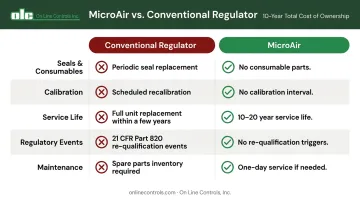
OLC builds MicroAir units for a 10–20 year service life — and many remain in continuous operation at that age. They are factory set before shipping and require no field calibration, ever. The viscostatic damping fluid doesn't evaporate when the unit stays vertical, and there are no consumable seals or components to schedule for replacement. OLC's service records document units in active use at 15–20 years under constant production conditions.
Compare this to conventional precision regulators that typically require periodic seal replacement, recalibration, or full unit replacement within a few years of installation. In a catheter manufacturing environment operating under 21 CFR Part 820, any maintenance event on production equipment can trigger re-qualification requirements — adding engineering time and documentation burden beyond the direct replacement cost.
What this means operationally:
- No calibration interval to schedule or document
- No spare parts inventory required for the regulator
- Out-of-warranty units under 10 years old can typically be serviced in one day at OLC's Shrewsbury facility
- 3-year warranty covers parts and labor with unlimited phone support
10-year cost drivers this eliminates: Planned vs. unplanned downtime hours, maintenance labor per line per year, regulator replacement frequency, and re-qualification documentation under 21 CFR Part 820.
Facilities running multiple extrusion lines simultaneously benefit most — particularly operations with lights-out or minimally staffed night shifts where unattended reliability is non-negotiable.
What Happens When the Wrong Regulator Runs a Catheter Line
The pattern is consistent across catheter manufacturing facilities that have made the switch to MicroAir: chronic dimensional drift gets attributed to resin lot variation, die wear, or downstream equipment — never the regulator. Gauge alarms accumulate. Operators compensate manually, adjusting setpoints to chase a moving target. The line keeps running, but scrap climbs and NCRs stack up.
This misdiagnosis happens because pressure control is rarely the first variable investigated when dimensional variation appears. Engineers check resin viscosity, die temperature, line speed, and pull rate first. The regulator sits in the background, appearing to function because it holds a pressure reading. At catheter lumen pressures, though, holding a reading on a gauge is not the same as maintaining stable, hysteresis-free output.
The quality system consequences compound quickly:
- Each dimensional non-conformance triggers NCR documentation under 21 CFR Part 820
- Recurring NCRs generate CAPA investigations that consume engineering time
- Process capability data requested during customer or regulatory audits surfaces the underlying instability
The hidden cost is the most frustrating part for manufacturers who have made the switch: the regulator costs a small fraction of what it was causing in production losses. Once MicroAir is installed, yield numbers clarify quickly — and what was written off as process noise turns out to have a single, addressable source.
Getting MicroAir on Your Catheter Line
MicroAir delivers its full performance advantage when it's matched to the line's actual operating pressure range. OLC offers three primary models:
| Model | Control Type | Best For |
|---|---|---|
| MicroAir I | Manual 30-turn knob | Stable single-pressure applications |
| MicroAir II | Contact closure inputs (Up/Down) | Gauge-integrated closed-loop control |
| MicroAir IV | 0–10V analog / PLC input | Bump, taper, and automated switching |
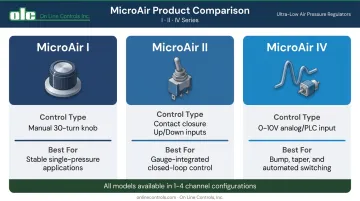
All three models are available in single to 4-channel configurations for multi-lumen catheter production, with each channel independently pressure-controlled.
MicroAir units are factory set and require no field calibration, so installation into an existing line is straightforward:
- Mount the unit vertically near the die
- Connect ¼" NPT fittings to factory air regulated to ~50 psi
- Set operating pressure at the midpoint of the selected range for best resolution
The unit is ready to run.
For new extrusion equipment, MicroAir ships pre-integrated through leading extruder OEMs including Davis-Standard, Graham/AK Brand, Conair, RDN, and Gimac.
OLC sells and ships directly to catheter manufacturers across all 18 countries it serves. Regional representation is available through Argonavis (Mexico) and HnG Medical (China, Japan, Korea, and Southern Asia). For technical support and sizing guidance, contact OLC at 978-562-5353 or olc@onlinecontrols.com.
Conclusion
For catheter manufacturers, the pressure regulator directly determines whether the line produces conforming medical-grade tubing or generates scrap, NCRs, and process instability. A regulator that cannot resolve sub-1-inch-of-water pressures is simply the wrong tool for catheter-grade tolerances.
MicroAir's core advantages — ultra-low pressure precision, hysteresis-free stability, and a 10–20 year service life with minimal maintenance — build measurable returns across every production run. Manufacturers who switch typically see sustained gains in dimensional Cpk, first-pass yield, and lower cost per foot of conforming product.
To discuss your specific catheter extrusion application and get a sizing recommendation, contact On Line Controls directly at 978-562-5353 or olc@onlinecontrols.com.
Frequently Asked Questions
What is the purpose of a pressure regulator in catheter extrusion?
During free extrusion, a pressurized air column inside the tube holds the lumen open as the catheter forms. The regulator controls that internal air support pressure. Without stable, precise control, OD, ID, and wall thickness drift out of tolerance as the tube travels from die to cooling.
What makes catheter extrusion pressure control different from standard tubing?
Catheters require far tighter dimensional tolerances than industrial or commodity tubing, are subject to FDA device regulations under ISO 10555-1:2023, and form at internal air pressures that can fall below 1 inch of water — a range most standard industrial regulators cannot accurately resolve or hold steady.
What is hysteresis in a pressure regulator and why does it matter for medical tubing?
Hysteresis is the lag between a set pressure and actual output as operating conditions change. In catheter extrusion, this lag causes dimensional drift during line speed changes, spool transitions, or cutter operations, producing out-of-spec parts dozens of times per run, often without being traced back to the regulator.
How does MicroAir maintain pressure during cuts or spooling on a catheter line?
MicroAir's force balance design responds instantaneously to airflow demand changes. The floating valve stem and viscostatic damping system hold set pressure from near-zero flow up to the rated maximum, preventing the spikes or drops that other regulators produce during cuts and spool transitions.
Does MicroAir require calibration or scheduled maintenance?
No calibration is required. Units ship factory-set and never need recalibration in the field. With a 10–20 year service life, no consumable parts, and a 3-year parts and labor warranty with unlimited phone support, ongoing maintenance is minimal.
Can MicroAir be retrofitted onto an existing catheter extrusion line?
Yes. MicroAir mounts near the die with standard ¼" NPT fittings and connects to factory air at approximately 50 psi, with no special infrastructure required. OLC works directly with manufacturers to match the correct model and pressure range to their line, making the transition from a legacy regulator straightforward.