Introduction
Choosing the wrong motor type for a motorized potentiometer is a quiet but costly mistake. Whether you're specifying control systems for a plastic tubing extrusion line or a broader industrial automation setup, the decision between AC and DC motors shapes how precisely you can control resistance, how often you'll deal with maintenance, and how long the equipment lasts.
The consequences show up fast: reduced control accuracy affects product quality, unplanned maintenance disrupts production schedules, and premature equipment failure accelerates capital replacement. With the global potentiometer market projected to reach $4.74 billion by 2035 — driven by industrial automation expansion — engineers who get this decision right early avoid compounding costs down the line.
This guide breaks down how AC and DC motorized potentiometers differ, where each performs best, and what to evaluate before specifying one for your application.
Key Takeaways
- Motorized potentiometers pair a motor with a variable resistor to automate position control — commonly used in extrusion lines, HVAC systems, and process equipment
- AC motors are built for continuous-duty operation, typically lasting 15–25 years with little to no maintenance
- DC motors offer strong starting torque and easy speed control via voltage adjustment — better suited for variable-speed or intermittent-duty applications
- Choose based on your duty cycle, required precision, operating environment, and whether your control system runs on AC or DC power
What is a Motorized Potentiometer?
A motorized potentiometer is an electromechanical device that combines a motor (AC or DC) with a potentiometer to provide automated, remote, or programmable resistance adjustment for precise control of electrical parameters. These devices eliminate manual adjustment in industrial process control, automation systems, and precision equipment where feedback-driven control is essential.
Core Components
Motor Assembly (AC or DC)
The motor rotates the potentiometer shaft. Motor type determines torque delivery, speed control precision, and maintenance requirements. DC gearmotors typically deliver 0.22 oz-in stall torque with output speeds from 0.05 to 261 RPM; AC gearmotors run at fixed speeds of 1–15 RPM with continuous torque ratings of 12–100 in-lbs in industrial configurations.
Potentiometer Element
The resistive element—wirewound, conductive plastic, or cermet—provides variable resistance. Motor smoothness and precision directly affect potentiometer lifespan and accuracy. Conductive plastic elements offer 10-50 million turn life expectancy with infinite resolution, ideal for high-cycle servo feedback applications. Wirewound elements provide 500,000-2 million turns with higher power handling (up to 50 mA wiper current) suited for variable resistor applications.
Gear Reduction System
Gear reduction translates motor speed to precise, controlled potentiometer rotation. Ratios range from 41:1 to 235,067:1, producing output speeds as low as 0.05 RPM. Gear ratio selection must match motor characteristics for optimal performance, with run-up and run-down times varying from 10 to 300 seconds depending on gearbox configuration.
Position Feedback and Limit Switches
Optional feedback systems confirm potentiometer position and prevent over-travel. Dual-gang configurations use one potentiometer section for process control while the second provides position feedback to PLCs. Cam-operated limit switches (NO/NC) define electrical travel range and signal specific positions. DC motors offer simpler analog voltage control; AC motors may require Variable Frequency Drives (VFDs) for advanced functionality.
Benefits and Applications
Motorized potentiometers enable remote control, automated adjustment, and integration with feedback control loops in industrial processes. They eliminate manual adjustments, deliver consistent repeatability, integrate with PLCs and SCADA systems, and reduce operator intervention in hazardous environments.
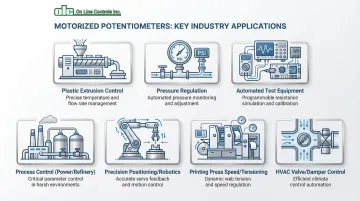
Key applications include:
- Plastic extrusion control systems for air pressure regulation
- Pressure regulation in manufacturing processes
- Automated test equipment requiring precise analog control
- Process control systems in power plants and refineries
- Precision positioning in industrial machinery and robotics
- Speed controls and tensioning motors in printing presses
- Valve positioning and damper control in HVAC systems
AC vs DC Motorized Potentiometers: Key Differences
While both motor types drive potentiometers effectively, they differ fundamentally in power source requirements, control characteristics, maintenance needs, and suitability for specific industrial applications. These differences directly impact equipment performance, operational costs, and long-term reliability.
Power Source and Electrical Requirements
AC motors operate directly from standard industrial power supplies—single-phase 115 VAC or 230 VAC at 50/60 Hz—simplifying electrical installation in facilities with existing AC infrastructure. DC motors require DC power sources (6V, 12V, or 24V) or rectified AC with additional power conditioning components, potentially adding cost and complexity to initial installation.
AC systems eliminate the need for power conversion equipment when facility infrastructure already provides appropriate voltages. DC systems may require dedicated power supplies but offer advantages in control precision and integration with low-voltage control systems commonly found in industrial panels.
Torque Characteristics and Starting Performance
DC motors deliver high starting torque and maintain consistent torque across speed ranges, making them ideal for applications requiring frequent starts, stops, or position changes under load. Their linear speed-torque characteristics enable quick response to control signals and predictable performance under varying load conditions.
AC motors typically have lower starting torque, especially shaded-pole designs, but excel in continuous operation applications. Permanent split capacitor (PSC) AC motors offer moderate starting torque. AC motor torque characteristics can be modified with Variable Frequency Drives at additional cost, providing torque boost capabilities and tighter speed regulation for demanding applications.
Speed Control and Precision
DC motor speed is easily controlled by varying input voltage or using Pulse Width Modulation (PWM), providing precise, responsive speed regulation ideal for applications requiring fine position control or variable speed operation. This simple control method requires minimal additional electronics and works directly with analog control systems.
AC motor speed is determined by power frequency (typically 60 Hz in North America, 50 Hz elsewhere) and requires VFDs for variable speed control. VFDs offer advanced features like programmable acceleration/deceleration and precise speed regulation. However, they add complexity, cost, and potential harmonic distortion and voltage spikes that can damage motor windings.
For fixed-speed applications, AC motors provide robust, cost-effective performance without additional control electronics.
Maintenance Requirements and Lifespan
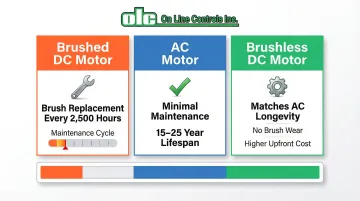
AC motors typically feature brushless designs requiring minimal maintenance, with operational lifespans exceeding 10,000 hours under rated conditions and service lives of 15-25 years in industrial environments. The absence of brushes and commutators eliminates the primary wear component, making AC motors cost-effective for continuous-duty applications.
DC motors with brushes require periodic inspection and replacement, typically every 2,500 hours of operation. Brush wear creates maintenance schedules and associated downtime costs.
Modern brushless DC (BLDC) motors eliminate this concern entirely, matching or exceeding AC motor longevity — though at higher initial cost due to complex electronic controllers and rare-earth magnet construction.
Environmental Suitability
AC motors generally handle harsh industrial environments better due to simpler, more rugged construction and sealed designs. Key advantages include:
- Brushless configuration eliminates arcing at the commutator interface
- Sealed housings resist dust, moisture, and temperature extremes
- Simpler internal construction withstands vibration better over time
DC motors may require additional environmental protection in demanding conditions, particularly brushed designs where contaminants accelerate brush wear. Industrial-grade DC motors with IP65 or IP67 ratings are available for harsh environments, providing dust-tight and water-resistant protection for demanding plant-floor installations.
What to Consider When Choosing Between AC and DC Motor Types
Selecting the right motor type requires evaluating multiple factors specific to your application, operating environment, and control system requirements. These factors directly influence equipment performance, operational reliability, maintenance costs, and total cost of ownership over the equipment's 10-20 year lifespan.
Application Precision and Control Requirements
Applications requiring fine position control, frequent adjustments, or integration with analog/digital control systems typically benefit from DC motors' superior speed control and response characteristics. DC motors' linear voltage-speed relationship enables precise positioning with simple control electronics, making them ideal for servo applications, automated test equipment, and processes requiring variable speed operation.
Fixed-position or infrequent adjustment applications may not require DC precision and can use more economical AC motor solutions. Applications with discrete speed requirements (high/medium/low) or simple on/off control are well-served by AC motors operating at fixed speeds without the added complexity and cost of variable speed drives.
Duty Cycle and Operating Pattern
Continuous-operation applications running 24/7 favor AC motors' durability and low maintenance requirements. Industrial processes like plastic extrusion, continuous manufacturing lines, and power generation benefit from AC motors' brushless designs that eliminate scheduled maintenance for brush replacement, reducing downtime and labor costs.
Intermittent-duty applications benefit from DC motors' starting torque and control flexibility. Equipment operating in short bursts with frequent starts and stops—such as automated positioning systems, batch processes, or test equipment—leverages DC motors' ability to deliver high torque from standstill and respond quickly to control signals.
Understanding your equipment's typical operating pattern is critical: calculate starts per hour, run time percentages, and load variations to match motor capabilities to actual duty requirements.
Environmental and Operating Conditions
Harsh environments with dust, moisture, temperature extremes, or vibration may favor ruggedized AC motors unless DC precision is mandatory. AC motors' sealed, brushless construction provides built-in protection against contaminants that could compromise performance or accelerate wear.
When DC precision is required in harsh conditions, specify industrial-grade sealed DC motors with appropriate IP ratings (IP65 for dust-tight/water jet protection, IP67 for temporary immersion protection). Evaluate temperature ranges (-40°C to +125°C for premium potentiometer elements), humidity levels, and exposure to corrosive substances against motor specifications to ensure reliable long-term operation.
Control System Integration
Your existing control system architecture often determines the practical choice before other factors even come into play.
DC motors integrate directly with analog voltage control systems — changing input voltage from 0-24V controls speed without additional electronics. This makes them natural fits for systems using analog signals, simple PLCs with analog outputs, or manual control panels with potentiometer-based speed controllers.
AC motors connect directly to standard industrial AC power but may require variable frequency drives (VFDs) for speed control. VFDs add cost ($200–$2,000+ depending on horsepower and features) but unlock advanced capabilities:
- Programmable acceleration and deceleration curves
- Multiple speed presets
- Communication protocols (Modbus, Ethernet/IP) for PLC and SCADA integration
One additional consideration: dual-gang potentiometer configurations provide position feedback signals (0-10 VDC or 4-20 mA) to control systems regardless of motor type. Connecting potentiometers directly to PLC analog inputs can introduce non-linearity due to loading effects — use dedicated 10 VDC supplies or software linearization to compensate.
Total Cost of Ownership
Initial equipment cost is only part of the economic picture. Maintenance schedules, lifespan, energy efficiency, and parts availability all shape what a motor actually costs over time.
| Factor | Brushed DC | AC Motor | Brushless DC |
|---|---|---|---|
| Initial cost | Low | Low–Medium | Higher |
| Maintenance | Brush replacement ~every 2,500 hrs | Minimal | Minimal |
| Efficiency | 70–80% | 70–80% | 85–90% |
| Best for | Intermittent duty | Continuous 24/7 | High-duty, energy-sensitive |
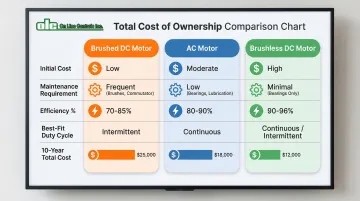
For a motor running 16 hours daily, brushed DC service intervals translate to brush replacement roughly every 6 months — each event adding labor, downtime, and parts costs. AC and brushless DC motors eliminate this cycle entirely, though brushless DC units carry higher upfront costs due to their electronic controllers and premium magnets.
Power Supply Infrastructure
Existing facility electrical infrastructure — available voltages, AC vs. DC power availability, power quality — affects practical motor selection and installation costs. Facilities with standard 115 VAC or 230 VAC single-phase power can implement AC motorized potentiometers with minimal electrical work.
DC motor installations require appropriate DC power sources (6V, 12V, or 24V), which may already exist in control panels as standard control voltages, or may require dedicated power supplies adding $50–$300 to installation costs. Retrofitting existing equipment may be constrained by available power sources and electrical panel capacity, making AC motors more practical when DC power infrastructure doesn't exist.
How On Line Controls Can Help
On Line Controls has specialized in motorized potentiometers since 2000, offering precision control solutions engineered for demanding industrial applications, particularly plastic extrusion and process control systems. OLC's motorized potentiometers deliver the same durability that characterizes their MicroAir pressure regulators, with typical lifespans of 10-20+ years in harsh industrial environments.
OLC manufactures both AC and DC motorized potentiometers across a full range of specifications:
| DC Models | AC Models | |
|---|---|---|
| Power | 6V, 12V, or 24V | 115 VAC |
| Motor | Swiss-made | Hurst reversible |
| Speed Range | 1–120 RPM | 1–15 RPM |
| Current | 5–20 mA optimal | — |
| Potentiometer | Japanese-made wirewound or conductive plastic | Japanese-made wirewound or conductive plastic |
| Protection | Factory-set slip clutch with manual override | Factory-set slip clutch with manual override |
Key differentiators include:
- Manufactured in Shrewsbury, Massachusetts with worldwide shipping
- Backed by a three-year warranty on parts and labor, plus unlimited phone support
- Requires no calibration throughout the product's operational life
- Rated for 500,000 to 50 million turns depending on potentiometer element type
- Supported directly by engineers with 35+ years in precision control systems
OLC provides guidance on motor type selection based on your process requirements, environmental conditions, and control system architecture. Their engineering team helps customers specify motor voltage, RPM, potentiometer resistance (10 ohms to 100K ohms), and wattage ratings (0.5W to 5W).
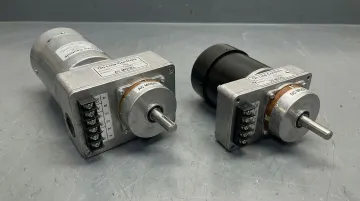
OLC serves customers across plastic tubing manufacturing, medical device production, industrial automation, oil and gas, power generation, aerospace, and robotics — with installations that have run reliably for decades.
Conclusion
The right motorized potentiometer comes down to matching motor characteristics to your specific application — operating environment, control objectives, duty cycle, and long-term maintenance reality all factor in.
Total cost of ownership matters more than purchase price alone. Here's where each motor type earns its place:
- AC motors suit continuous-duty applications with minimal maintenance needs and 15–25 year expected lifespans
- DC motors deliver superior control precision and starting torque for frequent position changes or variable-speed operation
- Harsh environments favor brushless AC designs; high-precision feedback loops favor DC with encoder support
- Control system compatibility — analog vs. digital, signal type, available supply voltage — often makes the final call
On Line Controls has manufactured motorized potentiometers since 2000 and has supplied precision control equipment to extrusion and industrial customers for over 44 years. Their US-built units carry a three-year warranty and routinely reach 10–20+ year service lives. If your application sits at the edge of the AC/DC decision — tight precision requirements, demanding duty cycles, or a challenging installation environment — contact On Line Controls directly at olc@onlinecontrols.com or 978-562-5353 to work through the specification before you order.
Frequently Asked Questions
What is the difference between AC potentiometer and DC potentiometer?
The primary difference is the motor type used to drive the potentiometer. AC motors run on alternating current (typically 115 VAC) with brushless designs suited for continuous duty and minimal maintenance. DC motors run on direct current (6-24 VDC) offering superior speed control through simple voltage adjustment and high starting torque for precision positioning applications.
Why use a DC motor instead of AC?
DC motors suit applications requiring precise speed control, high starting torque, frequent position changes, or simple integration with analog control systems. Their linear voltage-speed relationship enables accurate positioning with minimal control electronics.
Can you control the speed of a DC motor with a potentiometer?
Yes — varying the voltage via a potentiometer directly controls DC motor speed. It's a simple, effective method for small to medium DC motors in manual or semi-automated applications.
What are the typical lifespans of AC vs DC motorized potentiometers?
AC motorized potentiometers typically last 15-25 years with minimal maintenance due to brushless motor designs. Traditional brushed DC motors need brush replacement roughly every 2,500 hours, though modern brushless DC motors match AC longevity without the upkeep.
Which motor type is more energy efficient for motorized potentiometers?
Efficiency varies by duty cycle and operating pattern. AC motors are generally more efficient for continuous operation at fixed speeds, while DC motors can outperform them in intermittent-duty cycles with frequent speed changes. Brushless DC motors offer the highest efficiency overall, reaching 85-90% in high-duty applications.
How do I determine if my application needs AC or DC motor type?
Start by evaluating these five factors:
- Precision needs — fine control favors DC
- Duty cycle — continuous operation favors AC
- Environment — harsh conditions favor sealed AC or industrial DC
- Power supply — match the motor to your available voltage
- Control system — analog systems favor DC; fixed-speed setups favor AC
When in doubt, consult an experienced supplier who can assess your specific application and recommend the right motor type.