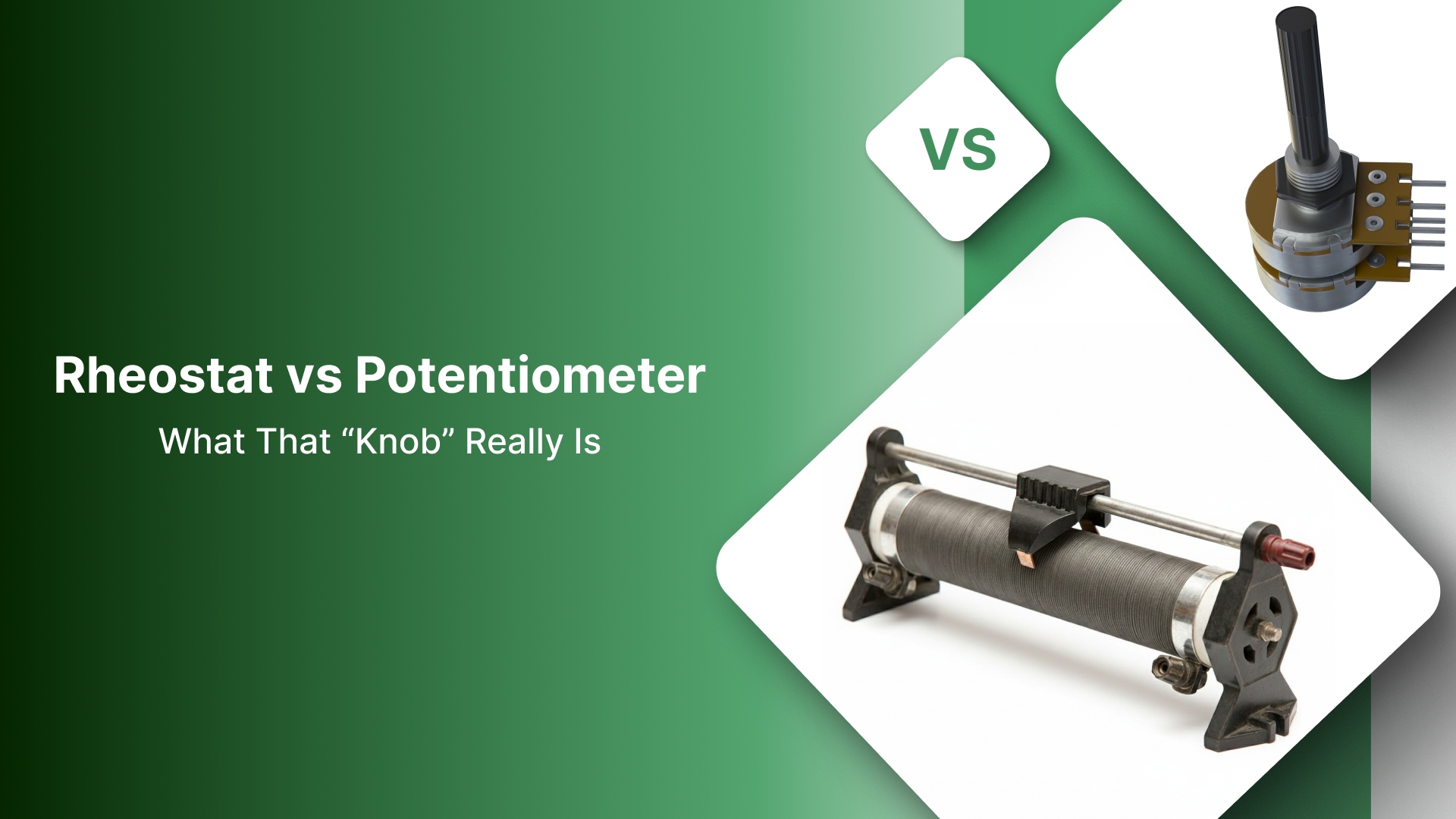
If you’ve ever retrofitted a machine, you’ve seen it. A “mystery knob” that sets speed, flow, or tension. Sometimes it’s a potentiometer. Sometimes it’s a pot wired like a rheostat. Sometimes the label is flat-out wrong.
And the difference isn’t academic. It changes how the circuit behaves. It changes how much heat the part has to live with. Get it wrong, and you end up with drift, noise, or a cooked component.
Let’s clear it up fast with a simple table. Then we’ll cover the details that actually help you choose the right part.
Key Takeaways
A potentiometer usually acts as a voltage divider. It gives you an adjustable output voltage (typically uses 3 terminals).
A rheostat acts as a variable resistor in series. It helps control current (typically uses 2 terminals).
You can wire many potentiometers to work like a rheostat, but power/heat rating often becomes the limiting factor.
If you are adjusting a signal or setpoint, choose a potentiometer. If you are controlling current to a load, a rheostat is the more typical choice (when the wattage is appropriate).
Rheostat vs Potentiometer (Quick Comparison)
Both parts can look like “a knob that changes something,” but they behave differently in a circuit. This table breaks it down by function, terminals, power handling, and practical use cases so you can make the right call fast.
Feature | Potentiometer | Rheostat | Practical takeaway |
|---|---|---|---|
Primary job | Acts as a voltage divider | Acts as a variable resistor (in series) | If you need an adjustable signal voltage, think potentiometer. If you need to limit current through a load, think rheostat. |
Terminals | 3 terminals (two ends + wiper) | Usually, 2 terminals are used (end + wiper) | The wiper is the “moving contact.” A pot uses it to create an output. A rheostat uses it to change resistance in a series path. |
Output behavior | Gives a variable output voltage (at the wiper) | Changes the series resistance, which changes the current (and voltage drop) | Pot = adjustable reference/setpoint. Rheostat = adjustable “restriction” in the circuit. |
Typical power handling | Often lower power (many are signal-level) | Often higher power (built to dissipate heat) | Always check the watt rating. The physical size usually tells a story. |
Heat/efficiency | Usually, minimal heat is used in normal signal use | Can run hot by design (it burns power as heat) | If it’s in the load path, heat is the risk. Heat drives drift and early failure. |
Best for | Setpoints, trimming, sensor/controls input, calibration | Current limiting for loads, legacy speed/brightness control, and test setups | If the knob feeds a controller input, it’s usually a pot. If it’s in series with a load, it’s acting like a rheostat. |
Common applications | Speed reference input, volume/level control, position sensing, and tuning a circuit | Lamp dimming (old-school), heater control (old-school), motor speed on simple DC setups, and lab benches | Modern systems often use PWM/VFDs for power control. Rheostats still show up in legacy gear and specific use cases. |
Pros | Simple, cheap, easy to interface with electronics | Simple, direct current control without extra electronics | Pot shines for signals. Rheostat shines when you truly need “variable resistance” in series. |
Cons | Not meant for high load current; wiper wear/noise can matter | Inefficient, heat-heavy, bulky for higher wattage | Most “it failed” stories come from using a small pot like a power rheostat. |
Can one replace the other? | Often yes (a pot can be wired as a rheostat) | Usually not as a true voltage divider (depends on terminals/design) | Substitution is about wiring + ratings. The circuit goal decides what’s acceptable. |
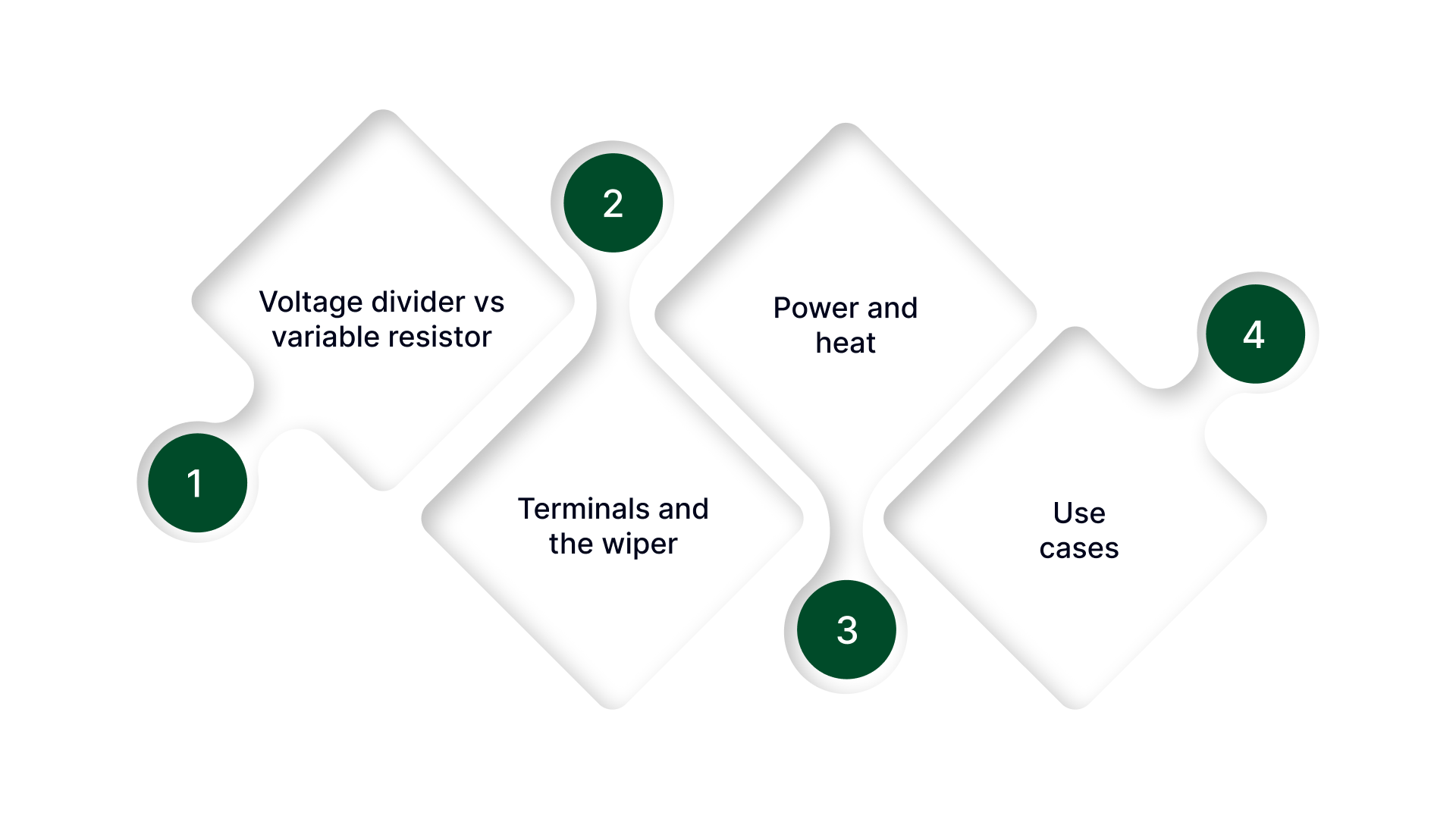
Voltage divider vs variable resistor
A potentiometer is usually used to produce a controlled voltage. You apply a voltage across the two end terminals. The wiper “picks off” a portion of that voltage. The circuit reads that wiper voltage as a setpoint or signal.
A rheostat is used in series to change how much current flows. It does that by changing resistance in the current path. That extra resistance causes a voltage drop and turns power into heat. That’s why rheostats are often larger and rated in watts.
Terminals and the wiper (why 3 vs 2 matters)
A potentiometer has three terminals because it’s designed to be a divider. Two terminals sit at the ends of the resistive track. The third terminal is the wiper, which moves as you turn the shaft.
A rheostat usually uses two terminals in the circuit. It still relies on a wiper, but it uses it differently. The wiper becomes one end of the “adjustable resistor,” and the other end is one fixed terminal. You are not trying to create a stable output voltage. You’re trying to change resistance in series.
Power and heat (the #1 selection trap)
Any time you put a variable resistor in the load path, it has to dissipate power. That power becomes heat. The key spec is the watt rating. If the application can exceed that rating, the part runs hot, drifts, or fails.
Heat also changes reliability. It dries lubricants, stresses the resistive element, and accelerates wear at the wiper contact. That’s why “looks the same” is not a safe way to choose between these parts.
Use cases (signal control vs load control)
Choose a potentiometer when:
You need an adjustable reference or setpoint going into electronics (PLC input circuit, drive reference input, controller trim).
You want a predictable output voltage from the wiper.
The current is small (signal-level).
Choose a rheostat when:
You need to change the current through a load using a series resistance.
The application is legacy or purpose-built for resistive control.
You can support the wattage and heat safely.
Next, let’s tackle the question that causes the most confusion in retrofits: can you use a potentiometer as a rheostat, and when is that a bad idea?
Can a potentiometer be used as a rheostat?
Yes, sometimes. This is common in retrofits and quick fixes. But it only works when the circuit goal and the ratings line up.
When it works (simple rule)
A potentiometer becomes “rheostat-like” when you use it as a two-terminal adjustable resistor instead of a three-terminal voltage divider. In plain terms, the circuit uses the wiper plus one end of the resistive element, so turning the shaft changes the resistance seen in series.
This works best in low-power, low-current situations. Think trimming a small signal path or limiting current in a light-duty circuit—not driving a load that dumps real heat into the part.
Two gotchas you must check
Power and heat (watts + duty cycle)
A pot can look fine on the outside and still be the wrong part. If it sits in the load path, it will burn power as heat. That heat causes drift and early failure. Check the watt rating and think about duty cycle (minutes per hour, continuous vs occasional). If the part runs warm in normal operation, you’re already close to the edge.
Reliability and failsafe behavior (what happens if the wiper loses contact)
Wipers wear. Vibration, dust, and time make it worse. If the wiper momentarily loses contact, the circuit can “jump” to an extreme condition depending on how it’s connected. That can mean a sudden change in speed, flow, brightness, or current. In other words, it may work on the bench, then act flaky on the machine.
Practical takeaway: Using a pot as a rheostat is fine for the right low-power job. If you need real load control or predictable behavior over time, choose a component that’s rated for the current and heat you’re asking it to handle.
How to Choose the Right One: Checklist
Use this like a quick pre-purchase check. If you can answer these, you’ll usually pick the right part the first time.

What are you controlling: a signal or a load?
If you’re feeding a controller input or setting a reference voltage, you’re in potentiometer territory. If the component sits in series with a load to limit current, you’re in rheostat territory (or you may want a different control method).
What resistance range do you need (ohms)?
Match the circuit requirement. Too low and you won’t get enough adjustment. Too high and the circuit may become noisy or unresponsive.
How much power will it dissipate (watts), and for how long (duty cycle)?
This is the make-or-break spec for anything acting like a rheostat. Estimate worst-case dissipation and compare it to the part’s watt rating. Continuous load control demands far more margin than “occasional trim.”
Do you need a linear or audio taper? (only if it matters)
Most industrial setpoint and calibration uses want a linear taper. Audio taper shows up in sound/level controls. If the response feels “bunched up” at one end, taper is often why.
What’s the environment like?
Dust, oil mist, moisture, and vibration shorten life. If it lives on a moving machine or near contaminants, prioritize rugged construction and stable mounting.
What failure mode do you prefer?
Think about what happens if the wiper opens or the connection gets noisy. In some systems, you want “fail low.” In others, you want “fail high.” The wiring approach and component choice should support a safer outcome for your process.
If you’ve checked the function, the ohms, and the wattage, the last question is simple: do you need to turn that “knob” by hand, or does it need to be adjustable remotely and repeatably? That’s where motorized options come in.
Motorized potentiometer vs motorized rheostat
If the knob needs to be adjusted without opening the panel and still hit the same setpoint every time, go motorized.
Quick selection rules
Choose a motorized potentiometer when the circuit expects a control signal (setpoint/reference/trim). You’re automating a stable adjustable voltage, not dumping power as heat.
Choose a motorized rheostat only when the application truly needs variable resistance in the load path, and the unit is rated to handle the current and heat without drifting or failing early.
Why teams choose On Line Controls for motorized control
Retrofits fail when the replacement is “close enough” on paper but wrong in the real world. On Line Controls focuses specifically on motorized adjustment hardware built for panels and legacy upgrades.
What they offer
Motorized Potentiometers (MotorPots) for setpoints and control signals (speed references, flow trims, tension setpoints, calibration). These units pair a potentiometer with a motor/geartrain and use a slip clutch to protect end stops while still allowing manual adjustment when needed.
Motorized Rheostats for true resistance-based load control, available in common industrial wattages like 25W, 50W, and 100W.
What this solves
Replacing a legacy “mystery knob” with a dependable match that behaves correctly in the circuit.
Moving adjustments out of the panel and into a safer, more controlled workflow.
Getting the same setting across operators, shifts, and product runs.
Eliminating “bump it until it feels right” tuning.
If this is a retrofit, grab the part number (or take a quick photo) and use On Line Controls’ motorized potentiometer and motorized rheostat product pages to narrow the closest match.
Reach out if you want help locking the exact configuration.
Common mistakes
Before you order a replacement or make wiring changes, watch for these common mistakes that often lead to unstable performance or repeat failures.
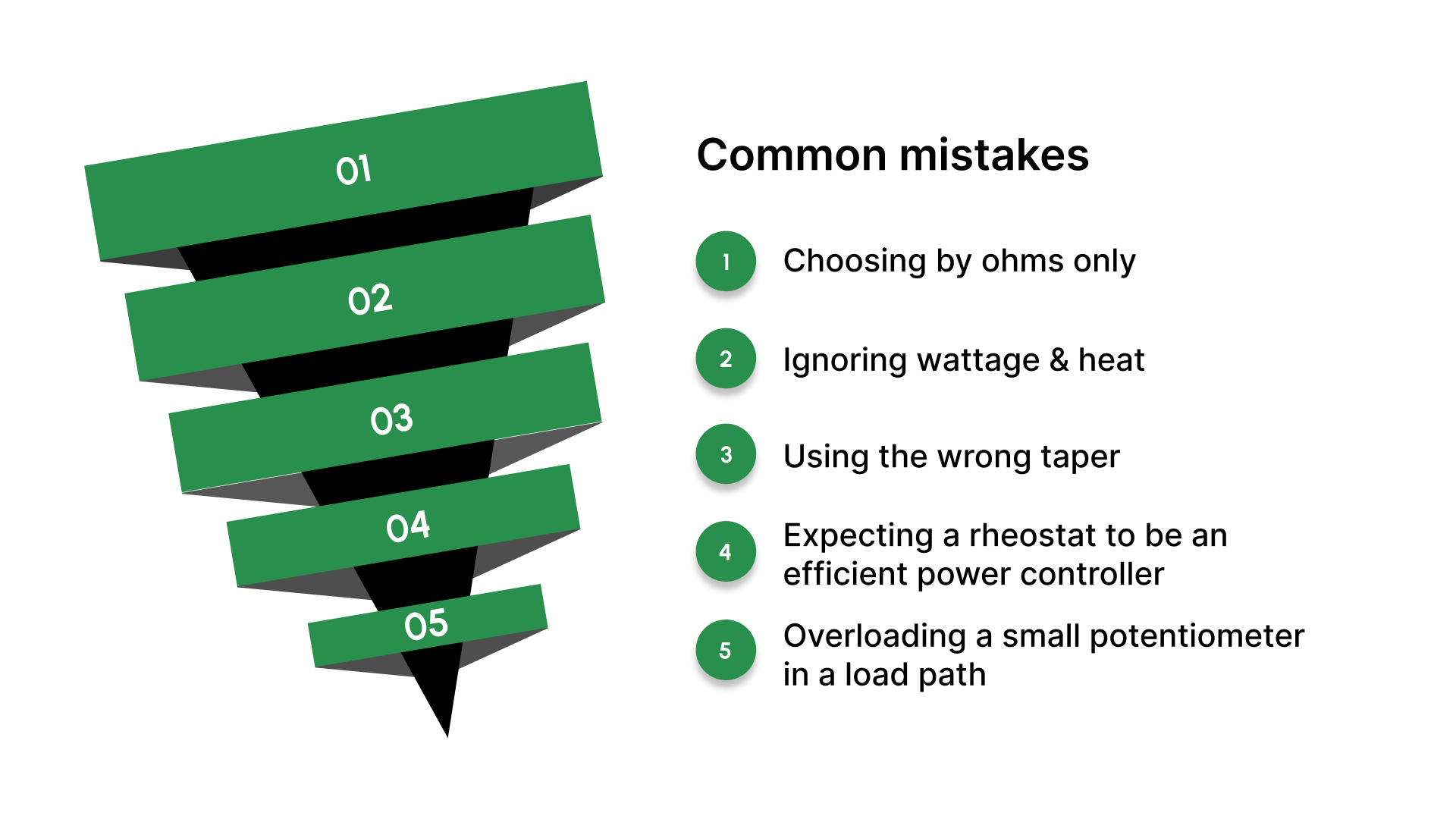
Choosing by ohms only
Ohms tells you the adjustment range. They don’t tell you if the part will survive the job.
Ignoring wattage and heat
Anything used like a rheostat can turn power into heat fast. If the watt rating is wrong, failure is only a matter of time.
Using the wrong taper
Most industrial setpoints want a linear taper. If the adjustment feels useless for half the turn and too sensitive at the end, taper is a likely culprit.
Expecting a rheostat to be an efficient power controller
A rheostat controls by wasting power as heat. It can work in the right legacy setup, but it’s not the efficient approach for most modern motor/heater control.
Overloading a small potentiometer in a load path
This is the classic “it worked for a week” problem. Many pots are built for signals, not load current. They overheat, drift, get noisy, or burn out.
Avoid these, and the choice usually becomes straightforward.
Conclusion
Once you know what the adjustment is doing, the choice becomes clear. Match the component to the job, confirm it can handle the electrical and thermal load, and avoid “looks similar” substitutions.
If the setting needs to change on command or stay consistent without manual tweaking, motorized adjustment is often the most reliable next step.
FAQs
Can a potentiometer be used as a rheostat?
Yes, in many cases. You use it as a two-terminal adjustable resistor instead of a three-terminal divider. The limiting factor is usually power and heat, so confirm the rating fits the job.
What is the main difference between a rheostat and a potentiometer?
A potentiometer is typically used as a voltage divider to provide an adjustable output voltage. A rheostat is used as a variable resistor in series to change current by changing resistance.
Why does a potentiometer have 3 terminals?
Two terminals connect to the ends of the resistive element. The third terminal is the wiper, which moves along that element and provides the adjustable output point.
Which one is used for current control?
A rheostat is the more typical choice because it changes resistance in series with the load, which changes the current.
Do rheostats handle higher power than potentiometers?
Often, yes. Rheostats are commonly built for higher power dissipation, while many potentiometers are signal-level parts. Always check the specific watt rating rather than assuming.