
Introduction
Analog control panels remain widely used in manufacturing and process control despite digital alternatives. These systems often require manual adjustment of potentiometers for setpoint changes, speed control, or process variables.
With 54% of Distributed Control System users citing obsolescence as a major replacement driver, facilities face a critical choice: expensive complete system replacement or strategic automation of existing infrastructure.
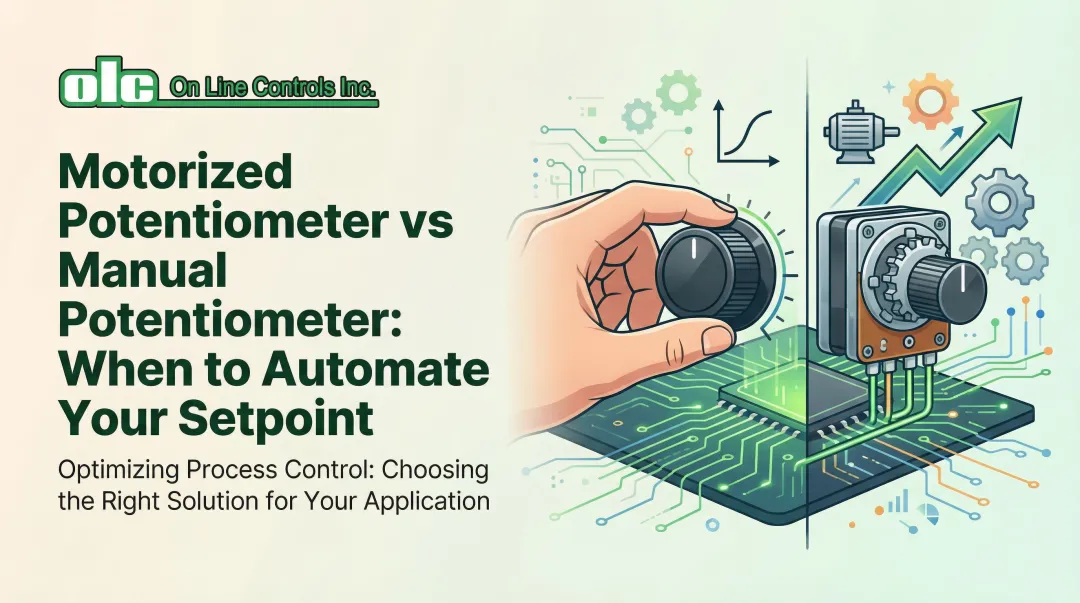
Motorized potentiometers have emerged as a bridge technology that preserves analog control architecture while enabling remote automation and integration with modern control systems.
Manual potentiometer adjustment creates bottlenecks in production environments. It requires operator presence for changes and limits integration with PLCs, SCADA systems, or automated process sequences.
This guide explains how motorized potentiometers automate analog control panels, covering the mechanical and electrical principles behind remote positioning and feedback.
Key Takeaways
- Motorized potentiometers add a DC motor and feedback system to standard pots for remote automated control
- Accept standard control signals (4-20mA, 0-10V, PWM) from PLCs and translate to precise shaft positions
- Achieve high-accuracy positioning within ±0.1% through closed-loop feedback control
- Common applications include process control automation, DC motor speed control, analog signal conditioning, and retrofitting legacy control panels
- Motorized pots eliminate manual adjustment while preserving existing analog control circuitry, making them cost-effective automation solutions
What Is a Motorized Potentiometer?
A motorized potentiometer is an electromechanical device that combines a standard potentiometer (variable resistor) with a DC motor and position feedback system. This allows remote electronic control of resistance or voltage output.
Traditional potentiometers require manual rotation to adjust resistance, which is impractical for remote locations, automated sequences, or applications requiring frequent adjustment based on process conditions.
What They Are NOT
Motorized potentiometers serve a distinct function compared to similar-sounding devices:
- Not encoders — which only measure position without providing variable resistance
- Not servo motors — which provide torque and positioning but not resistance changes
- Not digital potentiometers — which use electronic switching rather than mechanical wipers
Why They Remain Relevant
These devices offer several key advantages:
- Automate existing analog control circuits without complete system redesign
- Provide true analog output important for legacy equipment
- Offer fail-safe mechanical positioning that retains the last setting during power loss
With the market for analog panel meters and controls continuing to grow despite digitization trends, motorized potentiometers fill a critical gap for facilities with functional analog infrastructure.
Main Types and Specifications
Understanding the specifications helps determine which type best fits your application needs.
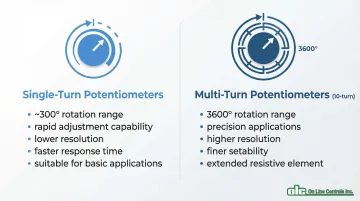
Single-Turn vs. Multi-Turn:
- Single-turn models: Approximately 300° rotation, suitable for rapid adjustment but lower resolution
- Multi-turn (10-turn): Common for precision applications, providing significantly higher resolution and setability due to the longer resistive element
Typical Specifications:
| Parameter | Range | Notes |
|---|---|---|
| Resistance | 100Ω to 100kΩ | Common values: 1kΩ, 10kΩ, 100kΩ |
| Power Rating | 0.5W to 5W | Higher wattage for wirewound models |
| Motor Voltage | 6-24V DC, 115V AC | Varies by model and application |
| Operating Temp | -10°C to +65°C | Extended ranges available for harsh environments |
| Control Input | 4-20mA, 0-10V, PWM | Current loop most common in industrial settings |
How Does a Motorized Potentiometer Work?
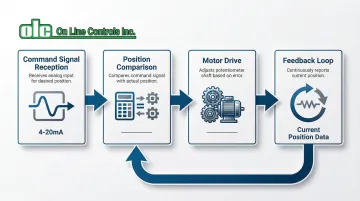
Motorized potentiometers operate through a closed-loop control system that compares a command signal to actual shaft position, driving a motor to eliminate any position error while the potentiometer wiper tracks the shaft movement.
Initiation (Command Signal Reception)
A control board receives command signals from external sources—PLC analog outputs, manual control stations, or automated sequences—typically as 4-20mA current loop, 0-10V DC, or PWM signals.
The 4-20mA current loop remains the standard for industrial integration due to superior noise immunity and inherent fault detection through its "live zero" (4mA baseline allows immediate detection of wire breaks at 0mA).
Control electronics translate the input signal into a target position:
- 4mA = 0% rotation
- 12mA = 50% rotation
- 20mA = 100% rotation
Continuous monitoring initiates motor movement whenever commanded position differs from actual position by more than the deadband threshold (typically 0.5-2% of full scale).
Core Operation (Motor Drive and Position Control)
A DC motor (typically 12V or 24V) drives the potentiometer shaft through a gear reduction system. A dedicated feedback potentiometer measures actual shaft position and reports it to the control board.
Comparing command position to feedback position, the control board energizes the motor in the appropriate direction (clockwise or counterclockwise) and modulates speed based on position error magnitude—faster for large errors, slower as the target approaches.
Gear Reduction Mechanism:
Most motorized pots use 100:1 to 500:1 gear ratios to convert high-speed, low-torque motor rotation into slow, high-torque shaft movement. This enables:
- Precise positioning control
- Sufficient force to overcome wiper friction
- Mechanical resistance management
- Timing customization from 41:1 up to 235,067:1 ratios
Travel Time Examples:
- Fast response models: 12 ±3 seconds full scale
- Process control models: 10 to 300 seconds adjustable
- Variable speed models: 0.8 to 6 RPM (75 to 10 seconds per revolution)
Regulation and Positioning Accuracy
This closed-loop feedback system ensures consistent accuracy throughout operation. The feedback potentiometer (separate from the user-accessible output pot) provides continuous position data, creating a servo loop that corrects for mechanical backlash, load variations, and external disturbances.
Deadband and Resolution:
Controllers implement adjustable deadbands to prevent "hunting" (oscillation around the setpoint):
- Industrial deadband settings: 6-25% of wiper voltage
- Motor activates only when error exceeds threshold
- Prevents premature wear on gears and resistive elements
- Maintains positioning resolution of 0.1-0.5% of full scale
High-precision models achieve independent linearity of ±0.1% and repeatability better than 0.01°, suitable for demanding industrial applications.
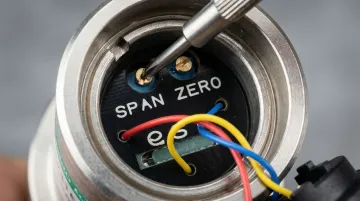
Calibration Capabilities:
Most motorized pots include trim adjustments for:
- Span — mapping 4-20mA to less than full mechanical rotation
- Zero offset — adjusting starting position
- Adaptation to applications using only a portion of the pot's range
Output and Integration
User-accessible potentiometers provide variable resistance or voltage division exactly as manual pots would, feeding analog control circuits, bridge circuits, or serving as setpoint references.
The pot's resistance or voltage output controls downstream equipment (motor drives, heaters, valve positioners) while the positioning system ensures this output tracks the remote command signal.
Many motorized pots include limit switches or cam switches that trigger at programmed rotation angles, providing discrete on/off signals for sequencing or status indication alongside the analog output.
Where Motorized Potentiometers Are Used
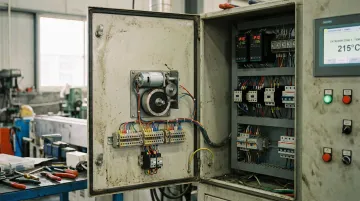
Motorized pots most commonly appear in control panels for legacy equipment automation and process variable adjustment. They excel at controlling temperature setpoints, pressure references, speed commands, and applications requiring smooth ramping between setpoints.
Understanding environmental requirements helps ensure reliable operation.
Optimal Operating Environments
Motorized pots perform best in controlled environments—industrial control cabinets and electrical enclosures—with stable temperatures (-10°C to +65°C typical). Ruggedized versions operate from -30°C to +85°C for harsh conditions.
They suit applications requiring moderate positioning speed (5 seconds to several minutes full-scale) rather than rapid response.
Key Application Areas
DC Motor Field Control: Gradual current ramping during startup prevents mechanical stress and electrical surges while enabling automated startup sequences.
Analog Process Controllers: Setpoint automation for temperature, pressure, and flow control enables remote adjustment and system integration.
Test Equipment: Programmable resistance decades automate testing sequences, improving repeatability and reducing test time.
Audio Equipment Automation: Remote volume and tone control in professional mixing consoles allow saving and recalling settings.
Plastic Extrusion Lines: Process parameters require frequent adjustment based on material or product changes. On Line Controls manufactures motorized potentiometers specifically for plastic tubing and pipe extrusion, providing the same 10-20+ year service life found in the company's MicroAir pressure regulator line.
Conclusion
Motorized potentiometers automate analog control panels by combining motor-driven positioning with feedback control. They translate standard industrial control signals into precise mechanical shaft positions that adjust resistance or voltage outputs.
This bridge technology preserves functional analog infrastructure while enabling remote control and automation in modern manufacturing environments. Engineers can evaluate whether motorized pots suit their specific needs by considering:
- Analog circuit preservation requirements
- Remote control and automation needs
- Positioning accuracy specifications
- Cycle time and resolution demands
- Control signal type compatibility
With cycle life ratings reaching 100 million movements for precision models and design lifespans of 10-20 years, these devices offer a cost-effective alternative to complete system replacement. They extend the productive life of proven analog control systems while delivering the automation capabilities modern operations require.
Frequently Asked Questions
What is the difference between a manual potentiometer and a motorized potentiometer?
Manual pots require hand rotation to change resistance, while motorized pots use a DC motor and control electronics to position the shaft remotely via electrical signals. Motorized versions enable automated control while typically retaining manual override capability.
Can motorized potentiometers be retrofitted to existing control panels with manual pots?
Retrofitting is possible but requires additional panel space, control signal wiring, and power supply (typically 24V DC). New installations are generally more practical due to dimensional differences and integration complexity.
What control signal types do motorized potentiometers accept?
Common input types include 4-20mA current loop (most common in industrial settings), 0-10V DC or 0-5V DC voltage signals, PWM (pulse width modulation), and some models accept control from an external manual potentiometer for local/remote operation switching.
How accurate are motorized potentiometers for process control applications?
Typical positioning accuracy is 0.25-1% of full scale with repeatability of 0.1-0.5%, adequate for most analog control applications. They aren't suitable for applications requiring encoder-level precision.
What industries and applications most commonly use motorized potentiometers?
Primary users include plastic extrusion (process setpoint control), DC motor control systems (field current ramping), industrial heating (temperature controller setpoint automation), test and measurement equipment (programmable resistance), and legacy equipment automation where analog control must be preserved.
What is the typical lifespan and maintenance requirement for motorized potentiometers?
Quality motorized pots typically last 10-20+ years in industrial applications with minimal maintenance. The motor operates only during adjustments, and sealed mechanisms prevent contamination, with conductive plastic elements offering up to 100 million movements.