Introduction
Unplanned downtime costs industrial facilities as much as $125,000 per hour, yet studies show nearly 80% of audited control loops fail to reduce process variability adequately. Imprecise control creates a cascade of problems: product defects, material waste, safety incidents, and costly production stoppages.
The solution lies in proven analog technology. Despite the rise of digital alternatives, analog control potentiometers remain essential components in automation systems requiring continuous, real-time feedback.
These devices deliver benefits critical to manufacturing success:
- Smooth, proportional control for processes where slight variations impact product quality
- Real-time adjustment capability without digital conversion delays
- Reliable performance in demanding industrial environments
- Simple integration with existing control systems
From medical device manufacturing to aerospace and automotive production, analog potentiometers provide the accuracy that modern industry demands.
Key Takeaways
- Analog control potentiometers convert mechanical position into electrical signals, enabling precise process control with theoretically infinite resolution
- Superior reliability and real-time response make them ideal for industrial applications requiring continuous adjustment
- Linear taper models suit proportional control, while motorized variants enable automated adjustment in extrusion systems
- Selection criteria include linearity specs (±0.1% to ±5%) and lifecycle ratings (2 million to 100 million cycles)
- Industrial automation drives 28%+ of the $4.74 billion global potentiometer market projected by 2035
What Are Analog Control Potentiometers?
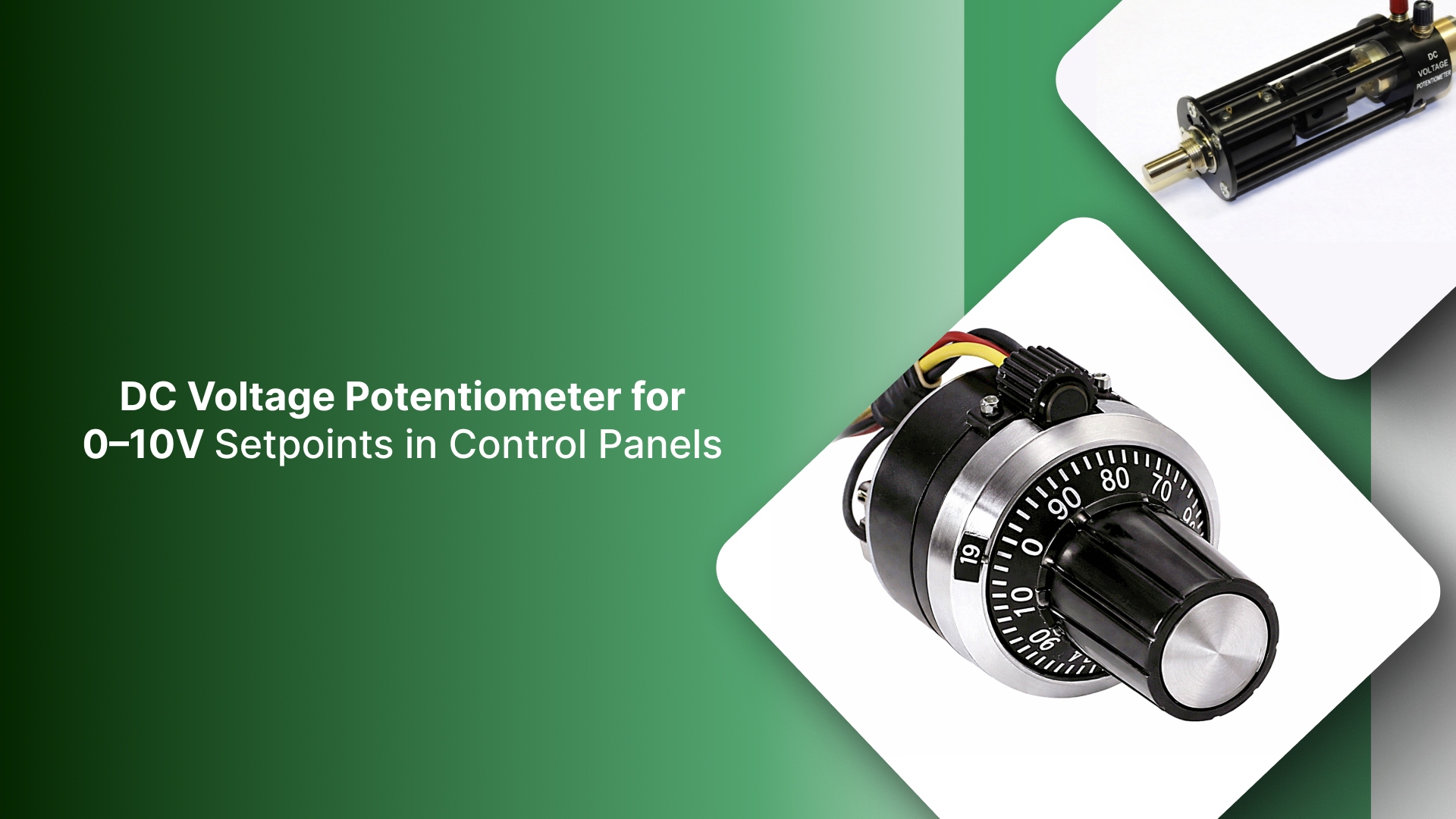
Analog control potentiometers are **three-terminal variable resistors** that convert mechanical position into electrical signals for automation systems. In extrusion lines and precision manufacturing, these devices enable dynamic process control by providing continuously adjustable resistance values.
Unlike fixed resistors, potentiometers adapt in real-time to changing production conditions.
Operating Principle
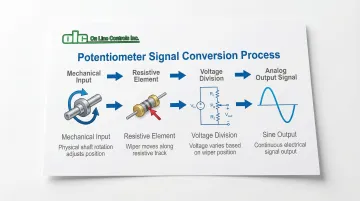
The basic construction consists of a resistive element with a sliding wiper that creates a voltage divider matching its position.
When voltage is applied across the outer two terminals, the wiper terminal outputs a voltage that varies linearly (or logarithmically, depending on taper) with its position. This proportional output enables precise feedback control in automated systems.
Key Components
The performance and longevity of potentiometers depend on their internal components.
Resistive Element Technologies:
- Carbon composition: Cost-effective for general applications
- Wirewound: High power handling and low temperature coefficients, but limited resolution
- Conductive plastic: Theoretically infinite resolution and extended life (up to 50 million cycles)
- Cermet: Balanced stability and high-temperature resistance
Additional Components:
- Wiper mechanism for mechanical-to-electrical conversion
- Protective housing (often IP65 or IP67 rated for industrial environments)
- Electrical terminals with gold plating for reliable connections
The variable resistance capability is essential for applications like valve position control, servo feedback, and process parameter adjustment—functions that fixed resistors cannot perform. In extrusion control systems, motorized potentiometers from manufacturers like On Line Controls enable automated adjustments to maintain precise tubing dimensions throughout production runs.
How Potentiometers Enable Precision in Industrial Automation
Continuous Analog Feedback
Analog potentiometers provide continuous feedback for closed-loop control systems, enabling real-time adjustments without the discrete steps built into digital encoders. This smooth, uninterrupted signal is critical for applications requiring seamless control response.
Resolution Capabilities
Modern conductive plastic potentiometers offer essentially infinite resolution, limited only by mechanical precision and electrical noise rather than discrete steps.
This allows for extremely fine control adjustments—essential in applications like:
- Medical device manufacturing: Where micron-level precision affects device performance and patient safety
- Aerospace: Where flight control surfaces require exact positioning
- Automotive: Where assembly line robotics demand repeatable accuracy
Linearity and Predictability
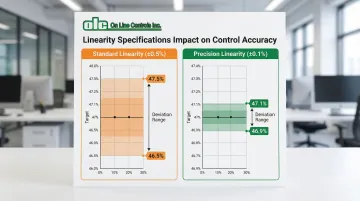
Independent linearity specifications of ±0.1% to ±0.2% ensure predictable, proportional control responses. High-precision models achieve this tight linearity through advanced manufacturing techniques and superior materials.
This enables control systems to accurately predict output based on input commands.
Applying Precision in Practice
These specifications translate directly to real-world performance. The relationship between mechanical position and electrical output creates a direct, intuitive control interface.
When a valve needs to be 47% open, a linear potentiometer with ±0.2% linearity will provide that exact position within tight tolerances. This precision becomes critical when the slightest pressure change can cause significant product variations, particularly in thin-walled tubing extrusion where dimensional consistency is paramount.
Types of Potentiometers for Industrial Applications
Linear Taper Potentiometers
Linear taper potentiometers provide proportional resistance change across the entire rotation or travel range. The resistance varies directly with position, making them ideal for:
- Position sensing in linear actuators and robotic arms
- Proportional valve control in process plants
- Servo feedback systems requiring absolute position data
- Setpoint adjustment where operators need intuitive, predictable response
Logarithmic Taper Potentiometers
Logarithmic (audio) taper potentiometers feature a non-linear resistance curve. Resistance changes slowly at one end and rapidly at the other.
While primarily used in audio applications to match human hearing perception, they find industrial use in:
- Process control applications where logarithmic scaling matches process characteristics
- Systems compensating for non-linear process variables
- Applications requiring fine adjustment at one end of the range and coarse adjustment at the other
Motorized Potentiometers
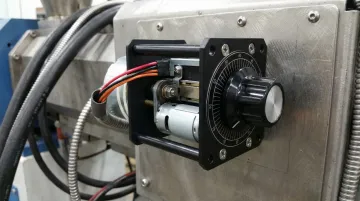
Motorized potentiometers combine precision position control with integrated motor drives for automated adjustment. These devices integrate a linear potentiometer, slip clutch, geartrain, and motor in a single panel-mount assembly.
These units offer adjustable run-up and run-down times from 10 to 300 seconds, enabling precise control. They support both automatic remote control and manual adjustment, with DC options (6, 12, 24 VDC) and AC options (115 VAC) at various RPM settings. Slip clutch protection prevents damage and enables manual override during operation.
Common applications include:
- Plastic extrusion control where remote adjustment of process parameters is essential
- Process automation in environments where manual adjustment isn't practical or safe
- Speed controls, flow meters, and tensioning motors in manufacturing
- Oil rigs, power plants, aircraft, medical equipment, and robotics
OLC (On Line Controls, Inc.) specializes in motorized potentiometers designed for demanding industrial applications. Units are built to last 10-20 years using Japanese-made potentiometers, Swiss-made motors, and heavy-duty components.
Key Specifications for Industrial Automation
Electrical Specifications
Industrial potentiometers offer resistance values from 10Ω to 10MΩ, with common standard values of 1kΩ, 5kΩ, 10kΩ, and 50kΩ. Selecting the right resistance range ensures compatibility with your control circuitry and signal requirements.
Power ratings range from 1W to 5W at 70°C—significantly higher than consumer-grade components. Higher ratings allow operation in demanding applications without heat damage.
Key electrical parameters include:
- Tolerance: ±5% to ±10% standard; ±1% or better for precision models
- Temperature coefficient: Indicates resistance change per degree Celsius
- Wirewound elements provide the lowest temperature coefficients for stable performance across temperature ranges
Mechanical Specifications
Rotation angle determines resolution and control range. Single-turn models provide 360 degrees of adjustment, while multi-turn options (3-turn or 10-turn) offer finer resolution for precise applications.
Linearity measures how closely resistance changes match the physical rotation. Standard industrial models achieve ±0.5% to ±5%, while high-precision models reach ±0.1% to ±0.2%.
Operational lifespan varies significantly by construction type:
- Standard wirewound: 25,000 to 100,000 cycles
- High-endurance cermet: 2 million cycles
- Conductive plastic: 10 to 50 million cycles
- Heavy-duty linear: Up to 100 million cycles
Mechanical torque must match your application requirements to prevent premature wear or control difficulty.
Environmental Ratings
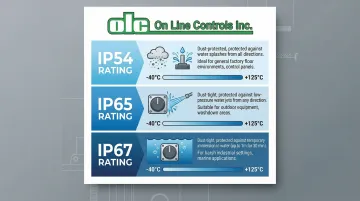
Environmental protection ensures reliable operation in harsh industrial conditions. The IEC 60529 IP rating system defines protection levels:
- IP65: Dust-tight with water jet protection for general industrial use
- IP67: Dust-tight with immersion protection for washdown or outdoor areas
Industrial models typically operate from -40°C to +125°C, with specialized units rated higher for extreme environments.
Vibration and shock resistance are critical for mobile equipment. Industrial units withstand 50g shock and 20g vibration, preventing failures in high-vibration applications.
Sealed housings protect against dust, moisture, and chemical ingress that degrade performance or cause premature failure.
Analog vs Digital Control: Choosing the Right Solution
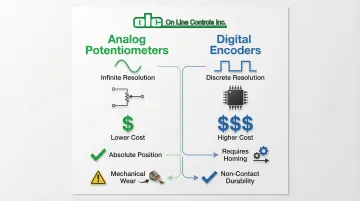
Comparison Matrix
| Feature | Analog Potentiometer | Digital Encoder |
|---|---|---|
| Output Signal | Continuous analog voltage | Digital pulses |
| Resolution | Theoretically infinite (conductive plastic) | Discrete steps (bit-count dependent) |
| Cost | Lower | Higher |
| Integration | Simple—no A/D conversion for analog loops | Requires digital processing |
| Position Memory | Absolute position retained on power loss | Incremental types require homing |
| Wear | Mechanical contact causes gradual wear | Non-contact (optical/magnetic) offers longer life |
| Complexity | Minimal—voltage divider circuit | Higher—requires microprocessor interface |
When Analog Potentiometers Excel
The table above highlights key differences, but practical application requirements determine the best choice. Analog potentiometers offer distinct advantages in several scenarios:
Simple analog control loops: Potentiometers integrate directly without microprocessor interfaces, making them ideal for straightforward voltage-based control systems.
High-reliability environments: Fewer electronic components mean fewer failure points. This simplicity proves critical in safety systems and remote installations where maintenance access is limited.
Legacy equipment: Existing analog control systems accept potentiometer signals directly, eliminating expensive interface hardware and retrofit costs.
Immediate position feedback: Potentiometers provide absolute position data instantly upon power-up. Incremental encoders require homing sequences before operation can begin.
Budget constraints: Analog potentiometers cost significantly less than digital encoders with comparable resolution, making them cost-effective for applications where digital communication isn't required.
When Digital Solutions May Be Preferable
Digital encoders excel in different contexts:
Applications requiring frequent adjustments benefit from remotely programmable parameters. Systems built around microprocessors integrate more naturally with digital position sensors than analog signals. When control architectures already use Modbus, CANbus, or similar protocols, digital encoders eliminate A/D conversion steps.
CNC machining and advanced robotics may require the non-contact durability and high-speed capability of optical encoders. These applications demand extreme precision at velocities where mechanical contact would cause unacceptable wear.
Common Industrial Applications
Process Control Systems
Analog potentiometers serve as setpoint adjusters and feedback sensors for critical process parameters:
- Flow rate control: Valve position feedback ensures precise flow regulation
- Pressure setpoints: Operators adjust target pressures for pneumatic and hydraulic systems
- Temperature control: Potentiometers set heating/cooling system targets
- Valve positioning: Continuous feedback enables exact valve opening percentages
Motion Control and Robotics
Position feedback is essential for accurate motion control:
- Robotic joint positioning: Potentiometers provide absolute position data for each axis without homing
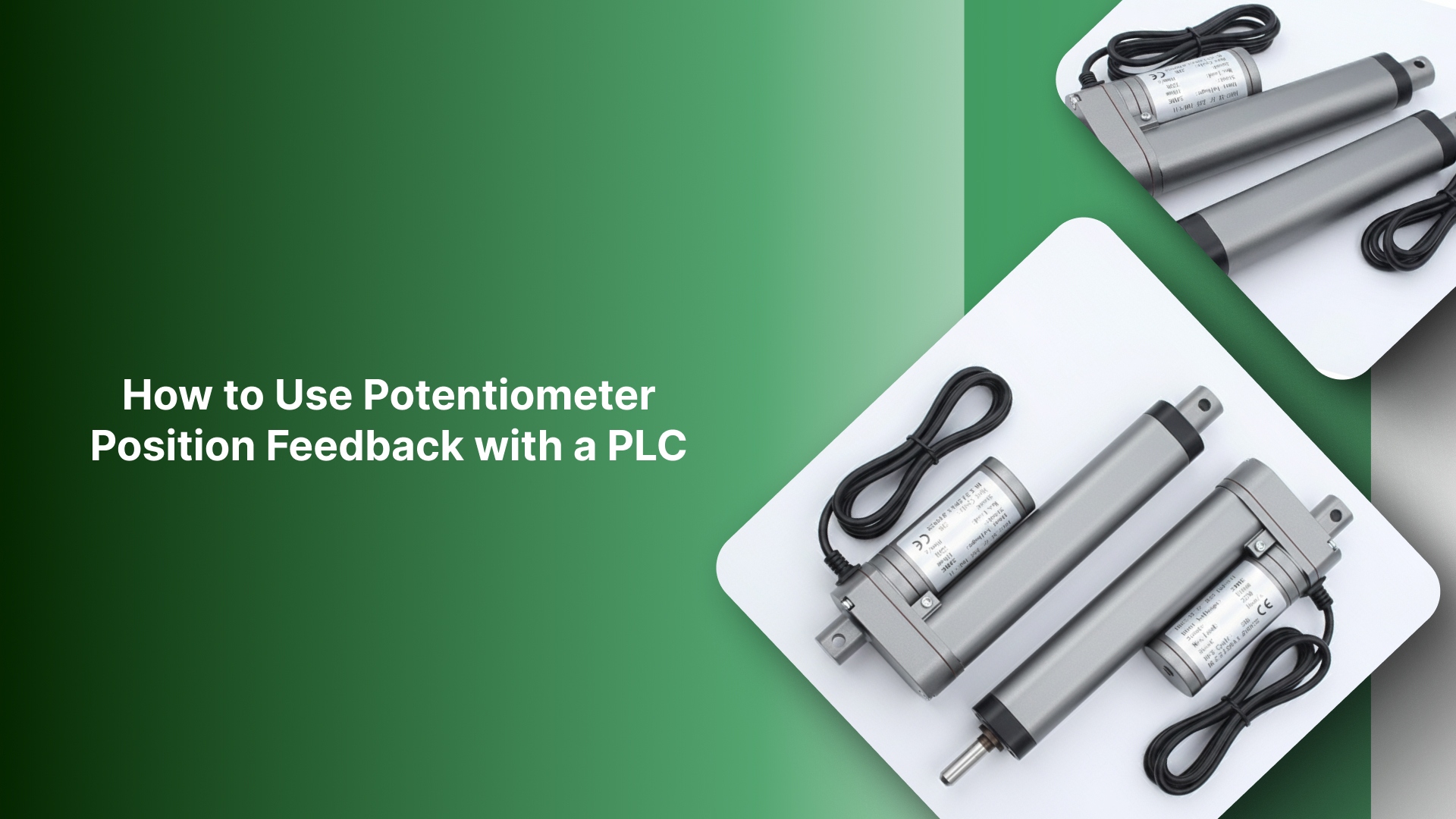
- Linear actuator feedback: Track exact extension/retraction in automated systems
- Speed control: Variable resistance adjusts motor speed in conveyor and drive systems
- Trajectory planning: Real-time position data enables smooth motion profiles
Specialized Manufacturing Applications
Beyond general motion control, potentiometers address specific challenges in specialized production environments.
Plastic Extrusion Control
Motorized potentiometers enable remote adjustment of extrusion parameters where even slight pressure variations affect product quality.
OLC's motorized potentiometers for plastic tubing extrusion provide run-up and run-down times from 10 to 300 seconds for precise control.
Material Handling Systems
Joystick controls for forklifts and cranes, plus dancer arm position feedback for tension control in web processing (paper, plastic film).
Automated Assembly Lines
Position sensors track component placement, ensuring proper alignment and assembly quality in high-speed production environments.
Frequently Asked Questions
What's the difference between a potentiometer and a rheostat in industrial automation?
Rheostats use only two terminals (one end and the wiper) for current control, while potentiometers use all three terminals for voltage division. Potentiometers are preferred for control signals and feedback, while rheostats handle higher power applications like motor speed control.
How long do industrial potentiometers typically last?
Wirewound models offer 25,000 to 2 million cycles, while conductive plastic models achieve 10 to 100 million cycles. Longevity depends on operating environment, wiper current, vibration, and contamination. Premium industrial units can operate for 10-20+ years.
Can potentiometers be used in harsh industrial environments?
Yes. Sealed versions with IP65 or IP67 ratings withstand dust, moisture, vibration, and temperature extremes from -40°C to +125°C. Choose models with metal housings and sealed shafts for demanding conditions.
How do I select the right potentiometer taper for my application?
Choose linear taper for proportional control applications like position sensing, valve control, and setpoint adjustment. Logarithmic taper is rarely used except when compensating for specific non-linear process variables.
What causes potentiometer failure in industrial settings?
Common failure modes include wiper wear, contamination from dust or moisture, mechanical damage from shock or vibration, and electrical overstress. Proper specification and environmental protection minimize these risks.
Are analog potentiometers still relevant with modern digital control systems?
Absolutely. Analog potentiometers remain valuable for their simplicity, lower cost, and inherent reliability. They interface easily with both analog control loops and digital systems through ADCs. The global potentiometer market is projected to reach $4.74 billion by 2035, with manufacturers like On Line Controls continuing to supply motorized potentiometers for precision extrusion control applications.