
Introduction
When position feedback fails during a critical production run, the consequences cascade quickly. Machine failures cost large industrial facilities approximately 323 production hours annually, with downtime averaging $532,000 per hour. For manufacturers running continuous extrusion processes, even brief sensor failures can ruin entire production batches.
Rotary feedback devices—sensors that convert mechanical rotation into electrical signals—represent a critical control point in industrial equipment. A failed potentiometer in an extrusion line or worn encoder in a positioning system can halt production instantly.
Choosing the right feedback technology determines whether equipment delivers years of reliable service or becomes a maintenance liability. This article examines how rotary encoders, resolvers, and potentiometric feedback systems perform in demanding industrial environments, helping you select solutions that balance reliability with total cost of ownership.
TLDR: Key Takeaways
- Rotary feedback devices convert shaft rotation into electrical signals to monitor position, speed, and direction in control systems
- Incremental encoders track relative position; absolute encoders retain exact position data even after power loss
- Magnetic encoders handle contaminated environments best. Optical types deliver highest precision. Resolvers survive extreme conditions
- Marine equipment requires sealed, corrosion-resistant encoders certified for harsh saltwater environments
- Absolute encoders typically deliver lower total ownership costs despite higher upfront pricing
Understanding Rotary Feedback Devices
Rotary feedback devices are electro-mechanical sensors that translate shaft rotation into usable electrical data. These devices monitor a rotating shaft and generate electrical signals—either analog voltages or digital pulses—that indicate position, speed, or direction of rotation.
The fundamental working principle involves a sensing disc or element attached to the shaft that rotates past stationary sensors, which then convert this mechanical motion into electrical signals that control systems can interpret.
Critical Role in Closed-Loop Control
These feedback devices form the backbone of closed-loop control systems for motors, actuators, and positioning systems across industrial and marine applications. In a closed-loop system, the controller continuously compares the desired position or speed against the actual position reported by the feedback device, then adjusts motor commands to eliminate any error.
This constant feedback loop enables:
- Precise positioning accuracy for robotic arms and CNC machinery
- Speed regulation for conveyors and material handling systems
- Synchronization of multiple axes in complex automation
- Compensation for mechanical wear, backlash, and thermal expansion
Preventing Costly Downtime
The financial impact of feedback device failure is severe. Fortune Global 500 manufacturers lose an estimated $864 billion annually (approximately 8% of revenues) to unplanned downtime, with 83% of industry decision-makers reporting that equipment interruptions cost at least $10,000 per hour.
Automotive manufacturers face especially high risks, losing approximately $1.3 million per hour during production stoppages.
Robust rotary feedback systems directly address these risks by enabling predictive maintenance strategies. Maintenance teams can monitor feedback signal quality and detect early signs of degradation, then schedule replacements during planned downtime rather than responding to catastrophic failures.
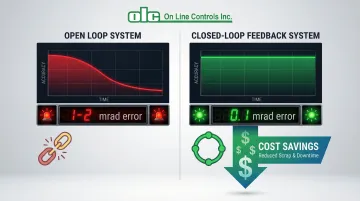
Research on heliostat tracking systems demonstrates that closed-loop feedback can reduce tracking error from 1-2 mrad (open loop) to 0.1 mrad, significantly improving performance and reducing operations and maintenance costs.
Types of Rotary Feedback Devices: Incremental vs Absolute
Incremental Rotary Encoders
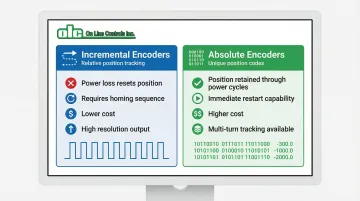
Incremental encoders generate a stream of electrical pulses relative to a reference point, with each pulse representing a fixed increment of shaft rotation. These devices excel at speed and relative position control.
They operate by producing two output channels (A and B) in quadrature—offset by 90 degrees—which allows the control system to determine both speed and direction of rotation. A third "Z" or index pulse occurs once per revolution, providing a reference point for homing procedures.
Key advantages:
- High resolution at lower cost—common models offer up to 5,000 pulses per revolution
- Simple integration with standard counter inputs on PLCs and motion controllers
- Fast response with output frequencies reaching 100 kHz or higher
- Cost-effectiveness for speed monitoring and relative positioning
Important limitations:
- Position data is lost during power failures, requiring homing sequences on restart
- Accumulated counting errors from electrical noise can cause position drift
- Requires constant monitoring to maintain position accuracy
- Unsuitable for applications needing immediate position knowledge after power restoration
Absolute Rotary Encoders
These limitations make absolute encoders the preferred choice when position must be retained through power cycles.
Absolute encoders assign a unique digital code to every shaft position, maintaining position knowledge even through power cycles and eliminating the need for homing routines. Each position within the encoder's resolution matches a distinct binary or Gray code output.
The control system knows the exact shaft angle immediately upon power-up.
Output formats include:
- Parallel outputs (multiple wires, one per bit)
- SSI (Synchronous Serial Interface) for robust point-to-point communication
- BiSS-C (Bidirectional Synchronous Serial) supporting speeds up to 10 MHz
- Industrial Ethernet protocols (EtherCAT, PROFINET) for network integration
Key advantages:
- Position retention through power cycles—no homing required
- Immediate restart capability critical for safety systems and marine applications
- Multi-turn tracking available (12-16 bit counters) for position knowledge across multiple revolutions
- High resolution with single-turn precision up to 22 bits (approximately 4 million counts per revolution)
Trade-offs to consider:
- Higher initial cost compared to incremental encoders
- More complex signal processing and interface requirements
- Typically require specialized communication protocols rather than simple pulse counting
Technology Variations: Magnetic, Optical, and Mechanical
Magnetic Rotary Encoders
Magnetic encoders use Hall effect sensors or magnetoresistive technology to detect changes in magnetic field strength as a magnetized disc or ring rotates past stationary sensors.
This non-contact sensing method offers exceptional resilience in challenging environments.
Environmental advantages:
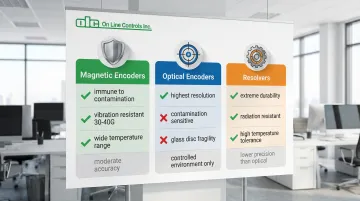
- Completely immune to dust, dirt, oil, and condensation
- Resistant to shock and vibration exceeding 30-40 Gs
- Wide operating temperature ranges (typically -40°C to +85°C or higher)
- No glass components that can shatter under impact
Ideal applications:
Magnetic encoders represent the optimal solution for harsh industrial environments including mining equipment, heavy machinery, outdoor installations, and marine applications where contamination and vibration are constant challenges.
They offer moderate-to-high accuracy rather than extreme precision. Yet their superior environmental tolerance makes them the practical choice for rugged applications.
Optical Rotary Encoders
Where magnetic encoders prioritize durability, optical encoders deliver maximum precision. These systems use an LED light source and photodetector array to sense rotation through a precision-etched code disc.
As the disc rotates, alternating transparent and opaque segments interrupt the light beam, generating electrical pulses.
Advantages:
- Highest resolution and accuracy available in rotary feedback technology
- Unmatched repeatability for precision machining and robotics
- Best choice for CNC machinery, telescopes, and laboratory equipment
Environmental vulnerabilities:
Optical encoders face significant challenges in harsh conditions:
- Highly sensitive to contamination—dust, oil, or condensation on the code disc interrupts signals
- Glass discs can shatter under high shock loads
- Requires sealed housings with proper environmental ratings
- Limited by optical component temperature ranges and condensation risk
For applications requiring extreme precision in controlled environments, optical encoders remain the standard. In contaminated or high-vibration settings, their vulnerabilities often outweigh their accuracy advantages.
Mechanical and Potentiometric Feedback Devices
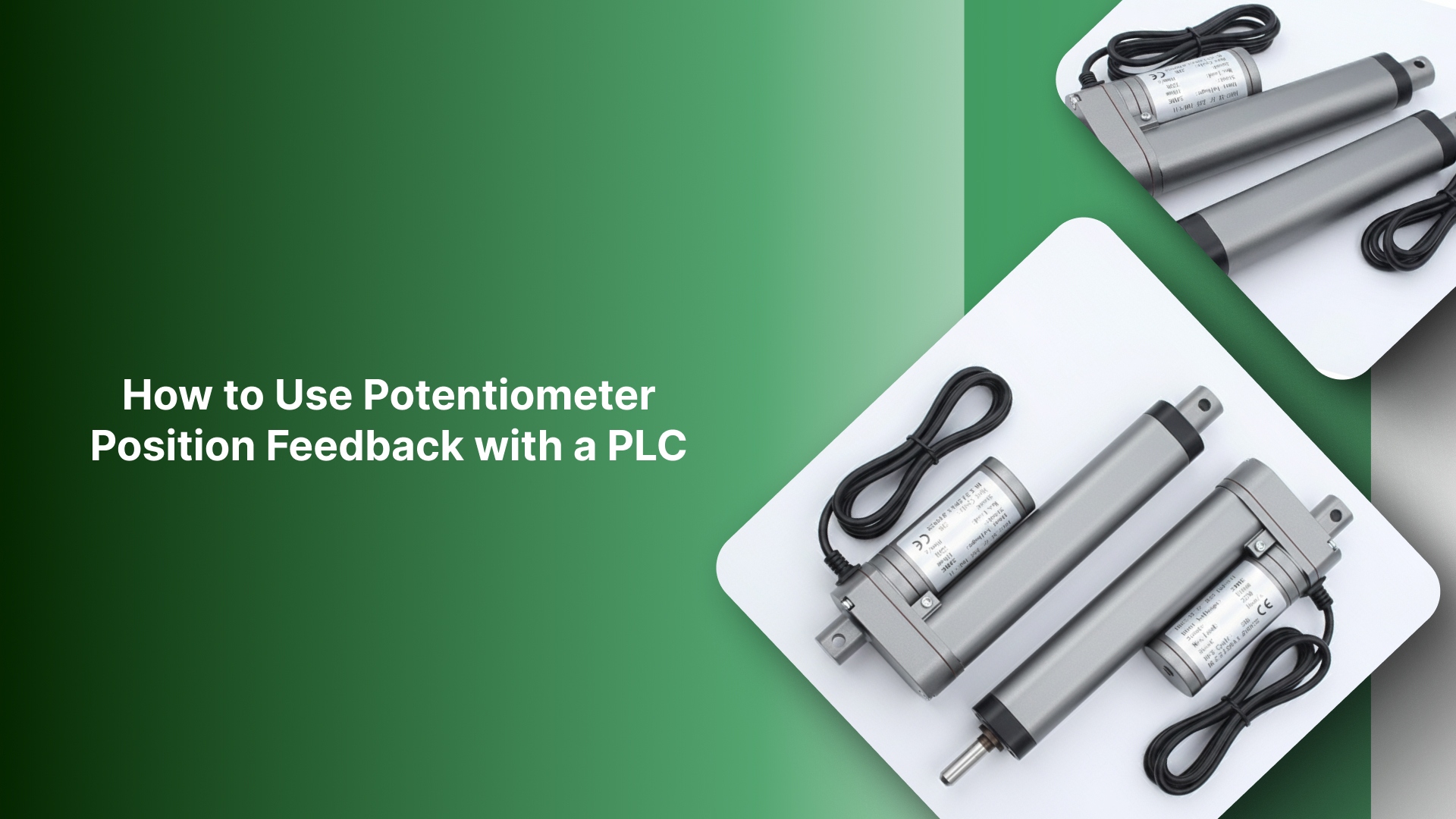
Mechanical feedback devices use contact-based sensing, with a wiper sliding across a resistive element to produce a voltage output proportional to shaft angle. These represent the simplest and lowest-cost feedback technology.
Use cases:
- Lower-speed, high-torque applications where resolution requirements are modest
- Cost-sensitive applications with limited duty cycles
- Systems requiring simple analog voltage outputs without digital processing
Durability considerations:
Standard industrial potentiometers are rated for approximately 200,000 cycles, while high-end cermet versions may reach 1-2 million cycles. This represents significantly shorter lifespan than non-contact encoders, which can exceed 10-20 years in appropriate environments.
Vibration accelerates wear by causing "dither" that degrades wiper contact. This makes potentiometers unsuitable for high-vibration environments despite their low initial cost.
Applications in Industrial Equipment
Rotary feedback devices deliver precision and reliability across diverse industrial automation applications:
CNC Machinery: High-resolution optical encoders provide position and velocity feedback essential for maintaining tight tolerances. Secondary encoders mounted after gear trains can improve absolute position accuracy by 70-80% by compensating for gear backlash and zero position errors.
Linear encoders are often preferred for axes to compensate for thermal expansion of ball screws, which can cause positioning errors exceeding 100 µm.
Robotic Arms and Automated Assembly: Compact inductive rotary encoders mounted at each joint capture actual position after the gear train, correcting for elasticity and enabling precise Tool Center Point (TCP) positioning.
Key specifications include:
- Approximately 20-bit resolution for precise joint control
- Safety Integrity Level (SIL) 2 or 3 certification
- Compact form factors for tight integration
Conveyor Systems and Material Handling: Incremental encoders monitor belt speed and position in harsh environments. Dust and vibration are constant challenges.
Magnetic encoders or robust optical units with IP65+ ratings provide the durability required for continuous operation.
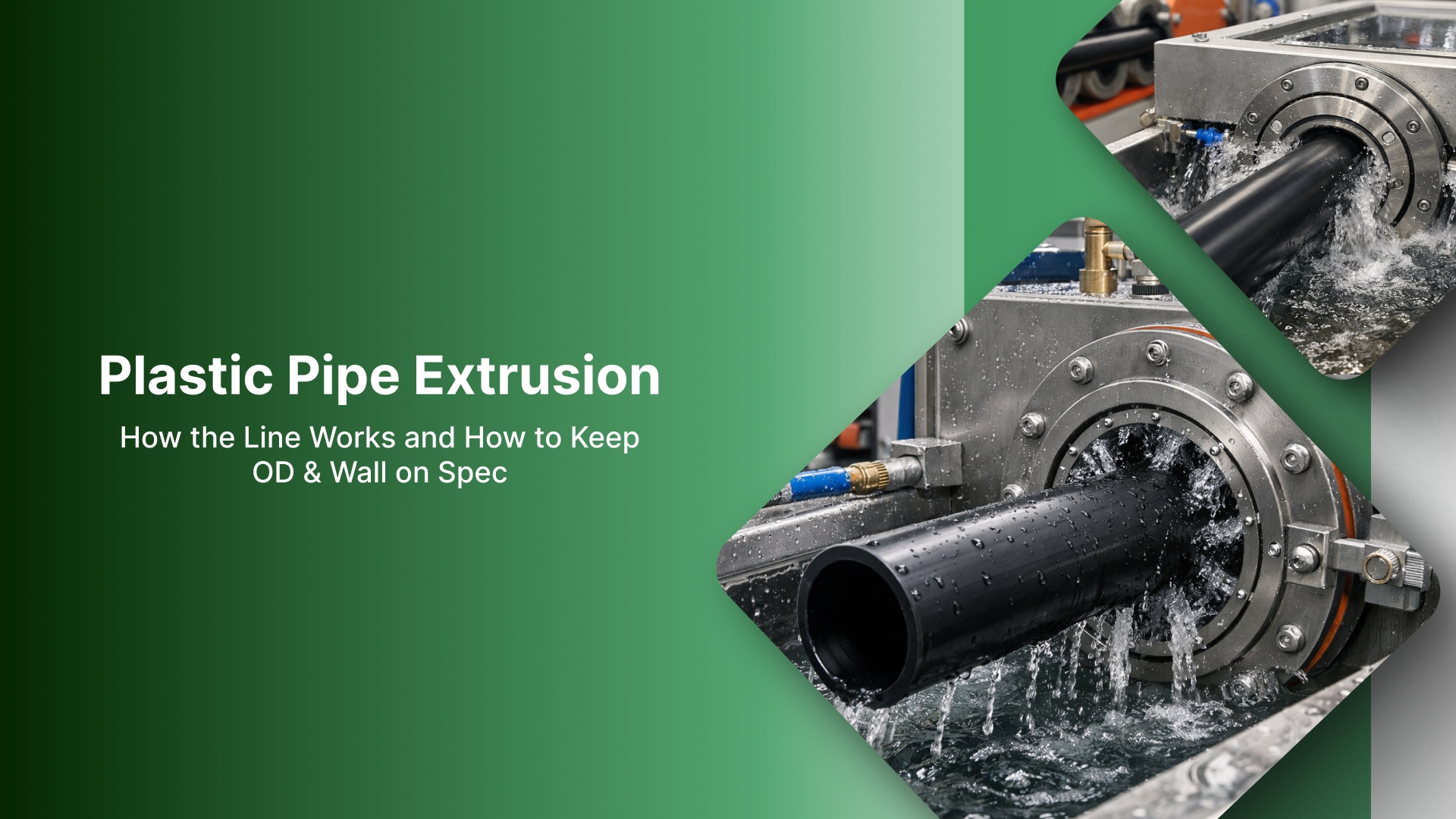
Precision Extrusion Control: Plastic extrusion demands specialized feedback solutions where dimensional accuracy directly impacts product quality.
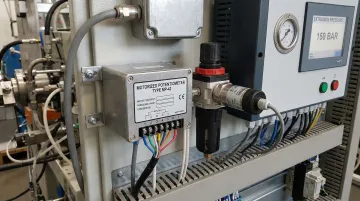
Motorized potentiometers address this need by combining position feedback with integrated motor control. For tubing extrusion applications, these devices enable closed-loop regulation of critical process parameters like internal air pressure—ensuring consistent wall thickness and diameter tolerances essential for medical catheter and automotive tubing production.
On Line Controls manufactures motorized potentiometers specifically engineered for extrusion control systems, working alongside their MicroAir pressure regulators to maintain precise dimensional control throughout the production process.
Applications in Marine Equipment
Marine environments create severe operating conditions for rotary feedback devices. Equipment must withstand salt spray, constant vibration, temperature fluctuations, and potential submersion while maintaining precise position feedback for critical ship systems.
Key Marine Applications
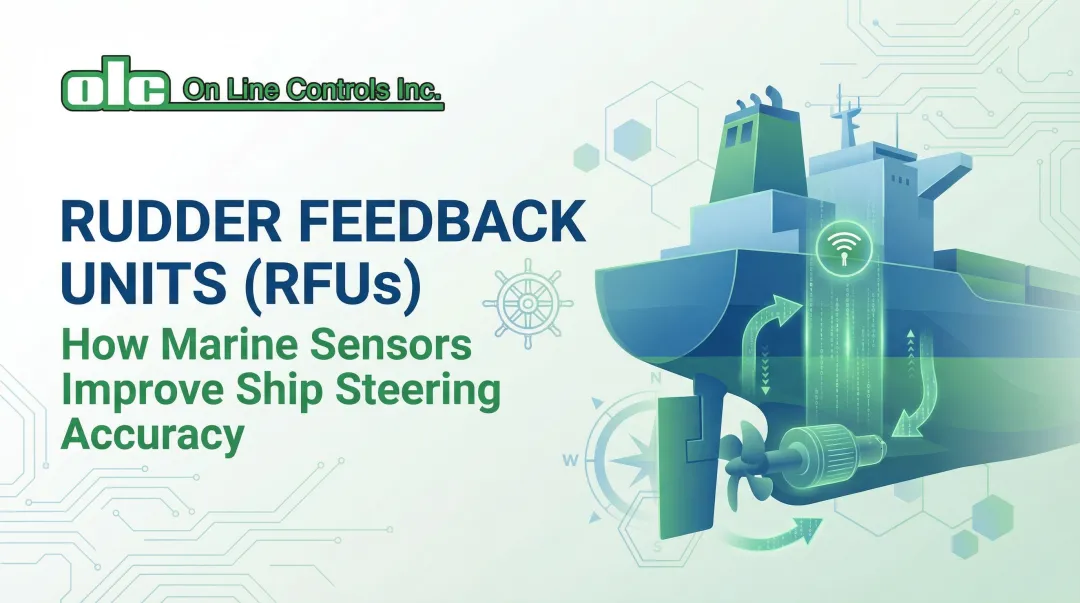
Ship Steering and Propulsion Systems: Encoders on podded thrusters, azimuth drives, and steering gear must provide immediate position knowledge after power restoration—making absolute encoders essential. These systems require automatic restart capability without manual intervention.
Winches, Cranes, and Cargo Handling: Load positioning systems rely on feedback devices to prevent overtravel, monitor cable payout, and synchronize multiple hoists. Encoders for offshore cranes must resist temperature fluctuations and aggressive seawater exposure.
Stabilizer Control and Dynamic Positioning: Ship stabilization systems and dynamic positioning for offshore vessels depend on continuous, accurate feedback under constant motion and vibration.
These demanding applications share common environmental challenges that drive encoder selection.
Environmental Challenges Unique to Marine Applications:
- Saltwater corrosion: Requires stainless steel (316 grade) or specially coated aluminum housings
- Constant vibration: Eliminates glass-disc optical encoders in favor of magnetic or resolver technology
- Temperature fluctuations: Wide operating ranges needed for equipment transitioning between engine rooms and exposed deck locations
- Submersion risk: IP67 (submersion to 1 meter for 30 minutes) or IP68 (continuous submersion) ratings mandatory
Certification Requirements
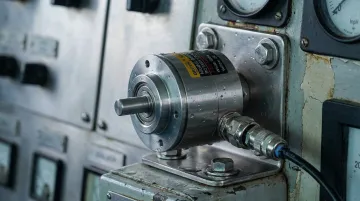
Marine encoders must meet classification society standards from organizations like DNV (Det Norske Veritas) and ABS (American Bureau of Shipping), which mandate rigorous testing including salt spray exposure, shock, and vibration resistance.
DNV-certified encoder series specifically designed for maritime applications feature seawater-resistant housings and pass stringent environmental qualification tests.
Selecting the Right Rotary Feedback Device for Your Application
Decision Framework
Evaluate these critical factors when selecting rotary feedback technology:
1. Accuracy vs. Environmental Robustness
- High precision in controlled environments → Optical encoders
- Contaminated or high-vibration conditions → Magnetic encoders or resolvers
- Moderate precision with extreme durability needs → Resolvers
2. Position Retention Requirements
- Can system re-home after power loss? → Incremental encoder (lower cost)
- Must position be immediately known on startup? → Absolute encoder
- Critical safety or marine applications → Absolute encoder (mandatory)
3. Environmental Protection Level
- Indoor, clean environment → IP54/IP65 sufficient
- Washdown areas or outdoor installation → IP67 minimum
- Marine/offshore or submersion risk → IP68 with stainless steel housing
- Classification society requirements → DNV/ABS certified models
4. Speed and Resolution Requirements
- Simple speed monitoring → Standard incremental encoder (1,000-2,000 PPR)
- Precision positioning → High-resolution optical (5,000+ PPR) or absolute (18-22 bit)
- Multi-turn position tracking → Absolute encoder with multi-turn capability
Total Cost of Ownership Analysis
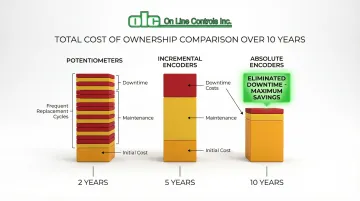
Initial purchase price represents only a fraction of true lifecycle costs. Understanding these factors helps justify the right technology choice:
Downtime Costs: Average industrial downtime costs $532,000 per hour. Absolute encoders eliminate homing sequences and provide instant position knowledge after power failures.
A single prevented failure can justify their premium over incremental encoders.
Maintenance and Replacement Frequency:
- Potentiometers: 200,000 to 2 million cycles (contact wear limits life)
- Non-contact encoders: Lifespan limited mainly by bearing life, typically 10-20 years
- Harsh environment failures: Optical encoders in contaminated settings may require frequent replacement; magnetic encoders provide longer service life
Integration and Commissioning: Industrial Ethernet protocols (EtherCAT, PROFINET) simplify wiring by allowing multiple encoders on a single network cable. This reduces installation labor and enables advanced diagnostics for predictive maintenance.
Protocol Compatibility
Match encoder communication protocols to your control platform:
- Simple pulse counting (HTL/TTL): Compatible with all PLCs, ideal for basic speed control
- SSI: Robust point-to-point absolute position, widely supported
- BiSS-C: High-speed (10 MHz) bidirectional communication, enables encoder diagnostics
- EtherCAT: Real-time deterministic performance, processes data in-line without CPU overhead (Beckhoff, Omron, Bosch Rexroth)
- PROFINET: Widely adopted in factory automation (Siemens, GE)
- EtherNet/IP: Standard for Rockwell Automation (Allen-Bradley) systems
Specialized Applications: For specific control requirements like plastic extrusion, analog proportional control may better integrate with existing analog-driven equipment.
Motorized potentiometers offer direct analog output with integrated actuation (eliminating conversion delays) while providing 10-20 year operational life in purpose-built configurations.
Frequently Asked Questions
What are the different types of rotary feedback devices?
The three primary types are incremental encoders (pulse-based relative position, lose data on power loss), absolute encoders (unique position codes retained through power cycles), and potentiometric devices (contact-based analog output, shortest lifespan). Choose incremental for speed monitoring, absolute for safety-critical marine systems, and potentiometers for low-duty analog control.
What are the 4 types of encoders?
The four classifications are incremental optical (highest precision for clean environments), incremental magnetic (harsh-condition pulse output), absolute optical (maximum accuracy with unique position codes), and absolute magnetic (position retention with environmental durability). Choose based on whether you need relative or absolute data and whether your environment demands optical precision or magnetic resilience.
How long do rotary encoders last?
Optical encoders typically last 5-10 years, while magnetic encoders often exceed 10-20 years due to non-contact sensing. Actual lifespan depends on operating conditions—contamination, vibration, and temperature extremes accelerate wear, while potentiometric devices last only 200,000 to 2 million cycles.
What's the difference between encoders and resolvers?
Resolvers use electromagnetic induction with no onboard electronics, making them impervious to radiation, extreme heat, and vibration—ideal for aerospace and severe industrial use. Encoders offer higher precision and digital output but are more environmentally sensitive. Choose resolvers for extreme durability; choose encoders for accuracy and digital communication.
How do I protect rotary encoders in marine environments?
Specify IP67 minimum or IP68 ratings with stainless steel 316-grade housings to resist corrosion. Use proper cable glands with strain relief and require DNV or ABS certification for critical applications. Favor magnetic encoder technology over optical in exposed locations where contamination is inevitable.