Introduction
Multi-lumen tubing is a foundational component in medical catheter manufacturing, dialysis lines, and specialty industrial applications. Extruding it well demands dimensional precision that single-channel pressure control cannot reliably deliver.
The core problem sits in the free extrusion zone: as molten polymer exits the die and cools, each lumen must be individually supported by internal air pressure to hold its shape. That requires independent control per channel.
When all lumens share one pressure source, adjusting for one affects all the others. The result is dimensional inconsistency — wall collapse, lumen distortion, ovality — that compounds into scrap and rework.
This article breaks down why each lumen behaves differently under extrusion conditions, how multi-channel pressure regulators address that mechanically, and what independent per-lumen control delivers on a production line.
Key Takeaways
- Multi-lumen tubing has two or more independent internal channels, each requiring stable air pressure to hold its shape during extrusion
- Lumens differ in cross-section and flow resistance, so a single shared pressure source cannot serve them accurately
- Multi-channel regulators assign one independently adjustable output per lumen, preventing cross-channel interference
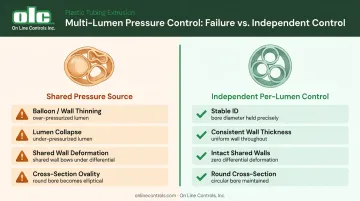
- Independent control keeps every lumen at its target ID, wall thickness, and roundness at the same time
- Multi-channel regulators are standard in medical catheter, drainage tube, and specialty industrial tubing lines
What Is Multi-Lumen Tubing and Why Does Each Lumen Need Its Own Pressure Control?
Multi-lumen tubing is a single extruded tube body containing two or more independent internal channels, each formed simultaneously during the extrusion process and separated by thin polymer walls. Unlike post-bonded tube bundles or co-extruded parallel assemblies, everything exits the die as one integrated profile.
Medical catheters, dialysis lines, and minimally invasive access devices need to route multiple fluids, gases, or instruments through a single compact body — consolidation is the entire point. A triple-lumen central venous catheter, for example, handles infusion of blood products, fluid withdrawal, and central venous pressure monitoring simultaneously — through one device placed in a single vein.
The Pressure Control Challenge
During free extrusion, there's no external tooling holding the tube's shape after it exits the die. Internal air pressure acts as a non-contact mandrel, supporting each lumen from the inside as the polymer transitions from molten to solid.
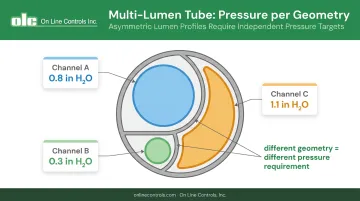
Each lumen in a multi-lumen profile has its own geometry: different cross-sectional area, wall thickness, and position within the tube body. These differences mean each lumen has different flow resistance and responds differently to the same pressure input.
What this creates in practice:
- A larger lumen requires more pressure to maintain its ID than a smaller adjacent one
- A lumen near the tube wall behaves differently than one centered in the profile
- Thin shared walls between lumens transmit pressure disturbances from one channel to the next
These variables differ lumen-to-lumen, so the pressure required to hold each lumen's geometry also differs. A shared, undivided pressure source applies the same value to all lumens simultaneously — and that uniform approach produces inconsistent geometry across the profile.
Why Single-Channel Regulators Create Multi-Lumen Problems
When one regulator feeds multiple lumens through a manifold without independent channel control, any adjustment made for one lumen affects all others at the same time.
The consequences are predictable:
- Over-pressurized lumens balloon or distort outward, thinning the surrounding wall
- Under-pressurized lumens collapse inward or narrow, reducing usable ID
- Shared walls between lumens deform when adjacent channels experience different pressure states
- Ovality develops across the tube cross-section as lumens pull unevenly on the outer wall
Research on multi-lumen extrusion pressure control confirms that pressure fluctuations in one channel can deform adjacent lumens or the shared walls between them. In medical-grade tubing where wall thicknesses can reach down to 0.001 in., even minor cross-channel interference produces out-of-spec product.
How Multi-Channel Pressure Regulators Work During Multi-Lumen Extrusion
A multi-channel pressure regulator is a single control unit housing multiple independent pressure-regulation channels. Each channel is dedicated to one lumen — it can be set, monitored, and adjusted without affecting any other channel in the unit.
Setup and Connection
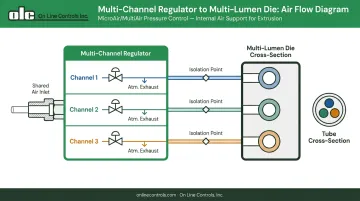
Each output channel connects directly to the corresponding air pin or mandrel port feeding one lumen inside the extrusion tooling. This creates an isolated pressure circuit per lumen: from the regulator output, through the die, to the internal air column inside the forming tube.
OLC's MicroAir multi-channel units use ¼" NPT male fittings for air connections, with one air inlet and a separate outlet for each channel. The units must be located close to the die to minimize pressure loss between the regulator and the lumen it's controlling.
Key setup requirements:
- Match channel count to lumen count (dual, 3-channel, or 4-channel configurations available)
- Each channel is factory-set to its specified pressure range before shipping — no field calibration needed
- Target operating pressure for each channel should sit near the middle of its range, leaving adjustment room in both directions
- Units are ordered with the specific range each lumen requires, since different lumens often need different pressure ranges
Internal air pressure during free extrusion typically operates in an extremely low range — fractions of an inch of water column for thin-walled medical tubing. OLC's MicroAir regulators are capable of stable, repeatable output down to below 1 inch of water (0.036 psi), which is the precision level required to hold tight lumen geometry without over-pressurizing delicate tube walls.
Core Operation
Each channel in a multi-channel MicroAir unit functions as a self-contained force-balance regulator. The relief valve stem hangs vertically on a balance spring and floats on a cushion of air. Because friction is negligible, the regulating element responds instantly to small pressure changes without the deadband or lag present in standard industrial regulators.
A fluid-filled chamber below the relief valve adds viscostatic damping — enough to prevent oscillation, but without introducing lag. The damping fluid never contacts the output air stream.
In multi-lumen extrusion, lumens share thin polymer walls. A delayed response in one channel can cascade into dimensional drift across the tube cross-section before the operator detects it — hysteresis-free, per-channel response stops that from happening.
Channels remain isolated because each has its own independent regulation mechanism. The unit has one shared air inlet, but each channel's pressure is balanced and expelled to atmosphere independently. A demand change in one channel does not transfer pressure to neighboring channels — whether that demand change comes from a line speed increase, a cut, or a material viscosity shift.
Regulation and Real-Time Control
Operators adjust each channel independently at the regulator, responding to dimensional readings from inline measurement systems. If one lumen begins reading small on ID, only that channel's pressure is increased; neighboring channels remain at their set points.
OLC's MicroAir product line supports multiple control modes:
| Model | Control Method | Interface |
|---|---|---|
| MicroAir I | Manual knob adjustment | Magnehelic gauge |
| MicroAir II | Manual + automated up/down contact closure | Compatible with LaserLinc, Zumbach, BetaLasermike |
| MicroAir IV | 0–10 VDC analog input or dual-state logic | PLC integration, optional 4–20 mA output |
With optional analog output added, any MicroAir channel can be integrated into a complete closed-loop control system — connecting inline OD measurement to automatic pressure correction for each individual lumen.
Once baseline pressures are established for a given die and material, operators can record and reproduce those settings across production runs. The standard magnehelic gauge reads to 2% of full scale; optional digital LED displays provide better than 0.1 inch of water resolution, making it easy to document exact channel positions for each die and material combination.
What Independent Pressure Control Delivers on the Production Line
Dimensional Quality
With a single shared pressure source, optimizing one lumen's pressure degrades another. That trade-off disappears with independent channels. Each lumen can be held to its own tolerance window simultaneously — tighter OD, ID, and wall consistency across the entire tube cross-section throughout the run, not just during occasional acceptable windows.
Process Stability During Transitions
Line speed changes, material lot changeovers, and die temperature fluctuations affect each lumen differently. With independent channels, operators respond to each lumen's drift individually. Without them, every adjustment is a compromise, partially fixing one lumen while worsening another.
Asymmetric Multi-Lumen Profiles
Asymmetric tubing — where lumens differ in size, shape, or spacing within the same tube body — cannot be managed with a shared pressure source at all. A crescent-shaped lumen and a round lumen in the same profile require fundamentally different support pressures to hold their geometry. Each channel can be configured with a different pressure range and internal connections, giving operators the control each lumen geometry demands.
OLC serves customers producing tubing with up to 29 lumens — at that scale, per-lumen independence isn't just useful. It's the only workable approach.
Setup and Repeat Production
Once baseline channel pressures are established for a specific die and material combination, those settings can be recorded and reproduced for repeat runs. MicroAir units are factory-set before shipping with pressure repeatability of ±0.2% of full scale for low ranges, so recorded settings hold run-to-run without recalibration. This reduces the trial-and-error startup time that typically accompanies qualifying a new multi-lumen extrusion run.
Where Multi-Channel Pressure Regulators Are Used
Multi-channel pressure regulators are used on any extrusion line producing tubing where two or more lumens must be formed simultaneously. The primary application environments include:
- Medical catheters — central venous catheters, PICCs, multi-lumen access sheaths
- Drainage and fluid management — multi-lumen drainage tubing, dialysis lines
- Minimally invasive devices — endoscope working channels, balloon catheter bodies
- Automotive and pneumatic tubing — multi-channel control lines requiring simultaneous fluid or gas routing
MarketsandMarkets projects the multi-lumen medical tubing market at USD $8.02 billion in 2026, growing to USD $10.83 billion by 2030 — driven by demand for more capable, space-efficient devices across cardiovascular, renal, and oncology applications.
Medical Tubing: Where Tolerances Are Tightest
Catheter bodies, multi-lumen access sheaths, and hemodialysis catheters are produced to tolerances measured in thousandths of an inch. Regulatory requirements are strict, scrap costs are high, and even minor cross-channel pressure interference produces out-of-spec product.
That combination — tight dimensions, zero tolerance for inconsistency, and high per-unit cost — makes independent per-lumen pressure control a process requirement, not an option.
OLC's MicroAir multi-channel regulators are used by medical tubing producers and extrusion OEM manufacturers across 18 countries. OEM customers including Davis-Standard, Conair, RDN, and Gimac integrate MicroAir units directly into their extrusion lines — so multi-channel pressure control is part of the line from day one, already qualified when the machine ships.
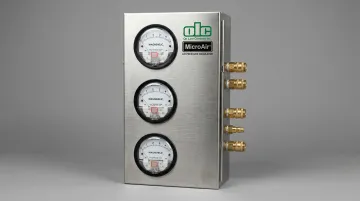
Available multi-channel MicroAir configurations:
| Model | Dual-Channel | 3-Channel | 4-Channel |
|---|---|---|---|
| MicroAir I | DMAI | MU3MAI | — |
| MicroAir II | DMAII | MU3MAII | — |
| MicroAir IV | DMAIV | MU3MAIV | MU4MAIV |
All units are manufactured in the USA and backed by a 3-year warranty. OLC designs them for a 10–20 year service life — no recalibration required, no spare parts stocked under normal operating conditions.
Conclusion
Multi-lumen tubing is defined by the independence of its internal channels — and the pressure control system used during extrusion must mirror that independence. A single shared pressure source applies one value to all lumens at once; it cannot account for the different geometry, wall thickness, and flow resistance of each channel.
Knowing why independent channel regulation matters gives process engineers a concrete framework for troubleshooting dimensional problems. When a lumen reads narrow on ID, the cause is often insufficient support pressure in that specific channel — not a line speed or temperature problem. When shared walls show uneven thickness, cross-channel pressure interference is the likely culprit.
Engineers who build multi-lumen extrusion processes around dedicated per-lumen pressure control start with a more stable foundation. In practice, that means:
- Each lumen held to its own pressure setpoint, regardless of what neighboring channels are doing
- Process adjustments targeted to the specific channel causing dimensional drift
- Settings that carry over reliably from run to run, reducing setup time on repeat jobs
Frequently Asked Questions
What is multi-lumen tubing?
Multi-lumen tubing is a single extruded tube containing two or more independent internal channels, each serving a distinct function such as fluid delivery, gas passage, or instrument routing. All channels are formed simultaneously in one extrusion pass, separated by thin polymer walls within one tube body.
What is a multi-lumen catheter used for?
Multi-lumen catheters allow clinicians to perform several functions simultaneously through a single device: delivering medication, infusing blood products, monitoring central venous pressure, and drawing blood samples. This eliminates the need for multiple separate catheter insertions during complex procedures.
What is the difference between single and double lumen?
A single-lumen tube has one internal channel for one function. A double-lumen tube has two independent channels, enabling two separate fluids, gases, or functions to operate simultaneously within the same tube body without cross-contamination between them.
Why does each lumen in multi-lumen tubing require independent air pressure during extrusion?
Each lumen has its own cross-sectional geometry, wall thickness, and flow resistance. The pressure needed to prevent collapse or distortion during extrusion differs from lumen to lumen — so a shared, undivided supply cannot simultaneously provide the correct pressure to each channel.
What problems occur when lumens share uncontrolled internal air pressure during extrusion?
Dimensional inconsistency between lumens, wall collapse, ovality, and shared-wall deformation are the common failure modes. In medical-grade tubing, these defects drive scrap and rework that a single shared pressure supply cannot prevent — because each lumen needs its own independently regulated channel to hold correct geometry throughout the run.