Introduction
In precision manufacturing, manual adjustments cost more than most engineers realize. A 2.92% scrap rate in motor manufacturing dropped to under 0.7% simply by reducing process variation—saving approximately $135,000 annually. The control device driving those setpoints was the difference.
Choosing between a manual and motorized potentiometer affects production consistency, labor overhead, remote control capability, and how well your process integrates with automation.
Manual potentiometers suit static setpoints and budget-constrained installations. Motorized units enable the closed-loop control that extrusion lines and similar continuous processes depend on. This guide compares both types across cost, functionality, and use cases—then provides a decision framework for when automation delivers measurable ROI.
Key Takeaways
- Manual potentiometers are simple, low-cost ($5–$50) setpoint controls suited for infrequent adjustments at accessible equipment locations
- Motorized potentiometers add motor-driven remote control ($100–$500+) for precise, repeatable adjustments in continuous extrusion lines without manual intervention
- Manual is the right fit when changes happen less than weekly, budget is tight, and operators can reach the equipment easily
- Go motorized when adjustments are frequent, locations are remote or hazardous, precision requirements reach ±0.25% accuracy, or PLC integration is required
Manual vs Motorized Potentiometer: Quick Comparison
| Feature | Manual Potentiometer | Motorized Potentiometer |
|---|---|---|
| Cost | $5–$50 typical; minimal installation | $100–$500+; requires power supply and control interface |
| Control Method | Direct physical adjustment via knob or screwdriver; operator must be present | Remote adjustment via control signals; supports PLC/SCADA integration |
| Precision | Operator-dependent; repeatability varies; no position feedback | High repeatability with ±0.25% to ±0.5% accuracy; eliminates human error |
| Lifespan | 10,000–100,000 cycles depending on element type | 10–20+ years; 500,000 to 50 million turns depending on construction |
| Maintenance | Low; primarily wiper contact cleaning | Moderate; motor and gearing checks; slip clutch protection prevents damage |
| Best For | Static setpoints, infrequent changes, accessible locations, no automation infrastructure | Dynamic processes, frequent adjustments, remote/hazardous locations, automated control loops |
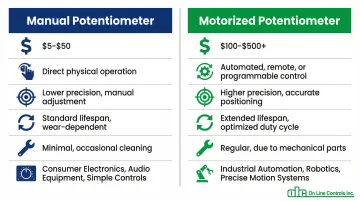
The table tells you what each type costs and how it performs. What it can't tell you is when those differences actually matter for your process.
The cost gap is real, but so is the context. A $20 manual pot is the right call for a setpoint you adjust twice a year. For a process that needs hourly corrections—or one running in a hazardous zone where an operator can't safely walk up to the equipment—the $100–$500 investment in a motorized unit pays back quickly in reduced labor and fewer errors.
The precision difference is where extrusion applications feel it most. Two technicians manually setting the same target often land in different spots. A motorized unit with position feedback returns to the exact setpoint every time, which matters when you're holding tight tolerances on tubing wall thickness or outside diameter.
Use this as a quick decision guide:
- Choose manual if setpoints rarely change, locations are accessible, and no PLC/SCADA integration is required
- Choose motorized if adjustments are frequent, remote operation is needed, or your process is part of an automated control loop
- Choose motorized if the equipment sits in a hazardous zone or if repeatability is critical to product quality
What is a Manual Potentiometer?
A manual potentiometer is a three-terminal variable resistor adjusted by direct physical manipulation—turning a knob, moving a slider, or rotating a screwdriver slot. This mechanical action changes the resistance and controls voltage or current in a circuit.
Operational Principle:
The device functions as a voltage divider. A wiper contact moves along a resistive element, dividing input voltage proportionally based on wiper position. If you apply 10V across a potentiometer and position the wiper at the midpoint, the output reads approximately 5V.
Construction Types:
Manual potentiometers come in different configurations for varying resolution needs:
- Single-turn models: Offer 270-300° of mechanical travel, suitable for coarse adjustments where speed matters more than fine resolution
- Multi-turn models: Provide 3-10 full rotations (1,080-3,600° of travel), enabling precise voltage division where fine control matters
Resistive Element Materials:
The element material determines performance characteristics:
| Material | Key Characteristics | Best For |
|---|---|---|
| Carbon composition | Low cost, moderate stability | General-purpose applications |
| Cermet (ceramic-metal) | Wide resistance range, infinite resolution, excellent stability | Trimming applications |
| Wirewound | High power ratings (up to 1W for 10-turn models), finite resolution; 25,000–1 million cycle lifespan | High-power, stable setpoints |
Industrial Benefits:
Manual potentiometers require no external power and have minimal components, which keeps costs low and reliability high. They're straightforward to replace in legacy systems. Common applications include:
- Initial setup and calibration of control systems
- Trim adjustments in analog circuits
- Manual speed controls
- Static setpoint settings in non-automated processes
Use Cases of Manual Potentiometers
Understanding where manual potentiometers genuinely fit helps clarify when upgrading to motorized control is worth the investment — and when it isn't.
- Infrequent setpoints: Quarterly calibration, seasonal process changes, or annual equipment tuning don't justify automation. When setpoints hold stable for weeks or months, manual adjustment makes economic sense.
- Budget-constrained installations: For small-scale manufacturers or retrofit scenarios lacking automation infrastructure, a $20 manual potentiometer delivers the same voltage division function as a $300 motorized unit — when automation isn't required.
- Legacy equipment: HVAC systems, older manufacturing lines, and building automation often rely on manual potentiometers for local setpoint control. These installations operate reliably for decades when control requirements stay simple and infrequent.
What is a Motorized Potentiometer?
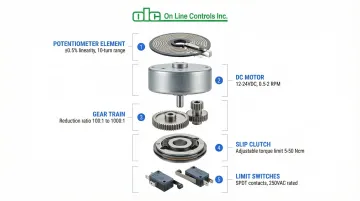
A motorized potentiometer integrates a precision potentiometer with a geared motor and slip clutch, enabling remote or automated adjustment of resistance while preserving manual override capability. This combination delivers the voltage divider function of a standard potentiometer with the control flexibility of automation.
Operational Principle
A DC or AC motor drives the wiper through precision gearing in response to control signals: DC voltage, current loop (4-20mA), or digital commands. The motor rotates the wiper to the programmed position, changing resistance and output voltage proportionally. The slip clutch protects end stops and allows manual adjustment when the motor is de-energized.
Component Construction
Industrial motorized potentiometers contain:
- Potentiometer element: Conductive plastic (10–50 million turns lifespan) or wirewound (500,000–2 million turns) for different durability requirements
- Motor: DC (6–24 VDC common) or AC (115 VAC) with adjustable speeds from 1–120 RPM
- Gear train: Provides torque multiplication and precise speed control; enables adjustment times from 10–300 seconds for full travel
- Slip clutch: Factory-set protection against over-rotation and mechanical damage
- Limit switches (some models): Automatic end-of-travel protection
Industrial Benefits & Performance
Motorized potentiometers eliminate the need for operator presence at equipment locations. They deliver high repeatability (±0.25% accuracy typical), connect directly to PLCs and SCADA systems, and handle frequent adjustments across 10–20 year service lifespans. OLC units use Japanese-made potentiometers, Swiss-made DC motors and geartrains, and heavy-duty Hurst USA-made AC motors.
Key performance specs:
- Adjustment speed: 10–300 seconds for full travel depending on gear ratio
- Resistance ranges: 10Ω to 200kΩ across different models
- Power ratings: Up to 5W for high-current applications
- Environmental resilience: IP65+ enclosures available; operating range -10°C to +70°C
These specs translate directly into practical advantages across several industrial applications.
Use Cases of Motorized Potentiometers
Dynamic Process Control
When setpoints must change frequently or in real-time, motorized potentiometers become essential. Common examples include:
- Plastic extrusion lines adjusting air pressure multiple times per shift to hold dimensional tolerances
- Chemical processing plants regulating flow rates continuously based on downstream sensor readings
- Web handling systems modifying tension setpoints to prevent material damage at speed
Remote and Hazardous Locations
Equipment in high-temperature zones, elevated platforms, cleanrooms, or hazardous areas requires remote adjustment capability. Motorized potentiometers allow safe, centralized control without putting operators near the risk.
Precision Applications
In plastic tubing extrusion for medical catheters, reducing dimensional tolerance from ±0.08 mm to ±0.01 mm yields material savings of 12.5%. Motorized potentiometers enable the continuous micro-adjustments necessary to hold these tolerances, with a direct impact on material costs and product quality.
Automation Integration
Motorized potentiometers accept analog signals (4–20mA, 0–10V) or digital commands from PLCs, enabling automated response to sensor feedback. In power generation, they adjust Automatic Voltage Regulator (AVR) setpoints for remote synchronization and load sharing. In robotics, they provide position feedback for joint control.
Motorized vs Manual: When to Choose Each Type
Decision Framework
The choice hinges on five key factors: adjustment frequency, remote operation needs, budget constraints, automation infrastructure, and precision requirements.
Choose Manual Potentiometers When:
- Adjustments occur less than weekly (quarterly calibration, seasonal changes)
- Budget is limited—under $100 per unit is acceptable
- No automation infrastructure exists (no PLC, SCADA, or control system)
- Operator access is easy and safe
- Static setpoints provide adequate process stability
- Human judgment is required for final setting verification
Choose Motorized Potentiometers When:
- Adjustments are frequent (more than once per shift) or continuous
- Remote operation is required—equipment is inaccessible or in hazardous locations
- High repeatability is critical—±0.5% accuracy or better required for quality
- Integration with PLC/SCADA systems is needed for automated control
- Process demands real-time setpoint changes for quality control
- Labor cost of manual adjustments exceeds $500/month
Once you've identified which type fits your operation, the next step is confirming the financial case.
Cost-Benefit Analysis Framework
Calculate payback period using this formula:
Monthly Labor Cost = (Operator hourly rate) × (Minutes per adjustment ÷ 60) × (Adjustments per month)
Motorized Upfront Cost = Unit cost + Installation + Control interface
Monthly Savings = Manual labor cost + Scrap reduction value + Downtime reduction
Payback Period (months) = Motorized upfront cost ÷ Monthly savings
Example Calculation:
A manufacturer adjusts setpoints 3 times per shift, 2 shifts per day, 22 days per month = 132 adjustments monthly. Each adjustment takes 10 minutes at $25/hour operator rate.
- Monthly labor cost: $25 × (10 ÷ 60) × 132 = $550
- Motorized upfront cost: $400 unit + $100 installation = $500
- Payback period: $500 ÷ $550 = 0.9 months
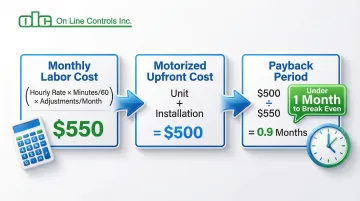
That's under one month to break even on labor alone—before counting scrap reduction or quality-related savings.
Not every application is a clean either/or decision, though.
Hybrid Scenarios
Some applications benefit from both types:
- Initial setup + production control: Use manual potentiometers to dial in the starting range, then let motorized units handle fine-tuning during production runs
- Redundancy on critical lines: Run motorized as primary with a manual unit wired in as a fallback—if the motor fails, operators can maintain control without shutting down
- Multi-zone lines: Assign manual units to stable zones adjusted once per run and motorized units to zones that shift with product changeovers
If you're still weighing the options, the checklist below can help you reach a clear answer.
Decision Checklist
If you answer YES to 3 or more, consider motorized:
- Adjustments needed more than once per shift
- Equipment in hard-to-reach or hazardous area
- PLC or control system already in place
- Precision critical to product quality (tight tolerances)
- Labor cost of manual adjustment exceeds $500/month
- Process requires documented, repeatable setpoints
Real-World Application: Motorized Potentiometers in Plastic Tubing Extrusion
The Challenge
Plastic tubing manufacturers face a critical control problem: maintaining consistent outside diameter (OD) during extrusion. Medical catheter tubing often requires tolerances as tight as ±0.03 mm. Manual adjustment of internal air pressure leads to dimensional variation, increased scrap, and significant operator time loss.
Three variables constantly drift and compound each other:
- Extruder temperature shifts with ambient conditions and material lot variation
- Line speed changes alter melt pressure and draw-down ratio
- Material viscosity fluctuates between resin batches
When operators manually adjust pressure regulators every 30–60 minutes to compensate, they introduce human variability. Two operators targeting the same pressure rarely achieve identical results — and recovering optimal settings after product changeovers burns additional production time.
The Solution
Integrating motorized potentiometers with precision air pressure regulators enables automated setpoint adjustment in response to real-time OD measurements. The system works as follows:
- Laser or ultrasonic OD gauge measures actual tubing diameter
- Controller compares measurement to target specification
- Motorized potentiometer adjusts air pressure regulator setpoint automatically
- System maintains target OD within tight tolerances without operator intervention
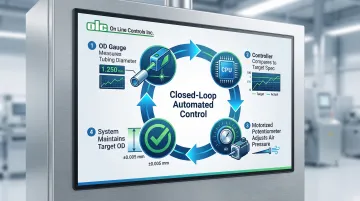
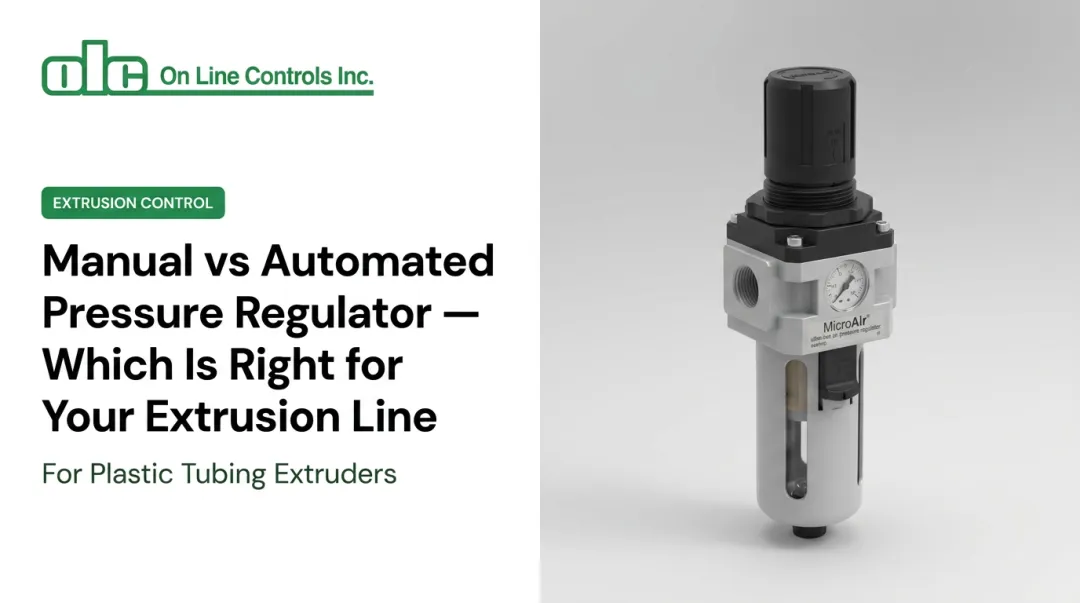
OLC's motorized potentiometers are designed to work directly with MicroAir regulators — sharing compatible signal ranges and control interfaces — making them a practical fit for closed-loop medical tubing control.
Quantifiable Results
Industry data demonstrates the impact of automated setpoint control:
- Dimensional consistency: Reducing tolerance from ±0.08 mm to ±0.01 mm saves 12.5% in raw material costs
- Scrap reduction: Automated process control reduced scrap rates from 2.92% to under 0.7%, saving approximately $135,000 annually in one motor manufacturing case study
- Setup time: Automated setpoint recall eliminates manual "tweaking" during product changeovers, reducing setup times by up to 28%
- Operator efficiency: Eliminates 2-4 hours of manual adjustment time per shift in high-volume production
OLC Product Advantages
OLC's motorized potentiometers are built for demanding production environments:
- Conductive plastic models rated for 10–50 million turns, supporting 10–20+ year service life
- Manufactured in the USA with full in-house quality control and fast turnaround
- Three-year warranty on all products, backed by unlimited phone support
- Direct compatibility with MicroAir precision air regulators for closed-loop extrusion control
Looking to automate your extrusion setpoints for consistent quality? Contact OLC at (978) 562-5353 or olc@onlinecontrols.com to explore motorized potentiometer solutions tailored to your process needs.
Conclusion
The choice between manual and motorized potentiometers comes down to operational context. Manual potentiometers suit static, low-frequency adjustments in accessible locations with budget constraints—think quarterly calibration or seasonal process changes. Motorized potentiometers excel in dynamic, automated processes requiring remote control and high repeatability: continuous process control, hazardous locations, or PLC-integrated quality loops.
Selecting the right type delivers practical outcomes:
- Reduced labor costs from eliminating manual adjustment cycles
- Improved product consistency through repeatable, precise setpoints
- Minimized downtime with remote control in hard-to-reach locations
- Alignment with long-term automation and PLC integration goals
For manufacturers in extrusion and similar continuous processes, motorized options like those from OLC offer a clear path to ROI: enhanced process control, material savings of up to 12.5%, and elimination of manual intervention. Start by calculating your adjustment frequency, labor costs, and quality requirements. Those three numbers will point you to the right technology.
Frequently Asked Questions
What is a motorized potentiometer?
A motorized potentiometer is a standard potentiometer fitted with an integrated motor and gearbox, allowing remote or automated adjustment via electrical signals. Most models retain manual override capability through a slip clutch, so operators can still adjust the setpoint directly when needed.
How do I know what kind of potentiometer I need?
Start with two questions: how often do setpoints change, and can operators easily reach the equipment? Motorized units suit high-frequency adjustments, remote or hazardous locations, and facilities with PLC/SCADA infrastructure. Manual potentiometers work well when adjustments are rare, operator access is straightforward, and budget is the primary concern.
When should I choose motorized over manual potentiometers?
Motorized potentiometers make the most sense in three situations: the equipment is in a remote or hazardous area, adjustments happen more than once per shift, or precision repeatability directly affects product quality. If monthly labor costs for manual adjustments exceed $500, the ROI case for motorized control is typically straightforward.
What are the maintenance differences between manual and motorized potentiometers?
Manual potentiometers require minimal maintenance—primarily wiper contact cleaning to remove dust or oxidation. Motorized potentiometers need periodic checks of motor, gearing, and limit switches, but robust industrial models like OLC's are designed for 10-20+ year lifespans with low upkeep and factory-set slip clutches that protect against damage.
Can motorized potentiometers be operated manually if needed?
Yes. Most motorized potentiometers include a slip clutch or manual override, allowing direct adjustment when the motor is not energized. This supports setup, troubleshooting, and backup operation during motor failure or power loss.