Introduction
When a critical control component fails on your extrusion line, the clock starts ticking at $10,000 to $500,000 per hour in lost production. Procurement teams often dismiss American-made components as premium-priced, but this calculation ignores the total cost of ownership.
The 2020-2023 supply chain crisis proved that sticker price doesn't equal true cost. 76.6% of companies experienced external supply chain disruptions in 2022, with price-focused sourcing strategies crumbling under delays and quality failures.
American-made industrial control components deliver measurable ROI advantages through extended lifespan, reduced downtime, and responsive support. This article quantifies the difference using reliability data, cost comparisons, and real operational outcomes for plastic tubing manufacturers and industrial facilities.
Key Takeaways
- Pay 15-30% more upfront, get components lasting 2-3× longer (10-25 years vs. 3-7 years)
- Total cost of ownership favors domestic sourcing: 40-60% fewer failures plus immediate expert technical support
- Domestic manufacturing eliminates 79-day international lead times and ensures UL/CSA compliance
- ROI breakeven occurs within 18-36 months through reduced replacement cycles and minimized production interruptions
What Are American-Made Industrial Control Components?
American-made industrial control components are precision devices—pressure regulators, motor controls, sensors, PLCs, and switches—manufactured entirely or primarily in the United States under rigorous US quality and safety standards. These components power the critical systems in extrusion lines, process control applications, automated manufacturing, and medical device production where reliability directly determines production output.
These components operate in environments where failure carries severe consequences:
- Medical tubing manufacturers depend on precision pressure regulation to maintain tight tolerances required for catheter production
- Automotive suppliers rely on motor controls where a single component failure can halt assembly lines costing $2.3 million per hour
- Continuous process operations in plastics and chemicals run 24/7 with minimal maintenance windows, making component longevity essential
The value proposition centers on operational continuity and measurable cost avoidance rather than origin alone. When a pressure regulator maintains accuracy for 20 years instead of requiring replacement every 5 years, the savings compound through avoided downtime, eliminated recalibration costs, and reduced spare parts inventory.
American-made components represent a strategic procurement decision focused on total lifecycle value.
Key Advantages of American-Made Industrial Control Components
The advantages below focus on measurable operational and financial outcomes: reduced downtime, lower total cost of ownership, faster problem resolution, and supply chain predictability. Each directly ties to KPIs that procurement and operations teams track quarterly.
These advantages compound over multi-year equipment lifecycles—the longer components remain in service, the wider the total cost of ownership gap becomes between domestic and imported alternatives.
Extended Product Lifespan and Reduced Replacement Frequency
American-made industrial control components typically feature higher-grade materials, more rigorous quality control, and design-for-longevity approaches that result in operational lifespans of 10-25 years versus 3-7 years for many imported alternatives. Manufacturers like On Line Controls document units still operating after 15-25 years in continuous extrusion applications, demonstrating the durability advantage of domestic precision manufacturing.
This advantage shows up in real-world usage through:
- Fewer component replacements over equipment lifetime
- Reduced inventory carrying costs for spare parts (typically 15-25% of inventory value annually)
- Elimination of production line downtime for swap-outs during critical production periods
- Lower total procurement costs when averaged over 10-year periods
The financial impact: Every avoided replacement saves not just the component cost but also labor, downtime, recalibration time, and potential quality issues during changeover. Manufacturing downtime costs range from $10,000 to $500,000 per hour depending on industry and scale. A single avoided emergency replacement in a high-volume facility can pay for the initial price premium of domestic components.
Key metrics affected: Maintenance cost per production hour, mean time between failures (MTBF), spare parts inventory costs, unplanned downtime hours, and total cost of ownership over 10-year periods.
Where you'll see the biggest gains: High-volume production environments where downtime costs exceed $10,000/hour, medical device manufacturing with strict quality documentation requirements, and remote installations where service visits are expensive or logistically complex.
Superior Reliability and Consistent Performance
Reliability means consistent performance within specification over the component's lifetime, with minimal drift, recalibration needs, or unexpected failures.
American manufacturing standards—tighter tolerances, batch testing, comprehensive quality audits—create this reliability advantage through components that maintain accuracy without frequent recalibration, operate stably across temperature and humidity variations, and exhibit predictable wear patterns enabling planned maintenance.
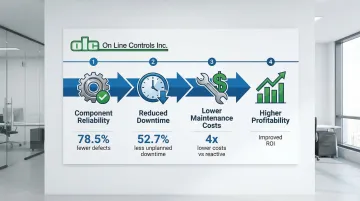
Manufacturers that rely less on reactive maintenance experience 78.5% fewer defects and 52.7% less unplanned downtime compared to operations heavily dependent on emergency repairs. This performance gap stems directly from component reliability—when pressure regulators maintain set points without drift, motor controls respond consistently, and sensors provide accurate readings year after year, the entire production system operates within tighter quality bands.
What this means for operations: Reliable components reduce quality defects in end products (out-of-spec tubing diameter, inconsistent extrusion), eliminate emergency shutdowns, and allow operations teams to schedule maintenance during planned downtime rather than reacting to failures. Reactive maintenance costs up to 4 times more than planned maintenance, with emergency repairs reaching 10× planned maintenance costs when factoring in rush freight and premium labor rates.
Operations teams track this advantage through product quality reject rates, process capability indices (Cpk), unplanned downtime incidents, maintenance cost as percentage of asset value, and production schedule adherence.
Critical applications: Industries with tight quality tolerances (medical tubing, automotive components), 24/7 operations where downtime windows are scarce, and applications where component failure creates safety risks or regulatory compliance issues.
Faster Support Response and Direct Manufacturer Access
American-made components come with domestic technical support, direct manufacturer communication without distributor layers, and same-time-zone responsiveness that dramatically reduces troubleshooting and resolution time.
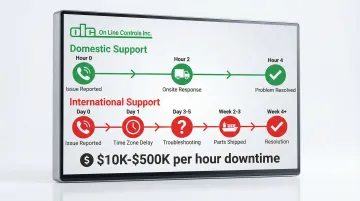
Domestic suppliers typically provide critical onsite response times of 2-4 hours for priority incidents, compared to potential weeks of delay for international support coordination.
This advantage operates in practice through:
- Technical support calls answered same-day rather than next-day or later due to time zone differences
- Engineers who understand specific application context and industry requirements
- Replacement parts shipped overnight instead of weeks-long international freight
- Ability to escalate issues directly to design engineers when standard troubleshooting fails
The downtime cost equation: Every hour spent troubleshooting a malfunctioning component is lost production time. Faster resolution means less revenue loss. A single servo motor failure can shut down an entire production line; if this outage lasts an 8-hour shift, the cost can reach $1 million based on median hourly rates. Direct manufacturer relationships also enable custom solutions or modifications that imported components cannot accommodate.
This support advantage drives improvements in mean time to repair (MTTR), technical support resolution time, emergency freight costs, production line availability percentage, and customer satisfaction scores for time-sensitive orders.
Ideal for: Just-in-time manufacturing environments with minimal buffer inventory, custom or specialized applications requiring engineering consultation, and operations with lean maintenance teams who rely on external expertise for complex troubleshooting.
The Hidden Costs of Imported Alternatives
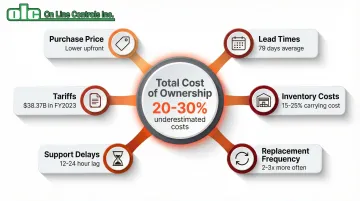
Imported control components often appear cost-competitive on purchase orders, but total cost analysis reveals multiple hidden expenses that erode or eliminate initial savings. When procurement teams calculate only the unit price without accounting for lifecycle costs, they systematically underestimate the true expense of imported components by 20-30% according to total cost of ownership research.
Supply Chain Delays and Inventory Costs
International shipping delays averaged 79 days for production materials in 2024, significantly higher than the 2019 average of 65 days. During the 2021 electronics shortage, lead times skyrocketed from 16 weeks to over 52 weeks.
These extended timelines force manufacturers to hold larger safety stock inventories, directly increasing working capital requirements and carrying costs of 15-25% annually. When a critical component fails, waiting 8-12 weeks for international replacement becomes unacceptable—especially when production lines are down.
Component Lifespan and Replacement Frequency
Imported industrial components typically require replacement 2-3× more frequently over a 10-year period, multiplying both purchase costs and installation labor. The operational lifespan difference is substantial.
Each replacement cycle introduces new risks:
- Quality issues during component changeover
- Production line downtime for installation
- Recalibration time and potential errors
- Additional procurement and logistics costs
Technical Support Limitations
Time zone delays introduce 12-24 hour response lags for technical support. Language barriers and multi-layer distribution chains complicate troubleshooting—is the issue with the component, the distributor, or the overseas manufacturer?
The math is stark: at $10,000/hour downtime cost, a 24-hour support delay costs $240,000 in lost production.
Tariff Impact on Total Cost
U.S. tariffs on Chinese imports amounted to $38.37 billion in FY 2023. When total cost of ownership includes duties, freight, and carrying costs, 32% of Chinese goods are actually more expensive than U.S. sourcing—rising to 46% with a 15% tariff applied.
How to Calculate ROI on American-Made Components
Calculating true ROI requires moving beyond purchase price to total cost of ownership over a 10-year period.
Compare American-made versus imported alternatives across five cost categories: purchase price, installation/replacement labor, downtime costs, maintenance/support costs, and inventory carrying costs.
Sample ROI Calculation
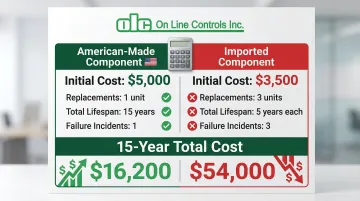
Consider a critical pressure regulator for a medical tubing extrusion line:
| Cost Category | American-Made | Imported Alternative |
|---|---|---|
| Purchase Price | $5,000 | $3,500 |
| Expected Lifespan | 15 years | 5 years |
| Units Needed (15 years) | 1 | 3 |
| Total Purchase Cost | $5,000 | $10,500 |
| Installation Labor | $500 × 1 = $500 | $500 × 3 = $1,500 |
| Recalibration | $0 (factory-calibrated for life) | $500/year × 15 = $7,500 |
| Failure Incidents | 1 in 15 years | 3 in 15 years |
| Downtime Cost per Failure | $10,000 × 1 = $10,000 | $10,000 × 3 = $30,000 |
| Emergency Support/Freight | $200 × 1 = $200 | $1,500 × 3 = $4,500 |
| Inventory Carrying Cost | $500 (minimal spares) | $2,000 (higher safety stock) |
| 15-Year Total Cost | $16,200 | $54,000 |
This $37,800 difference illustrates why purchase price alone misleads. The real driver is downtime costs.
For every $1,000 in component cost, a single hour of unplanned downtime ($5,000-$15,000/hour in manufacturing environments) can erase the savings from choosing cheaper components. In automotive production where downtime reaches $2.3 million per hour, component reliability becomes critical to financial performance.
When American-Made Makes Financial Sense
The ROI case strengthens in these scenarios:
- High-utilization equipment (>16 hours/day operation)
- High downtime costs (>$5,000/hour)
- Critical quality applications where component variance affects product specifications
- Long equipment lifecycles (>7 years) where reliability advantages compound
- Regulated industries requiring verified processes and documented component performance
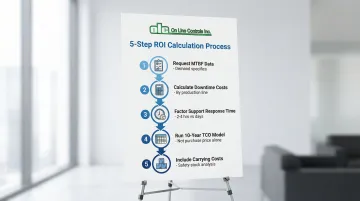
Actionable next steps:
- Request lifespan data and MTBF (Mean Time Between Failures) statistics from vendors—demand specifics, not marketing claims
- Calculate your facility-specific downtime costs by production line
- Factor in support response time differences (2-4 hours domestic vs. days or weeks international)
- Run 10-year TCO models rather than comparing purchase prices alone
- Include inventory carrying costs for safety stock in your analysis
Conclusion
The ROI case for American-made industrial control components rests on three measurable advantages: 2-3× longer lifespans that reduce replacement frequency, superior reliability that minimizes costly downtime, and responsive support that cuts troubleshooting time from days to hours.
These advantages compound over multi-year equipment lifecycles. The longer components stay in service, the wider the total cost of ownership gap becomes between domestic and imported alternatives, with breakeven typically occurring within 18-36 months.
For manufacturers operating in high-stakes environments where production continuity drives profitability, American-made components should be evaluated as insurance against downtime risk and supply chain disruption, not just as a product purchase.
The ROI comes from what doesn't happen—failures, delays, quality issues—as much as from what does. The premium paid for American manufacturing becomes cost-effective when:
- A pressure regulator maintains accuracy for 20 years instead of failing after 5
- Technical support resolves issues in hours instead of days
- Supply chains remain predictable during global disruptions
Frequently Asked Questions
Are American-made industrial components really more expensive in the long run?
While upfront costs are 15-30% higher, total cost of ownership over 10 years is typically 20-40% lower due to longer lifespans (10-25 years vs. 3-7 years) and reduced downtime. ROI breakeven typically occurs within 18-36 months.
How do I calculate ROI when comparing American-made vs. imported control components?
Use a five-factor TCO calculation: purchase price difference, lifespan/replacement frequency, downtime cost per failure, annual maintenance costs, and support response time. In high-utilization environments, a single avoided failure can justify the entire price premium.
What is the typical lifespan difference between American-made and imported control components?
American-made components typically last 10-25 years with minimal maintenance, while imported alternatives average 3-7 years. This 2-3× lifespan difference means fewer installations and significantly lower total cost over a decade.
Do American-made components meet international standards if we export products?
Reputable US manufacturers like On Line Controls design for both domestic standards (UL, CSA, NFPA) and international compliance (CE, IEC), giving you flexibility for global markets without compromising reliability.
How does buying American-made impact lead times and supply chain reliability?
Domestic sourcing reduces lead times from 8-12 weeks to 1-3 weeks, eliminates customs delays and tariff uncertainty, and enables emergency overnight shipping. This predictability remains critical for just-in-time manufacturing operations.
What industries benefit most from investing in American-made control components?
High-benefit industries include medical device manufacturing, plastic extrusion (where precision directly impacts product quality), automotive suppliers (where downtime exceeds $20,000/hour), and any 24/7 operation where unplanned downtime creates significant revenue loss.