This guide walks through which specifications actually matter, how to read them correctly, and what omissions should stop a purchase order in its tracks — with particular focus on plastic tubing extrusion, where pressure control demands are far more stringent than in general industrial applications.
Key Takeaways
- Confirm pressure range and resolution cover your actual working pressure, including ultra-low ranges below 1 inch of water column
- Hysteresis undermines control consistency — prioritize designs that eliminate it entirely, not just reduce it
- Match Cv and port size to your system's flow demands, not pressure specs alone
- Check material callouts for body, seals, and diaphragm to confirm media compatibility and long-term reliability
- Warranty length, calibration needs, and stated lifespan directly affect total cost of ownership
What a Pressure Regulator Spec Sheet Actually Contains
Most spec sheets organize data into three categories:
- Performance specs — pressure range, accuracy, sensitivity, hysteresis, response time
- Physical/mechanical specs — port size, body material, dimensions, weight
- Compliance and commercial data — CE marking, country of manufacture, warranty terms
Understanding this layout helps procurement managers navigate directly to the parameters that matter for their application, rather than reading front to back.
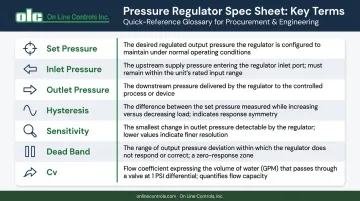
Before comparing spec sheets across vendors, it helps to know exactly what each listed value represents. The terms below appear on nearly every regulator spec sheet — and they are not interchangeable.
Key Terminology on Every Regulator Spec Sheet
| Term | What It Means |
|---|---|
| Set pressure | The target outlet pressure the regulator is adjusted to deliver |
| Inlet pressure | The upstream supply pressure fed into the regulator |
| Outlet pressure | The regulated downstream pressure delivered to the process |
| Hysteresis | Difference in output pressure between rising and falling input conditions |
| Sensitivity | Smallest input change that produces a detectable output change |
| Dead band | Input range after direction reversal that produces no output change |
| Cv | Flow coefficient — a standardized measure of flow capacity at a given pressure drop |
As defined by ANSI/ISA-S51.1, accuracy encompasses the combined effects of dead band, hysteresis, repeatability, and conformity — treating it as a single-number spec will give you an incomplete picture of real-world performance.
On pressure units: Spec sheets use PSI, bar, mbar, and inches of water column (in. WC) depending on the manufacturer and application. For low-pressure extrusion work, in. WC is the relevant unit. A quick reference: 1 PSI ≈ 27.7 in. WC, and 1 in. WC ≈ 0.036 PSI (per NIST conversion factors).
Always confirm which unit system a supplier uses before comparing values across vendors — a mismatch here is one of the most common sources of specification errors during procurement.
Critical Specs Procurement Managers Must Evaluate
Not all spec sheet parameters carry equal weight. Assess the following in the context of your specific application — a medical catheter line has different demands than an automotive tubing line.
Pressure Range and Resolution
The pressure range defines the lowest and highest outlet pressures a regulator can reliably control. Your application's working pressure must fall comfortably within this range — not at its edges.
For plastic tubing extrusion, internal air pressure requirements can be extremely low. MD+DI reporting on medical tubing extrusion notes pressure differentials in the range of a few to several tens of inches of water column. For small-bore and medical tubing processed via free extrusion, that means the regulator's outlet range must cover the low end of this window precisely.
OLC's MicroAir regulators, for example, offer ranges starting at 0–2 inches of water, with the MicroAir I capable of operating on a 0–0.25 inch of water full-scale range. Testing has confirmed the unit can hold 0.05 inches of water without issue — a spec level most standard industrial regulators cannot meet.
Resolution is a separate parameter. A regulator may cover the right range but lack the precision to fine-tune within it. MicroAir units with digital LED displays achieve ±0.1% of full scale accuracy below 60 inches of water, with two decimal place readout (0.01 inches) for ranges under 10 inches of water. Operating below 10% of full scale on any regulator risks some accuracy loss — which is why selecting the right range for your working pressure matters as much as the range itself.
Accuracy, Sensitivity, and Hysteresis
Three spec values determine whether a regulator can hold diameter within tolerance under real production conditions:
| Spec | What It Measures | What to Look For |
|---|---|---|
| Accuracy | Maximum deviation from set pressure under stable conditions (% of full scale) | Below 1% for precision extrusion; SMC IR series specifies ±0.5% repeatability |
| Hysteresis | Output pressure difference between increasing vs. decreasing pressure cycles | Design goal is zero; MicroAir's viscostatic damping system achieves hysteresis-free output |
| Sensitivity | Smallest input change that produces a measurable output response | Critical in dynamic conditions — cutting, spooling, or line speed changes |
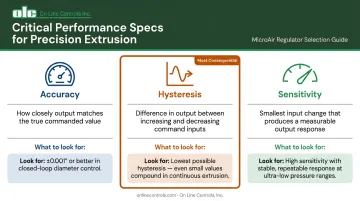
Hysteresis is the most consequential of the three. A regulator with measurable hysteresis behaves differently depending on which direction conditions are changing, producing inconsistent diameter control. No universal numeric benchmark exists across standards bodies, but any measurable hysteresis is a problem in precision extrusion.
OLC's MicroAir eliminates it through a viscostatic damping system: the relief valve stem floats on a cushion of air with negligible friction. Stability is specified at less than ±0.2% for ranges at 30 inches of water and below.
Flow Capacity (Cv Value)
Cv quantifies how much flow a regulator can pass at a given pressure differential. A regulator with insufficient Cv for your system's flow demand will cause pressure drop and instability even when set pressure appears correct.
As Cashco explains, Cv is defined by water flow in gallons per minute through the device at a specified pressure drop. For pneumatic sizing, compressible flow effects apply — use ISA-75/IEC 60534-based methods or a supplier calculator rather than liquid-only assumptions.
To cross-check Cv against your system, you need six inputs:
- Inlet pressure
- Outlet pressure
- Required flow rate
- Temperature
- Media type
- Line size
If a spec sheet lists Cv only at a single temperature or pressure point, ask the supplier for a fuller characterization.
Port size is a related but distinct check. MicroAir regulators use ¼" NPT male fittings across all models. If your system uses a different port size, plan for adapters — and note that adapters introduce potential leak points. Confirm fit before ordering.
Media Compatibility and Materials of Construction
The materials section of a spec sheet defines what the regulator body, diaphragm, and seals are made of. Incompatible materials degrade under specific media or environmental conditions.
For clean dry air service in tubing extrusion:
- Body: Stainless steel or anodized aluminum are appropriate; MicroAir units use stainless steel enclosures
- Seals/diaphragm: Buna-N is common for standard pneumatic service; PTFE or fluororubber for cleaner or more chemically demanding environments (SMC's clean regulators use stainless 316 wetted metal parts with PTFE or fluororubber diaphragm options)
- Media: Confirm the spec sheet specifies the intended media — "dry compressed air" is not the same as "instrument-quality dry air"
For medical tubing applications, internal materials must not contaminate process air. If the spec sheet doesn't include a material callout for the diaphragm and seals, that's a gap that requires follow-up before purchase.
How to Interpret Pressure Regulator Spec Sheet Values
Spec values only tell you something useful when read against context. For each number on the sheet, benchmark it against your actual operating conditions, the standard performance range for your process type, and whether the supplier's claims hold up in documented real-world use — not just on paper.
Normal and Acceptable Spec Ranges for Tubing Extrusion
A well-matched spec sheet for plastic tubing extrusion should show:
- Pressure range covering the required operating window with margin on both ends — not just touching the required value at the edge
- Hysteresis-free or near-zero hysteresis design (described in engineering terms, not just marketing language)
- Cv at or above the system's flow demand at operating pressure
- Materials confirmed compatible with clean dry air service
- Stability specification at or below ±0.2% of full scale for low-pressure ranges
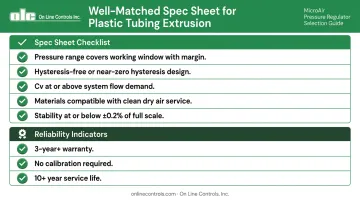
Performance specs confirm a regulator can do the job. Reliability indicators confirm it will keep doing it — and these are just as important for procurement decisions:
- A three-year or longer warranty signals manufacturer confidence in the product
- "No calibration required" — when supported by engineering documentation, not just a marketing claim — eliminates scheduled downtime and reduces total cost of ownership
- A stated service life of 10+ years is a practical signal of build quality. OLC's MicroAir regulators, for instance, are documented at 10–20 years under normal operating conditions — with a three-year warranty providing formal coverage on top of that.
Red Flags: Spec Sheet Omissions That Should Stop a Purchase
Treat any of the following as hard disqualifiers until resolved:
- Pressure range without specifying inlet vs. outlet — inlet and outlet specs are completely different; a regulator rated to 150 PSI inlet may only control output down to 5 PSI
- Hysteresis not listed at all — for precision applications, this omission signals the spec sheet was not written for your use case
- No material callout for seals or diaphragm — you cannot evaluate media compatibility without this
- Cv value absent or listed only at a single condition — insufficient for system sizing
- Warranty shorter than one year — below the baseline even for standard industrial components (SMC and Parker both offer minimum 12-month warranties as standard)
- No country of manufacture or CE directive basis listed — compliance claims without directive specifics are unverifiable
Common Procurement Mistakes When Reading Pressure Regulator Spec Sheets
Spec sheets pack a lot of numbers into a small space — and three misreads account for most mis-specified regulator purchases:
1. Inlet rating ≠ outlet range. A regulator rated to 150 PSI inlet may only control output down to 5 PSI. Order based on the headline pressure number without reading the outlet spec and you end up with a unit that cannot reach the required operating point.
2. Pressure range without flow capacity is an incomplete spec. An undersized Cv causes pressure instability under real operating conditions even when the set pressure looks correct. In extrusion, that instability shows up as variation in outside diameter — exactly what the regulator was supposed to prevent.
3. General industrial specs don't translate to precision low-pressure work. A regulator that performs reliably at 50–150 PSI in a machine tool application may be unsuitable for internal air support in small-bore medical tubing extrusion. The spec sheet must be evaluated against the specific process, not broad industrial norms.
Best Practices for Spec Sheet Evaluation in the Procurement Process
Build Your Checklist Before Opening Any Datasheet
Define minimum acceptable values for pressure range, hysteresis, Cv, port size, and material compatibility based on your application requirements. Use this as a filter before requesting quotes — it prevents confirmation bias when reviewing supplier-provided data.
Request Application-Specific Validation for Critical Processes
For medical or automotive tubing lines, a reputable manufacturer should confirm whether their product has been deployed in similar setups. OLC's MicroAir regulators are available through major extrusion OEMs — Graham/AK Brand, Davis-Standard, Conair, RDN, and Gimac — and field deployment data from comparable applications is available on request.
Verify Post-Purchase Support Terms Before Signing Off
Post-purchase support directly affects total cost of ownership. Check whether the manufacturer provides:
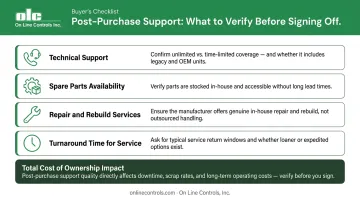
- Technical support (unlimited or time-limited?)
- Spare parts availability
- Repair and rebuild services
- Turnaround time for service
OLC provides unlimited phone support with the three-year warranty, and MicroAir units under 10 years old are serviced within one business day in most cases.
The units are also designed to eliminate ongoing maintenance overhead — recalibration is not required, and the damping fluid does not need replacement under normal operating conditions. For procurement teams weighing long-term supplier value, that means no spare parts inventory to carry.
Conclusion
A pressure regulator spec sheet contains everything needed to make the right sourcing decision — but only if the right parameters are prioritized. The variables that determine whether a regulator will perform in your process include:
- Pressure range and resolution
- Hysteresis design
- Flow coefficient (Cv)
- Wetted materials and seal compatibility
- Reliability indicators: warranty length and calibration requirements
Reading specs in isolation leads to mismatches. The correct approach benchmarks each value against actual application requirements and treats missing data — no hysteresis callout, no material spec for seals, no outlet pressure range — as disqualifiers rather than minor gaps.
For plastic tubing extrusion, especially free extrusion of medical or small-bore tubing, the evaluation standard is higher than for general industrial regulators. Regulators like OLC's MicroAir line — designed with no recalibration requirement, hysteresis-free operation, and a three-year warranty — demonstrate what a complete spec sheet should look like. Use that standard as your benchmark before committing to any sourcing decision.
Frequently Asked Questions
What pressure units are used in extrusion processes?
Extrusion processes use PSI and bar for higher-pressure systems, and inches of water column (in. WC) or millibar (mbar) for ultra-low pressure applications like internal air support in plastic tubing extrusion. Confirm which unit system a supplier's spec sheet uses before comparing values — 1 PSI equals approximately 27.7 in. WC, so the same pressure reads very differently depending on the unit.
What is hysteresis on a pressure regulator spec sheet and why does it matter?
Hysteresis is the difference in output pressure between a rising and falling pressure cycle. A high hysteresis value means the regulator responds inconsistently depending on the direction of change. In precision applications like tubing extrusion, that inconsistency directly affects outside diameter consistency.
What pressure range should a regulator have for plastic tubing extrusion?
Free extrusion of medical or small-bore tubing typically requires internal air pressure control in the range of 0.1 to 30+ in. WC. Confirm the regulator's outlet range covers your working pressure with margin, and verify it operates reliably at that level — not just at the edge of its rated range.
What does Cv (flow coefficient) mean on a pressure regulator spec sheet?
Cv measures how much fluid a regulator can pass at a given pressure drop; a higher Cv means greater flow capacity. Verify the regulator's Cv meets or exceeds your system's flow demand at operating pressure — if it falls short, pressure instability results even when the set point looks correct.
What certifications should a pressure regulator spec sheet list for industrial applications?
CE marking is standard for equipment used in or exported to European markets, but the applicable directive depends on the product. The Pressure Equipment Directive (2014/68/EU) covers stationary equipment above 0.5 bar; electro-pneumatic regulators may also fall under the Low Voltage Directive. Ask suppliers to specify which directive applies to the exact part number, not just a blanket "CE compliant" claim.
What does "no calibration required" mean on a pressure regulator spec sheet?
It means the regulator maintains accurate performance over its service life without periodic recalibration, eliminating scheduled downtime and reducing maintenance overhead. Confirm the claim is backed by documented engineering design, not just marketing language. OLC's MicroAir units, for example, achieve this through factory pre-testing and a viscostatic damping system that prevents output drift, supported by a three-year warranty.