Introduction
A mismatched sensor output type can silently corrupt PLC input logic: triggering missed detections or causing downstream actuators to respond to phantom signals. Getting the type wrong doesn't always produce an obvious fault — sometimes it just produces bad data.
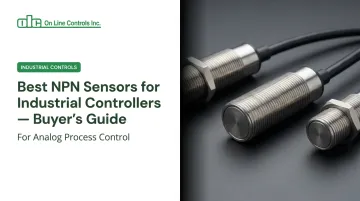
NPN inductive proximity sensors are the workhorses of sinking-logic control architectures in packaging lines, automotive assembly cells, and plastic tubing extrusion operations.
Selecting the right NPN sensor goes beyond procurement. Signal type compatibility, output current headroom, environmental protection ratings, and PLC input module type all determine whether your automation runs reliably or becomes a recurring maintenance item.
This guide covers how NPN sensors work with industrial controllers, what to look for before buying, and which brands consistently deliver in demanding production environments.
Key Takeaways
- NPN sensors are sinking output devices that pull the signal wire to ground (0V) on activation; they require a sourcing-type PLC input module
- NPN differs from PNP in current direction; pairing an NPN sensor with a sinking PLC input produces no valid signal without signal conditioning
- Key selection criteria: supply voltage range, output current rating, IP rating, housing form factor, and PLC input module type
- Top NPN sensor brands covered: Omron, Pepperl+Fuchs, Sick AG, Balluff, and Turck
- Always verify your controller's input spec: sourcing vs. sinking mismatches are the most common wiring error in industrial automation
What Are NPN Sensors — and Why Do They Matter for Industrial Controllers?
An NPN sensor uses an NPN transistor in its output stage. When the sensor detects a target, it connects the black signal wire to 0V DC (ground), sinking current through the load. The load must be wired between the output pin and the positive supply rail. The sensor does not source positive voltage to the output.
Per IS/IEC 60947-5-2, three-wire DC proximity switches use a standardized designation: N = NPN output, P = PNP output, with wire colors brown (+), blue (−), and black (signal output). This standard applies across inductive, capacitive, and photoelectric sensor types — which means the wiring rules are consistent regardless of sensing technology.
What NPN Sensors Do in a Control Chain
NPN sensors deliver discrete ON/OFF signals to PLCs, industrial PCs, or embedded controllers. In plastic tubing extrusion lines, for example, position-based sensor signals feed controller inputs that govern motorized actuators, pressure set points, and downstream process adjustments. Getting the signal type right at the sensor level matters. A mismatched input type can cascade into incorrect actuator commands and process faults downstream.
PLC Compatibility — Check This Before You Buy
Rockwell Automation's 1769-IQ16 module documentation makes the rule explicit: sourcing I/O circuits supply current to sinking field devices. NPN sensors are sinking devices, so they require a sourcing PLC input module.
To identify your input module type:
- Check the module name — Siemens labels sourcing/sinking capability directly in the module designation (e.g., "SNK/SRC")
- Look for L+ or M terminal commons in the wiring diagram — L+ commons indicate sourcing inputs, M commons indicate sinking inputs
- Confirm in the module's installation manual before procurement, not after
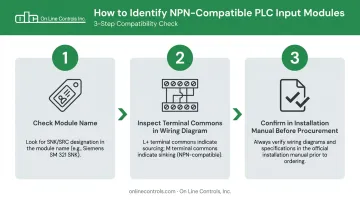
Connecting an NPN sensor to a sinking input module without a signal conditioner or relay interface creates an incompatible circuit — there is no valid return path for current.
Best NPN Sensors for Industrial Controllers
The following sensors were evaluated on electrical compatibility with 24V DC industrial controllers, environmental durability, output current capacity, housing standardization, and long-term supplier support. All feature open-collector NPN discrete outputs suited to sourcing-type PLC input modules.
Omron E2E Series
Omron's E2E NEXT series is one of the most widely deployed inductive proximity sensor families globally, with NPN output variants spanning M8 to M30 cylindrical housings. The series covers a wide installation range from compact machine builds to large-frame industrial equipment.
Standout features:
- 360-degree visible LED indicator (orange operation, green communication/setting)
- Output short-circuit protection, power supply reverse-polarity protection, and output reverse-polarity protection
- PBT sensing face with nickel-plated brass or stainless-steel SUS303 housing
- UL 60947-5-2 and CSA C22.2 certifications confirmed
| Specification | Value |
|---|---|
| Operating Voltage | 10–30V DC (including 10% ripple p-p) |
| Output Current | 100 mA max (most models); 50 mA on M8 Premium; up to 200 mA on select extended-distance models |
| IP Rating | IP67 (IEC 60529), IP67G (JIS C 0920), IP69K (ISO 20653) |
| Housing Sizes | M8, M12, M18, M30 |
The triple IP rating (IP67/IP67G/IP69K) makes the E2E NEXT a strong choice for washdown-adjacent environments in food processing or medical device manufacturing lines.
Pepperl+Fuchs NBN/NBB Series
Pepperl+Fuchs has strong process and factory automation presence, and the NBN/NBB inductive series includes NPN variants used in packaging, automotive assembly, and industrial machinery. Two NPN models illustrate the range:
- NBB2-8GM30-E0: 5–30V DC, 100 mA max, IP65/66/67, −40 to +85°C, cULus Listed Class 2
- NBN8-18GM50-E0: 6–36V DC, 0–200 mA operating current, IP65/66/67/68/69, −40 to +85°C, DNVGL marine approval
| Specification | NBB2 (M8) | NBN8 (M18) |
|---|---|---|
| Operating Voltage | 5–30V DC | 6–36V DC |
| Output Current | 100 mA max | 0–200 mA |
| IP Rating | IP65/66/67 | IP65/66/67/68/69 |
| Temperature Range | −40 to +85°C | −40 to +85°C |
The extended voltage range on NBN8 models (up to 36V DC) and the multi-level IP rating add flexibility for harsh-environment installations. For hazardous-area requirements, Pepperl+Fuchs maintains a separate inductive sensor portfolio meeting ATEX, IECEx, and NAMUR standards — though those certifications apply to dedicated hazardous-area models, not the standard NPN E0 variants above.
Sick AG IME Series
Sick's IME inductive series provides NPN discrete output options across M8 to M30 form factors, with particular adoption in automotive manufacturing and high-speed assembly lines. Switching frequency is where this series stands apart from the others in this guide.
The IME08-04NNOZW2K datasheet confirms 4,000 Hz switching frequency — the highest among the sensors covered in this guide. That matters in high-speed parts detection, rotary indexing, and any application where targets pass the sensor face rapidly.
| Specification | IME08 (M8) | IME12 (M12) | IME30 (M30) |
|---|---|---|---|
| Operating Voltage | 10–30V DC | 10–30V DC | 10–30V DC |
| Switching Frequency | 4,000 Hz | 2,000 Hz | 100 Hz |
| IP Rating | IP67 | IP67 | IP67 |
| Certifications | cULus (NRKH.E181493) | cULus (NRKH.E181493) | cULus (NRKH.E181493) |
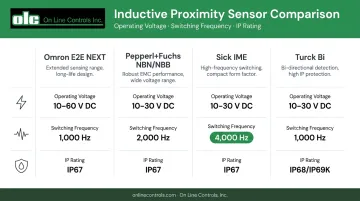
All three models share cULus certification under the same UL file number, simplifying North American compliance documentation across a multi-sensor installation.
Balluff BES Series
Balluff's BES inductive series spans miniature M5 housings to standard M30, covering NPN output options for both compact machine builds and conventional industrial installations. The catalog includes flush and non-flush mounting variants, weld-immune configurations, and hygienic versions for food and pharmaceutical environments.
Balluff's North American distribution footprint and model-specific datasheet depth simplify spare-parts sourcing and documentation management across multi-year maintenance programs.
Key selection notes:
- Available from M5 to M30 housing sizes — useful for tight installations where M8 is still too large
- Flush and non-flush mounting options across the BES range
- IO-Link readiness confirmed on select BES variants (model-specific)
- Extended operating temperature available depending on model
Note: For verified electrical specifications on specific BES NPN models, consult Balluff's model-specific datasheets directly at balluff.com — NPN output current, IP, and certification values vary by model.
Turck Bi Series
Turck is a US-headquartered sensor and connectivity manufacturer with a strong installed base in North American industrial applications. The Bi series NPN inductive sensors are known for rugged build quality.
The BI10-M30-AN6X is a confirmed NPN model with the following verified specifications:
| Specification | BI10-M30-AN6X |
|---|---|
| Operating Voltage | 10–30V DC |
| Switching Distance | 10 mm rated |
| Mounting | Flush |
| Output Type | NO (normally open) |
| Switching Frequency | 0.5 kHz |
Additional Bi series capabilities:
- UPROX+ factor-1 technology — available in Turck's lineup for non-reduction sensing of steel, aluminum, copper, and brass without recalibration
- WeldGuard coating options — weld-spatter-resistant housings for welding cell environments (10–30V DC confirmed on WeldGuard model)
- M30 threaded barrel standard on confirmed NPN variants
Note: CE/UL certifications and output current ratings should be verified from model-specific Turck datasheets for your specific Bi NPN model before procurement.
How We Chose the Best NPN Sensors
Many buyers select NPN sensors on price or brand name and overlook three compatibility issues that cause the majority of installation problems:
- Output logic mismatch: specifying an NPN sensor for a sinking PLC input module
- Insufficient output current: selecting a sensor whose rated load current falls below the connected load's requirements
- Underspecified IP rating: choosing IP65 where coolant splash, washdown, or submersion demands IP67 or IP68
Selection Criteria
Each sensor in this guide was evaluated against five criteria:
| Criterion | What to Look For |
|---|---|
| Electrical compatibility | 10–30V DC supply range, rated output current, confirmed NPN sinking logic |
| Environmental durability | IP67 minimum, operating temperature range, resistance to oils and coolants |
| Form factor standardization | M8/M12/M18/M30 threading, flush and non-flush mounting options |
| Compliance certifications | CE and UL/cUL marking for North American and international deployments |
| Supplier reliability | Distribution depth, documentation quality, long-term product availability |
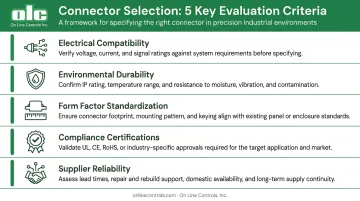
IP67 is confirmed across Omron E2E NEXT, Sick IME, and Pepperl+Fuchs NBB/NBN models. For factory floor installations where coolant and debris contact is routine, IP67 is the practical minimum — not an upgrade.
Conclusion
Selecting the right NPN sensor is a systems-level decision. Signal type compatibility, environmental durability, and current output ratings all determine whether your automation runs reliably for years or leads to recurring failures and replacement costs.
Sensors are one layer in a larger control chain. The downstream components they signal — actuators, pressure controllers, and analog process devices — must be equally well-specified. In plastic tubing extrusion lines, for example, a position or presence signal from a proximity sensor can initiate pressure adjustments or speed changes that depend on precise, low-latency response from every component in the loop.
OLC's motorized potentiometers are available in 24V DC motor configurations, making them compatible with the same DC control architectures where NPN sensors operate. MicroAir pressure regulators accept contact closure inputs (MicroAir II) or 0–10V analog signals (MicroAir IV). Their integration point is the controller output stage rather than the sensor input, but the same electrical standard requirements apply across the full system.
Before finalizing sensor selection, verify your PLC input module type (sourcing vs. sinking). Getting that right upstream makes every downstream component — including pressure regulators and motorized potentiometers — easier to specify and integrate. For guidance on precision control components that complement sensor-driven industrial systems, contact OLC at onlinecontrols.com or call 978-562-5353 (Monday–Friday, 9 AM–5 PM EST).
Frequently Asked Questions
What is the difference between an NPN and PNP sensor?
NPN sensors sink current — when triggered, they pull the output wire to 0V (ground). PNP sensors source current — when triggered, they pull the output wire to +VCC. NPN sensors require a sourcing PLC input module; PNP sensors require a sinking input module.
What types of sensors are used in industrial automation?
The primary types are inductive proximity, capacitive proximity, photoelectric, ultrasonic, and pressure sensors. Inductive proximity sensors with NPN or PNP discrete outputs are the most common for interfacing with PLC-based industrial controllers.
Can I use an NPN sensor with a sinking (PNP) PLC input module?
No. Without a signal conditioner or relay interface, connecting an NPN sensor to a sinking PLC input creates an incompatible circuit with no valid current path. Always check your PLC input module datasheet for sourcing/sinking compatibility before sensor selection.
Do NPN sensors need an external pull-up resistor when wired to a controller?
Most industrial PLCs with sourcing inputs handle pull-ups internally. For microcontrollers or custom PCBs without built-in pull-ups, add an external pull-up resistor between the signal wire and +VCC. Check your controller's input circuit documentation to confirm the correct resistor value.
What is the standard wire color code for 3-wire NPN industrial sensors?
Per IEC 60947-5-2: brown = +VCC, blue = 0V (ground), black = signal output (pulls to 0V when triggered). Note that some older or non-IEC-compliant sensors may use different color conventions — always verify against the sensor's datasheet.