Many operations default to imported pressure regulators based on purchase price. That decision looks reasonable on a spreadsheet until the regulator can't hold setpoint at 0.5 inches of water, or an international replacement shipment is stuck in customs while the line sits idle.
This article examines the specific operational reasons why USA-made pressure regulators outperform imports for critical tubing applications — focusing on measurable performance gaps, supply chain realities, and total cost over a production lifespan.
Key Takeaways
- USA-made regulators are engineered for sub-1-inch water column control — a range where most imported units fail to perform reliably
- Domestic sourcing eliminates international lead times, tariff exposure, and delayed technical support during production issues
- A 10–25 year lifespan with no calibration required makes total cost of ownership lower than imports that require replacement every few years
- FDA-regulated manufacturers avoid costly revalidation events by minimizing component replacements
- Precision, supply reliability, and durability together deliver value no import price discount can match
What Are USA-Made Pressure Regulators?
In plastic tubing extrusion, a pressure regulator controls the internal air pressure inside the tube as it forms — a process called free extrusion. That internal air pressure determines the tube's outside diameter, wall consistency, and dimensional stability.
The pressure ranges involved are unusually tight: medical catheters and small-bore tubing often require internal air support at 0.5 to 15 inches of water column. Some micro-tube applications operate below 1 inch of water column.
At those pressures, a regulator's design determines whether your line produces conforming product or scrap.
The origin of manufacture matters here because it's a performance variable, not just a sourcing preference. USA manufacturing practices — component sourcing, quality standards, and proximity for technical support — directly affect whether a regulator can hold a setpoint reliably over a multi-year production horizon.
On Line Controls, Inc. (OLC), based in Shrewsbury, MA, is one example of that manufacturing difference in practice. OLC has built precision ultra-low pressure regulators for plastic tubing extrusion since 1980. Their MicroAir regulators are specified by major extrusion OEMs, including:
- Davis-Standard
- Conair
- Graham/AK Brand
- RDN
MicroAir units are used in medical, catheter, automotive, and straw manufacturing operations across 18 countries.
Key Advantages of USA-Made Pressure Regulators for Critical Tubing Applications
The advantages below are grounded in what actually matters on an extrusion line: dimensional consistency, uptime, responsiveness, and total cost over the product's lifespan.
Advantage 1: Superior Precision at Ultra-Low Pressure Ranges
Critical tubing extrusion operates in a pressure range that exposes the limits of generic regulator design. Medical tubing extrusion pressure typically ranges from a few inches of water to several tens of inches, and some free-extrusion applications require control below 0.5 inches of water column. At these levels, hysteresis, response lag, and calibration drift aren't minor inconveniences — they show up directly as OD variance and wall variation.
Why standard and imported regulators fail here:
Most general-purpose regulators aren't designed for this range. They're built for compressed air systems operating at psi-level pressures, where a fraction of an inch of water column is noise. At sub-1-inch water column, that same noise is your entire operating range.
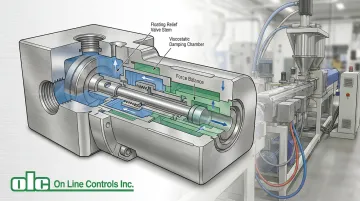
OLC's MicroAir regulators address this through a force balance design: the relief valve stem floats vertically on a balance spring, suspended on a cushion of air. Friction is effectively eliminated, producing hysteresis-free output as flow conditions change. A viscostatic damping chamber below the relief valve ensures stability without that fluid ever contacting the process air.
The MicroAir IV model responds to a step change of 50% of full scale in less than 0.1 second (typically 20 ms) — fast enough to maintain setpoint through cuts, spooling, and bump-and-taper transitions where pressure demand changes suddenly.
What this means for production quality:
Peer-reviewed catheter extrusion research confirms that wall thickness changes as internal air pressure changes due to radial forces inside the forming tube. A regulator that drifts or lags doesn't just cause one bad part — it causes a run of dimensional variation before anyone notices.
KPIs directly affected:
- Tubing outside diameter (OD) accuracy
- Wall thickness consistency
- Scrap and reject rate per production run
- First-pass yield
When this matters most: Medical catheter extrusion, small-bore tubing, multi-lumen tubing, bump-and-taper applications, and any line where downstream inspection is rigorous. Industry experts report tolerances in medical tubing approaching ±0.001 inch — there is no margin for regulator-induced variance at that level.
Advantage 2: Supply Chain Reliability and Responsive Technical Support
Imported pressure regulators introduce procurement variables that don't appear on the purchase order. The risks surface at the worst possible moment — when a regulator fails mid-production and needs an immediate replacement:
- Extended international lead times (weeks, not days)
- Customs clearance delays with no guaranteed timeline
- Tariff volatility that changes landed cost year over year
The downtime cost arithmetic:
Deloitte estimates unplanned downtime costs global industries $50 billion annually, with poor maintenance practices reducing productive capacity by 5–20%.
For a high-volume medical tubing operation with delivery commitments, an extrusion line waiting on international freight loses far more in production value than the price difference between a domestic and imported regulator.
Tariffs add a second cost variable. USTR finalized modifications to Section 301 China tariffs in September 2024, with ongoing reviews affecting manufactured goods. A landed cost calculation that made sense last year may look different today.
What domestic sourcing changes:
With an OLC MicroAir, phone support is available during production hours and repair turnaround on any unit under 10 years old is typically completed in one day. No customs queue, no freight delay, no time zone mismatch when you're troubleshooting a setpoint issue at the start of a shift.
KPIs directly affected:
- Line uptime
- Mean time to repair (MTTR)
- Unplanned downtime cost
- Procurement lead time
When this matters most: High-volume continuous production environments, medical tubing manufacturers with delivery commitments, and operations where regulatory compliance documentation must accompany replacement components.
Advantage 3: Long-Term Durability and Lower Total Cost of Ownership
The purchase price gap between imported and domestic regulators closes quickly once you factor in replacements, recalibration, and compliance events over a 15–20 year production horizon.
The real cost comparison:
OLC's MicroAir regulators carry documented lifespans of 10–25 years, with units commonly remaining in service for 15–20 years under constant use.
Maintenance demand is minimal: each unit is factory-set before shipping, the viscostatic damping fluid never needs refilling as long as the unit stays vertical, and the stainless steel enclosure requires no spare parts inventory.
Now consider an imported regulator requiring replacement every 3–5 years and periodic recalibration. Over a 20-year horizon:
| Cost Element | USA-Made (MicroAir) | Imported (3–5 yr lifespan) |
|---|---|---|
| Unit replacements | 1 | 4–6 |
| Recalibration events | 0 | Multiple per unit |
| Spare parts carrying cost | Minimal | Ongoing |
| Revalidation events (medical) | Minimal | 4–6 potential triggers |
| Warranty coverage | 3 years, parts & labor | Varies |
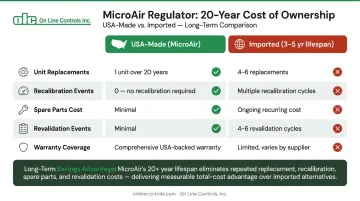
The revalidation exposure is particularly significant for FDA-regulated manufacturers. 21 CFR Part 820.75 requires manufacturers to review and evaluate process changes and perform revalidation where appropriate. Every regulator replacement is a potential revalidation trigger — a process that consumes engineering time, documentation, and compliance resources. For a facility running multiple extrusion lines, reducing regulator replacements from 4–6 events to one over 20 years can represent a meaningful reduction in engineering and compliance overhead.
KPIs directly affected:
- Total cost of ownership (TCO)
- Maintenance labor hours
- Equipment requalification frequency
- Compliance cost per year
- Capital expenditure cycle
When this matters most: FDA-regulated tubing manufacturers, high-run-time facilities where maintenance windows are limited, and any operation where consistent output quality is required across a multi-year production horizon.
What Happens When You Use the Wrong Regulator
The consequences of a poorly performing imported regulator don't announce themselves on day one. They appear as gradual drift — and they're easy to misdiagnose.
Common patterns that indicate a regulator is failing the application:
- OD running wide or inconsistent across a production run despite unchanged line settings
- Scrap rates creeping up without an obvious process cause — operators look elsewhere while the regulator is the actual culprit
- Frequent manual pressure adjustments by technicians compensating for a regulator that can't hold setpoint
- Unexpected downtime when an imported unit fails with no domestic replacement on hand
- Rising maintenance labor as technicians troubleshoot what looks like a process problem but is a hardware deficiency
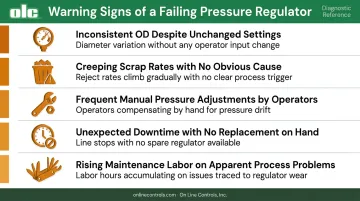
This pattern is consistent with how instrument drift behaves. As internal components degrade — affected by age, temperature cycling, or cumulative wear — the regulator's response characteristics shift. The line appears to have a process problem when the actual issue is a component that has drifted outside its functional range.
That misdiagnosis compounds the damage: engineering hours disappear into process investigations, quality flags accumulate, and the regulator continues drifting unchecked.
How to Get the Most Value from USA-Made Pressure Regulators
Selecting the right regulator matters as much as selecting a domestic one. The operating range should match the actual pressure requirements of the tubing line — not just the available port size or a general pressure rating.
For ultra-low pressure extrusion work:
- Select a regulator rated for the actual range you'll use, with your target setpoint in the middle of the meter scale for best stability
- For medical tubing and catheter applications: ranges of 0–3, 0–5, 0–15, or 0–30 inches of water are typical
- For automotive tubing and larger profiles: higher ranges up to 0–5 psi are available
- For multi-lumen tubing: each lumen requires independent pressure control — dual, 3-channel, and 4-channel configurations address this
OLC offers three MicroAir models for different control requirements:
| Model | Control Method | Best For |
|---|---|---|
| MicroAir I | Manual 30-turn knob | Standard single or multilumen tubing |
| MicroAir II | Up/Down contact closure inputs | Diameter gauge integration |
| MicroAir IV | 0–10V input, PLC-compatible | Bump/taper, high-speed switching |

Matching model to application is the last active decision you should need to make. Once the right unit is selected and set, the regulator runs the line. Operators set the pressure, monitor quality data periodically, and move on. Consistent, unattended operation — not repeated manual correction — is what well-matched pressure control actually looks like in practice.
OLC sells MicroAir regulators directly worldwide, backed by a 3-year warranty on parts and labor with unlimited phone support. For application-specific matching, contact OLC at 978-562-5353 or olc@onlinecontrols.com.
Conclusion
The case for USA-made pressure regulators in critical tubing applications comes down to three factors that compound over time:
- Precision performance at ultra-low pressure ranges that imported units aren't engineered to deliver
- Supply chain and support reliability that keeps production running when it matters
- Long-term durability that makes total cost of ownership lower despite a higher initial price
For medical tubing, catheter manufacturing, and other high-precision extrusion applications, the regulator is a core process component — not a commodity purchase. Its performance shows up directly in product quality, operator workload, and production efficiency — every shift, every run, for as long as the line operates.
A regulator that holds its setpoint at 0.5 inches of water, ships from Shrewsbury, MA with same-week availability, lasts 15–20 years without recalibration, and is supported by the people who built it is a better operational decision. For manufacturers running critical extrusion lines, that's the difference between a regulator that works and one that works for decades.
Frequently Asked Questions
How do you select a pressure regulator for plastic tubing extrusion?
Start with the operating pressure your line requires — for most medical and small-bore tubing, that means a regulator rated for sub-1-inch water column control. From there, evaluate flow capacity, media compatibility, and whether the application needs hysteresis-free performance. For best stability, the target setpoint should sit near the middle of the regulator's scale range.
Are compressed gas regulators standardized and interchangeable?
Port sizes may be standardized, but internal design, diaphragm sensitivity, and pressure range are not interchangeable across applications. A regulator designed for compressed air at psi-level pressures will not perform adequately in an ultra-low pressure tubing extrusion environment, even if it physically connects to the same fitting.
What makes USA-made pressure regulators better for medical tubing applications?
USA-manufactured regulators deliver tighter tolerances for ultra-low pressure control, domestic technical support available during active production issues, and no international lead time exposure. For FDA-regulated catheter and medical tubing lines, fewer component replacements also means fewer potential revalidation events under 21 CFR Part 820.
How long do USA-made pressure regulators typically last compared to imports?
Quality USA-made regulators for tubing extrusion are built for 10–25 year service life with no recalibration required. Lower-cost imported units typically need replacement or recalibration within a few years, increasing long-term cost, consuming technician time, and in regulated applications, potentially triggering requalification processes.
What are the risks of using imported pressure regulators on an extrusion line?
The primary risks are precision drift at low pressure ranges causing dimensional scrap, delayed replacement availability causing unplanned downtime, tariff-driven cost volatility, and limited access to technical support during production troubleshooting. Most of these risks don't surface at installation. They build gradually, often surfacing at the worst possible moment during a production run.
Do USA-made pressure regulators require calibration?
High-quality domestically manufactured regulators built specifically for tubing extrusion — such as OLC's MicroAir units — are factory-set and require no field calibration throughout their service life. This eliminates the maintenance burden and downtime associated with periodic recalibration cycles common with lower-precision alternatives.