At those margins, the pressure regulator isn't a background utility — it's a core process control component. Spec the wrong one and you're dealing with OD drift, wall inconsistency, elevated scrap, and quality documentation headaches. Spec the right one and it disappears into your line, quietly holding tolerance run after run.
This guide walks catheter engineers through the six critical speccing factors: operating pressure range, hysteresis, response time, control interface, process compatibility, and durability.
Key Takeaways
- Catheter extrusion requires air pressures below 1–4 inches of water column — a range standard industrial regulators cannot reliably control
- Hysteresis-free output is non-negotiable: any pressure variation between adjustment directions causes within-run OD variation
- The MicroAir IV responds to a 50% full-scale step change in under 0.1 second, covering cuts, spooling events, and bump/taper transitions
- Bump and taper designs require motorized, PLC-commandable regulators — manual dials can't meet the speed or repeatability
- A properly specced regulator needs no calibration, lasts 10–20 years, and removes one variable from your quality system
What Is a Pressure Regulator for Catheter Tubing Extrusion?
In free extrusion of plastic tubing, the tube exits the die unsupported — no mold, no mandrel. Internal air pressure is what prevents it from collapsing or overexpanding as it travels through the cooling zone. The regulator controls that pressure: it takes a standard factory air supply and reduces it to the precise, stable ultra-low output the process requires.
This is not a job for a standard industrial regulator. Research from Equilibar defines ultra-low pressure as below 0.1 psig (approximately 3 inches of water column), a range where most off-the-shelf regulators lose meaningful resolution.
ControlAir notes that general-purpose regulators typically have sensitivity of around 1 inch of water column, while precision regulators achieve 0.25 inches of water column or less. For catheter tubing, you need the latter.
Core Components
- Sensing/diaphragm element — continuously monitors downstream pressure and actuates the control valve to compensate for drift; must be sensitive to minute differentials at sub-inch-of-water pressures
- Control and adjustment mechanism — sets the target output pressure via manual dial or motorized actuator; motorized versions accept PLC commands or analog inputs (0–10V) for automated set point changes
- Outlet porting and flow path — must support low-volume, low-pressure airflow without turbulence or pressure spikes that would disturb the tube's internal geometry
Why Catheter Manufacturers Rely on Precision Regulators
- Consistent OD across long production runs
- Stable wall thickness for multi-lumen and thin-wall profiles
- Reduced scrap from out-of-tolerance tube
- Predictable dimensions for downstream cutting, tipping, and bonding
- Process control documentation that supports quality system requirements under FDA QMSR/21 CFR Part 820 and ISO 13485
Key Factors When Speccing a Pressure Regulator for Catheter Tubing
Catheter extrusion involves tighter tolerances, stricter regulatory scrutiny, and more demanding geometries (microbore, multi-lumen, bump, taper) than most other plastic tubing applications. The following six factors translate process requirements into specific regulator specifications.
Operating Pressure Range
This is the foundational spec. The regulator must accurately resolve and hold pressures within the actual operating window of your process.
For catheter tubing, published research on thin-wall catheter extrusion tested lumen air pressures from 0.19 kPa to 1.96 kPa (roughly 0.75 to 7.8 inches of water column) and confirmed that even small pressure changes materially affect OD, ID, wall thickness, and ovality. Industry equipment literature cites typical working ranges of 0–15 inches of water and 0–30 inches of water for most medical tubing, with microbore and catheter applications often operating at 0–3 or 0–5 inches of water.
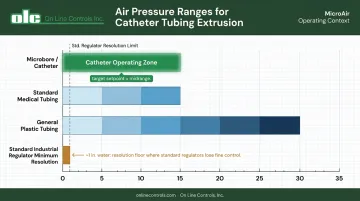
When selecting a range, your target operating pressure should sit near the middle of the regulator's rated range. Running a unit below 10% of full scale degrades precision — a 0–30 inch regulator on a process running at 0.5 inches of water has effectively no meaningful resolution at that setpoint.
Pressure Stability and Hysteresis
Hysteresis is the difference in output pressure when approaching a set point from above versus from below, caused by friction in springs, seals, and mechanical elements. In catheter extrusion, any hysteresis means the tube OD shifts depending on whether your process is trending upward or downward through the pressure range.
This produces OD variation within a single run that cannot be corrected without replacing or rebuilding the regulator. For medical-grade tubing, where OD tolerances can be as tight as ±0.015 mm, that variability is unacceptable.
Specify true hysteresis-free operation. Before committing to a unit, ask suppliers for:
- Documented hysteresis data or published performance curves
- Test results across the full rated range, not just at midpoint
- Confirmation that hysteresis-free performance holds over the product's service life
Response Time
Catheter extrusion runs continuously at speed. When a pressure disturbance occurs — a tube cut, a spooling changeover, a line speed change — the regulator must return to setpoint before that disturbance propagates into a section of tube. A slow response means a length of off-spec tube at every event.
Industry guidance for electronic pressure control in medical tubing extrusion has cited response times on the order of tens of milliseconds as sufficient, with high-speed switching for bump/taper applications capable of less than 0.1 second. That benchmark aligns directly with what modern motorized regulators can achieve.
Faster response directly reduces off-spec tube length per disturbance event, lowers scrap at cut points, and tightens dimensional control during profile transitions.
Control Interface: Manual vs. Motorized
| Scenario | Recommended Interface |
|---|---|
| Single-profile, constant-diameter runs | Manual dial regulator |
| Bump or taper catheter production | Motorized/electronically actuated regulator |
| Closed-loop OD gauge feedback | Motorized with analog output (0–10V or 4–20mA) |
| PLC-commanded set point changes | Motorized with 0–10V or contact closure input |
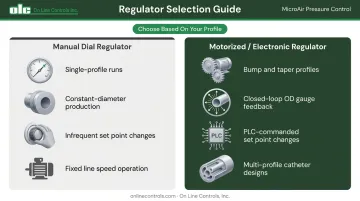
Manual dial regulators are appropriate when the process runs at a stable set point with infrequent changes. Once you introduce variable-diameter profiles, manual adjustment cannot match the speed or repeatability required.
Motorized regulators accept analog inputs, contact closures, or PLC commands to switch between programmed pressure set points during the run — without operator intervention. For multi-profile catheter designs, motorized control is a process requirement, not a convenience.
Compatibility with Process and Environmental Conditions
Key questions to ask any regulator supplier:
- What materials are the internal wetted components made of?
- Is the unit compatible with clean, dry compressed air and inert gas?
- Does the damping or sealing system introduce any contamination risk to the output air stream?
- Has the unit been installed in ISO-classified cleanroom environments, and what documentation supports that?
- How does the unit perform across the temperature range near your extruder?
An incompatible regulator (one that introduces contamination, drifts with ambient temperature, or corrodes under process conditions) creates quality and compliance risk in a regulated manufacturing environment. Under FDA QMSR and ISO 13485, process equipment suitability is a documented requirement, not an assumption.
Durability, Maintenance Requirements, and Lifespan
In continuous-run extrusion, calibration events, unplanned service downtime, and replacement cycles all introduce process disruption and quality system variables. Minimizing those touchpoints is part of the spec decision.
When evaluating durability, ask for:
- Documented operational lifespan in continuous extrusion service
- Whether calibration is required after installation and at what interval
- What the service trigger is (age-based, failure-based, or scheduled)
- Warranty terms, specifically whether parts and labor are covered
OLC's MicroAir regulators, for example, require no recalibration after installation and carry a three-year warranty — factors that reduce total cost of ownership considerably compared to units with recurring service requirements. A lower purchase price rarely stays lower once service intervals are factored in.
How OLC's MicroAir Pressure Regulator Can Help
On Line Controls (OLC) has been designing ultra-low air pressure regulators for plastic tubing extrusion since 1980. Their MicroAir line is designed specifically for catheter and medical tubing applications — operating reliably at pressures below 1 inch of water column, where most industrial regulators lose resolution entirely.
Here's how the MicroAir IV addresses each critical specification factor for catheter extrusion:
- Operating range — available from 0–0.25 inches of water up to 0–5 psi; most catheter applications use 0–3, 0–5, or 0–15 inch of water configurations; units have held pressures as low as 0.05 inches of water in testing
- Hysteresis — eliminated through a force balance mechanism and viscostatic oil damping system; the oil is isolated from the process air stream at all times
- Response time — the MicroAir IV responds to a 50% full-scale step change in less than 0.1 second (typically ~20 milliseconds), suitable for bump/taper transitions and cut events
- Control interface — MicroAir IV accepts 0–10V analog input and supports Dual State mode (switching between two set points via logic signal) and Linear mode (any pressure from near zero to full scale on demand); compatible with PLCs and OD gauge feedback loops from Beta LaserMike, Zumbach, LaserLinc, and Sikora
- No calibration required — factory-set before shipment; viscostatic damping maintains precision throughout the unit's service life
- Lifespan and warranty — 10–20 year operational lifespan documented in continuous extrusion service; 3-year warranty covering parts, labor, and unlimited phone support
- Manufactured in the USA; CE compliant for international shipping; direct worldwide sales support
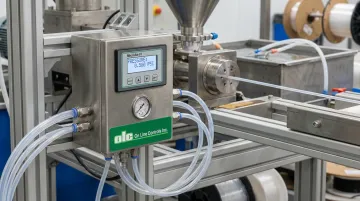
OLC's MicroAir regulators are integrated into extrusion lines by major OEM manufacturers including Davis-Standard, Conair, Graham/AK Brand, and Gimac. Mike Ferrandino, Medical Extrusion Consultant, calls them "the gold standard in air control for medical extrusion." Bob Bessemer of Novatec adds that they are "by far the most common unit used for medical tubing processing with great industry acceptance."
For application-specific guidance on model selection or range configuration for your catheter profile, contact OLC directly at olc@onlinecontrols.com or 978-562-5353.
Conclusion
Speccing a pressure regulator for catheter tubing extrusion comes down to matching the regulator's performance characteristics — pressure range, stability, response time, and control type — to the dimensional tolerance requirements and production profile of the catheter you're manufacturing.
A regulator that works well for general plastic tubing may be wholly inadequate for a 0.5-inch-of-water catheter process running at tight OD tolerances. And a manual dial regulator that's sufficient for single-profile production today won't keep up the moment your line shifts to bump or taper catheter designs.
Revisit your regulator specifications whenever:
- Line speeds increase or change significantly
- New materials with different melt viscosities are introduced
- Product geometry shifts (new OD targets, wall ratios, or catheter profiles)
The regulator is a small line item relative to extrusion equipment and scrap costs — but it's the component that determines whether you hit dimensional spec consistently. Manufacturers like OLC have built ultra-low pressure regulators specifically for these catheter extrusion conditions, where sub-inch-of-water stability is the baseline requirement, not a premium feature.
Frequently Asked Questions
How do you size a pressure reducing regulator?
Identify your required output pressure range and target operating point, confirm your inlet supply pressure, and estimate minimum and maximum process flow demand. Match these to a regulator whose control range, resolution, and flow capacity align. For catheter extrusion, prioritize resolution and stability at ultra-low pressures — and make sure your target pressure sits near the middle of the selected range, not at the bottom.
What sizes does catheter tubing come in?
Catheter tubing spans from microcatheters around 0.67 mm OD (2.0 Fr) up through drainage catheters at 18 Fr and larger. Published wall thickness tolerances run as tight as ±0.015 mm OD, so internal air pressure must be calibrated precisely to each tube profile.
What material is used for catheter tubing?
The most common catheter tubing polymers are PEBAX (polyether block amide), nylon, polyurethane, PTFE, and silicone. Each material has different melt behavior and dimensional sensitivity during free extrusion, which directly affects the specific pressure set point and stability requirements for the internal air regulator on that particular run.
What pressure range is typically required for catheter tubing extrusion?
Catheter tubing extrusion typically requires internal air pressures from fractions of an inch of water column up to roughly 4–8 inches — well below the reliable operating range of standard industrial regulators. A regulator that drifts or can't resolve pressure at these levels will produce OD variation that fails medical-grade dimensional specs.
What is hysteresis in a pressure regulator, and why does it matter for medical tubing extrusion?
Hysteresis is the difference in output pressure between the upward and downward adjustment paths of a regulator. In catheter extrusion, even minor hysteresis causes the tube OD to shift slightly depending on whether the process is trending higher or lower in pressure — a source of within-run dimensional variation that is unacceptable in medical-grade production.
Can one pressure regulator handle both standard and bump/taper catheter extrusion?
A manual regulator works for single-profile, constant-diameter runs. Bump and taper production requires a motorized or electronically actuated regulator that switches between programmed pressure set points at high speed — speccing one from the outset lets you run both profile types on the same line without hardware changes.