Introduction
When your motorized potentiometer fails mid-shift, you face an immediate choice: repair the unit or replace it entirely. With unplanned downtime costing manufacturers between $2,300 and $9,000 per minute according to industry estimates, you need to make the right call fast.
The wrong choice triggers consequences beyond the immediate fix. Rushing into repair can lead to recurring failures that multiply downtime costs, while unnecessary replacement strains your maintenance budget without adding value.
This decision requires evaluating failure type, component age, labor costs, and total cost of ownership. Your choice directly impacts control system reliability and product quality across your extrusion line.
Key Takeaways
- Motorized potentiometers combine variable resistance with automated positioning for precise process control
- Common failures—worn tracks, oxidation, motor issues—cause drift, noise, and positioning errors that disrupt production
- Decision factors include failure type, component age, downtime impact, and total lifecycle costs
- Replace for worn tracks or motor failures; repair for simple contact cleaning or loose connections
- High-quality components with 10-25 year lifespans minimize replacement needs and lower lifecycle costs
What is a Motorized Potentiometer?
A motorized potentiometer is a variable resistor with an integrated motor drive that enables remote, automated adjustment of resistance values for precise process control. Unlike manual potentiometers that require physical access for adjustment, motorized versions respond to electrical signals from PLCs or control systems, making them essential for automated manufacturing processes.
These units prove particularly valuable in plastic tubing extrusion, where they control critical parameters such as air pressure regulation, speed biasing, and temperature setpoints. These units typically operate in resistance ranges from 10 ohms to 100K ohms, with 10K-100K ohm ranges being most common for pressure control applications.
Core Components of a Motorized Potentiometer
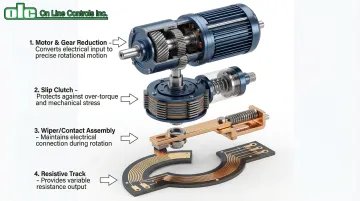
Every motorized potentiometer contains four essential elements:
Resistive Element: The track providing variable resistance, typically constructed from carbon film, conductive plastic, cermet, or wirewound materials. Conductive plastic elements offer the longest operational life—up to 100 million movements—while carbon film options last 10,000 to 100,000 cycles.
Wiper/Contact Assembly: Spring-loaded contacts that move across the resistive element, maintaining electrical connection throughout the travel range. Wiper quality directly impacts contact resistance variation and electrical noise during operation.
Motor and Gear Reduction System: Typically a stepper or DC motor (4.5-24 VDC) or AC motor (115 VAC) paired with precision gearing that provides automated positioning. The gearbox reduces motor speed while increasing torque for precise control.
Slip Clutch Mechanism: Protects end stops from mechanical damage at travel limits while allowing manual adjustment when the motor is off, preventing gear train breakage during overrun conditions.
Benefits and Why Manufacturing Relies on Motorized Potentiometers
Motorized potentiometers enable remote control and automation of analog processes, eliminating the need for manual adjustments during production.
Integration with PLCs and control systems ensures consistent process parameter maintenance across shifts and production runs.
Beyond automation, these devices reduce operator intervention, enable precise repeatability, and provide non-volatile analog memory—if power is lost, the potentiometer retains its position. In plastic extrusion, manufacturers gain stable tubing dimensions, reduced scrap rates, and the ability to make micro-adjustments without stopping production.
Common Failure Modes and Their Causes
Understanding failure modes guides repair versus replacement decisions. Different failures have vastly different repair costs and success rates. Accurate diagnosis is critical.
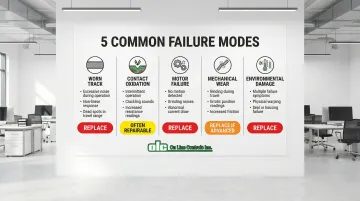
Worn or Damaged Resistive Track
Repeated wiper travel across the same areas causes physical wear of the resistive material, resulting in dead spots, noise, or erratic resistance values.
Common symptoms include:
- Increased "sliding noise" (electrical noise during movement)
- Non-linearity in output signals
- Open circuits at specific positions
This is the most common failure mode in high-use applications. Carbon film elements degrade gradually but produce increasing noise levels. Conductive plastic elements offer longer life but still suffer from micro-abrasion.
Track wear can't be reliably repaired. Attempts at carbon track restoration rarely provide long-term reliability, making replacement the only viable solution.
Contact Oxidation and Contamination
Environmental exposure, dust, moisture, or chemical vapors cause oxidation or contamination of wiper contacts.
Warning signs include:
- Intermittent operation
- Crackling noise during adjustment
- Increased contact resistance
- Complete signal loss when oxide films block conduction
Often repairable through cleaning with contact cleaner or light abrasion. Success depends on contamination severity and whether the carbon track beneath has sustained damage. If cleaning restores smooth, noise-free operation across full travel, repair may extend service life by months or years.
Motor or Gear Mechanism Failure
Motor winding failures, broken gears, or slip clutch degradation prevent automated positioning, though manual operation may still function.
Typical symptoms:
- Loss of motion
- Increased motor current draw
- Audible grinding noise
- Inability to hold setpoint position
Motor and gear repairs are generally not cost-effective due to the precision required and limited availability of replacement parts. Industrial maintenance labor averages $30.53 per hour, so a 3-4 hour repair attempt costs $90-120 in labor alone—often approaching or exceeding the cost of value-tier replacement units.
Motor or gear failure strongly indicates replacement makes more financial sense.
Mechanical Wear and Shaft Problems
Worn bushings, bent shafts, or damaged mounting hardware cause binding, poor contact pressure, or misalignment between wiper and resistive track.
Results include:
- Erratic readings
- Increased friction during travel
- Complete mechanical failure
Early-stage mechanical problems may be repairable if caught during routine inspection. However, visible mechanical wear often indicates the unit has reached end of service life, with multiple components showing degradation. Repair success rates drop significantly at this stage.
Environmental Damage from Temperature, Vibration, or Contamination
Exposure to excessive heat, continuous vibration, or corrosive environments accelerates all failure modes simultaneously.
Environmental effects:
- Vibration at 10Hz causes "dithering" wear at a single point, effectively wearing a hole in the track even without active adjustment
- Temperature extremes affect lubricant viscosity and cause material expansion that cracks housings or warps elements
Units showing environmental damage typically have multiple compromised components: warping, cracking, seal failures, and accelerated track wear. Repair rarely addresses all the degradation.
Replacement is the more reliable choice for restoring process control quality.
Repair vs Replacement: Key Decision Factors
The optimal decision balances immediate costs against long-term reliability, considering technical feasibility, labor investment, downtime impact, and total cost of ownership over the component's remaining service life.
Type and Severity of Failure
Simple contact cleaning or minor adjustments favor repair, while carbon track wear, motor failure, or multiple simultaneous issues strongly favor replacement.
Decision guideline: If the failure can be resolved with cleaning and the unit returns to smooth, noise-free operation across full travel, repair may be worth trying. Test the unit thoroughly—measure contact resistance variation (CRV) and sliding noise across the entire range. If problems persist or return within weeks, choose replacement.
For carbon track wear (dead spots, non-linearity), motor failures (no movement, grinding noise), or environmental damage (warping, multiple symptoms), proceed directly to replacement. Repair attempts waste both time and money in these cases.
Age and Service Life of the Component
Components beyond 75-80% of expected service life are more likely to develop additional failures soon after repair, making replacement more cost-effective from a lifecycle perspective.
Consider a 20-year rated unit that has operated for 15+ years. It's approaching end of life. Even if you successfully repair the immediate failure, other components are similarly aged and likely to fail within months.
The labor invested in repair delivers minimal return when the next failure occurs shortly after.
Repair timing guidelines:
- High-quality units (10-25 year lifespan): Consider repair in years 1-8
- Lower-quality units (5-7 year lifespan): Rarely worth repairing beyond year 4
- Always calculate remaining expected service life before committing to repair
Labor and Downtime Costs
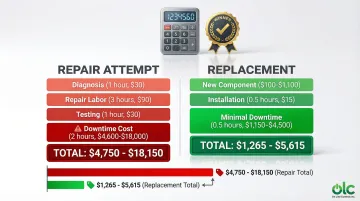
Calculate total repair cost including technician time for diagnosis, disassembly, repair attempt, testing, and reassembly, plus production downtime costs during the repair period.
Decision framework: If total repair cost (labor + downtime) exceeds 60-70% of replacement cost, and repair success is uncertain, replacement typically offers better ROI.
Example calculation: A repair requiring 3 hours of technician time ($90 in labor) plus 2 hours of line downtime ($4,600-$18,000 at average downtime rates) creates a total cost of $4,690-$18,090.
If a replacement unit costs $100-$1,100 depending on specifications and can be installed in 30 minutes, replacement delivers far better economics.
The calculation shifts based on component quality tier:
- Value-tier units ($1-$10): Any repair attempt exceeds replacement cost
- Industrial-grade units ($900-$1,100): Repair may be economical if diagnosis confirms a simple, fixable issue
Availability of Replacement Parts and Units
Long lead times for replacement units or unavailability of exact replacements may force repair attempts even when replacement would be preferred from a technical standpoint.
Industrial-grade motorized potentiometers often require 10-14 weeks for delivery when built to order. If your process cannot handle this downtime, attempting repair becomes necessary despite lower success probability. This underscores the importance of maintaining relationships with reliable suppliers who stock critical components or can provide fast-turnaround replacements.
For critical control loops, consider maintaining spare units on-site to eliminate lead time from the replacement decision. The carrying cost of a spare is typically far less than the cost of a single unplanned downtime event.
Impact on Process Control and Product Quality
Marginally functioning repaired units may introduce process variability, affecting product quality and requiring increased monitoring and adjustment.
A "noisy" potentiometer in a speed control loop introduces artificial variability. This causes the drive to hunt, leading to uneven film thickness or diameter variations in extruded tubing.
In precision applications like medical tubing extrusion where dimensional specs are critical, the reliability advantage of new OEM components often justifies replacement even for potentially repairable failures. The cost of scrap generated by process variability can quickly exceed the cost difference between repair and replacement.
Monitor key performance indicators after any repair: sliding noise, contact resistance variation, linearity, and process parameter stability. If the repaired unit doesn't match original specifications, plan for replacement during the next maintenance window.
Total Cost of Ownership and Preventive Replacement Strategy
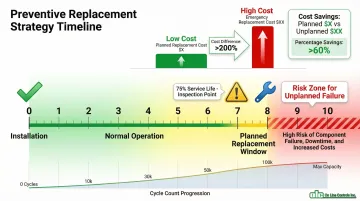
Planned replacement during scheduled maintenance windows costs significantly less than emergency repairs during unplanned downtime. The difference between $100 component cost + $30 labor (planned) versus $100 component cost + $4,600+ downtime cost (unplanned) is substantial.
Establish replacement criteria based on operating hours, cycle counts, or calendar age to prevent failures rather than reacting to them. For a conductive plastic potentiometer rated for 10 million cycles operating in a system that cycles 100 times per day, calculate replacement at 80% of rated life: (10,000,000 cycles × 0.80) ÷ 100 cycles/day = 80,000 days or approximately 8-9 years.
This preventive approach reduces total lifecycle costs by eliminating the premium costs associated with emergency response, expedited shipping, and unplanned production interruptions.
How OLC Can Help
OLC motorized potentiometers are engineered for long-term reliability, reducing the frequency of repair versus replacement decisions through quality design and manufacturing.
When you're not constantly managing component failures, you can focus resources on production optimization rather than emergency maintenance.
Components deliver 10-25+ year service life in demanding extrusion applications. This longevity stems from using premium components:
- Japanese-made potentiometers
- Swiss-made DC motors and geartrains
- Heavy-duty Hurst USA-made AC motors
- Factory-set slip clutch protection
Every unit is backed by a three-year warranty with no calibration requirements throughout its service life.
Long-Term Reliability Reduces Lifecycle Costs
OLC's proven track record of 10-25 year operational life in plastic tubing extrusion applications means fewer repair/replacement cycles over equipment lifetime. When a component lasts 20 years instead of 5-7 years, you eliminate 2-3 replacement cycles, along with the associated labor, downtime, and administrative costs.
The stable, hysteresis-free operation and instant response characteristics maintain process control quality throughout the component's service life. Unlike lower-tier alternatives that gradually degrade in performance, these potentiometers maintain original factory specifications until end of life, ensuring consistent product quality year after year.
When Replacement is Needed, OLC Provides Comprehensive Support
USA manufacturing, direct worldwide sales, and an established reputation ensure reliable availability and consistent quality when replacement is required.
The company provides comprehensive repair and rebuilding services, with delivery dependent on parts availability. OLC will even service legacy equipment from decades past.
These components serve major OEMs and manufacturers globally in demanding applications from medical tubing to automotive components, providing confidence in long-term parts availability and support. When you specify OLC motorized potentiometers, you're investing in a component that will likely outlast the surrounding equipment—and if replacement becomes necessary, you're working with a manufacturer committed to supporting your operation for the long term.
Conclusion
Base your repair versus replacement decision on these factors:
- Failure type and severity
- Component age relative to expected lifespan
- Total costs including downtime
- Impact on process reliability
Simple contact cleaning may extend service life cost-effectively. However, carbon track wear, motor failures, or components beyond 75% of expected life typically justify immediate replacement.
Repair may seem economical initially, but replacement with high-quality OEM components often provides better long-term value through improved reliability and reduced total life cycle costs.
The difference between a $50 repair that lasts 6 months and a $1,000 replacement that lasts 20 years becomes clear when you calculate the full cost of multiple repair cycles, associated downtime events, and process variability impacts.
Choosing proven, long-life components from the start reduces how often you face these decisions and minimizes both planned and unplanned maintenance interventions. When you're not constantly managing component failures, you can redirect maintenance resources toward preventive strategies that optimize overall equipment effectiveness.
Frequently Asked Questions
How to tell if a potentiometer is bad?
Look for scratchy or intermittent operation, dead spots where resistance doesn't change, and erratic multimeter readings. Complete signal loss or motor failure indicates severe damage requiring immediate attention.
What causes motorized potentiometer failure?
Carbon film wear from repeated use, contact oxidation from moisture or contaminants, and motor mechanism wear are primary causes. Excessive temperature, vibration, and chemical exposure accelerate degradation significantly.
Can you repair a motorized potentiometer yourself?
Cleaning oxidized contacts with electronic contact cleaner may work for contamination issues. However, carbon track wear, motor failures, or mechanical problems require professional assessment, as improper repairs can void warranties.
When is replacement more cost-effective than repair?
Replace when carbon tracks show dead spots, motor has failed, the unit is beyond 75% of service life, or repair costs exceed 60-70% of replacement cost. For components under $50, replacement is almost always more economical.
How long should a motorized potentiometer last?
Industrial-grade units last 10-25+ years in proper environments, while lower-cost alternatives may only achieve 5-7 years. Conductive plastic elements offer 10-100 million cycles compared to carbon film's 10,000-100,000 cycles.
What maintenance extends motorized potentiometer life?
Inspect regularly for contamination, maintain clean environments within specified temperature ranges, and avoid forcing manual adjustments against motor drive. Proper IP-rated enclosures (IP50-IP67) prevent premature failures in harsh industrial settings.